

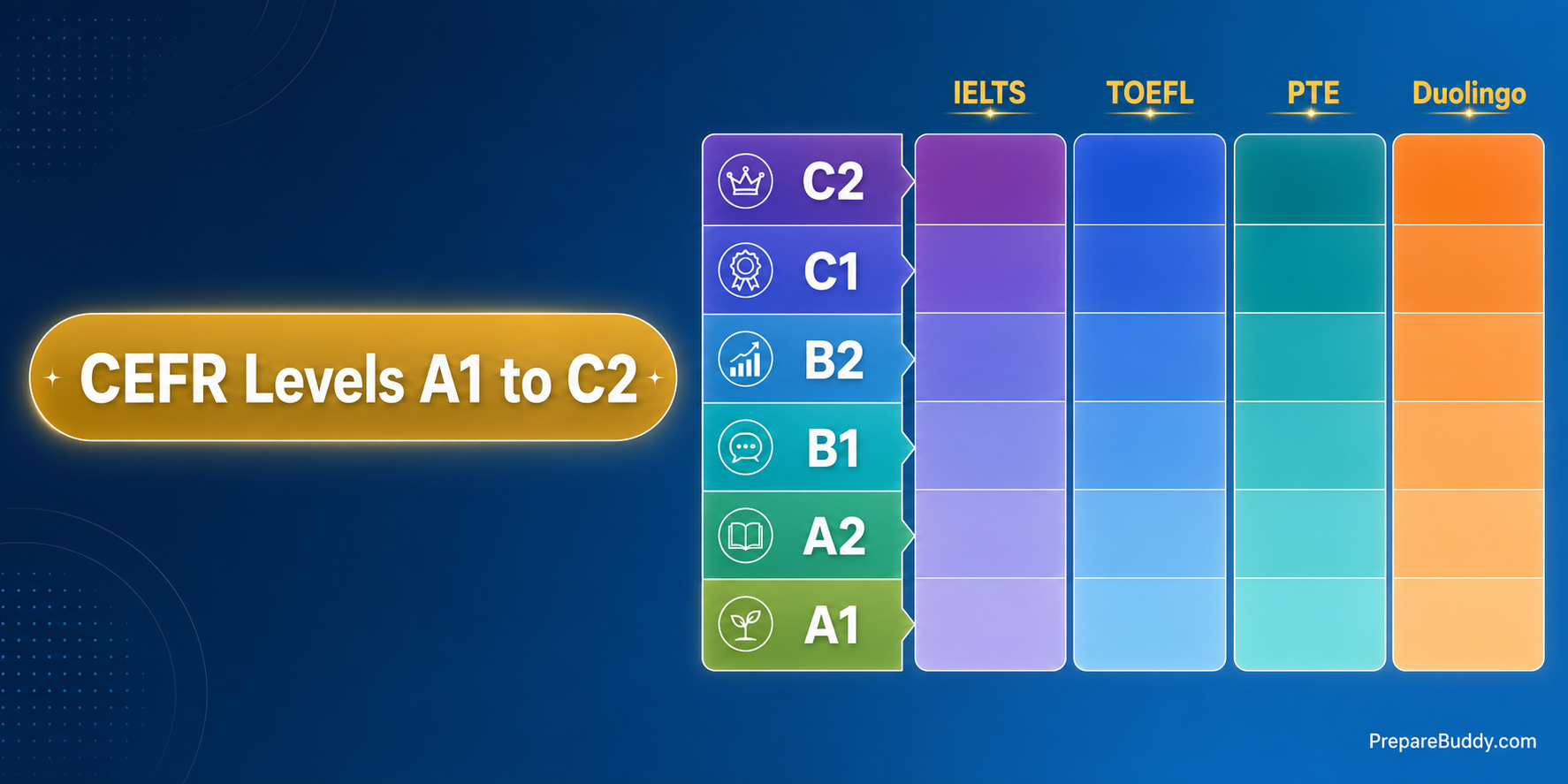
From January 2026, the TOEFL iBT stopped leading with its famous 0–120 number and began reporting results on a simple 1–6 band scale. The reason is a framework that already quietly governs IELTS, PTE Academic and the Duolingo English Test: the CEFR. If you have ever wondered why a TOEFL Reading band, an IELTS 6.5, a PTE 62 and a Duolingo 115 are treated as “the same English” by an admissions team, this guide is for you. We will explain what the CEFR levels mean, how A1 to C2 line up with every major test in 2026, and how to find your own level for free.
What the CEFR actually is
The Common European Framework of Reference for Languages (CEFR) is the international standard for describing language ability. Instead of a test-specific score, it sorts proficiency into six levels grouped into three bands — Basic (A), Independent (B) and Proficient (C). It was designed by the Council of Europe to be test-neutral, which is exactly why universities, employers and immigration authorities increasingly ask for a CEFR level rather than a single test number.
| Band | Level | Name | What it broadly means |
|---|---|---|---|
| C – Proficient | C2 | Mastery | Near-native; understands virtually everything read or heard with ease |
| C1 | Advanced | Fluent and flexible for academic and professional use | |
| B – Independent | B2 | Upper Intermediate | Handles complex text and study; the common university entry level |
| B1 | Intermediate | Copes with everyday and familiar work or study situations | |
| A – Basic | A2 | Elementary | Simple, routine exchanges on familiar topics |
| A1 | Beginner | Basic phrases and very simple interaction |
How CEFR levels map to IELTS, TOEFL, PTE and Duolingo in 2026
Each test board publishes its own official alignment to the CEFR. The table below brings them together so you can read across a single row. Use it to translate a target score into a level — for example, most undergraduate programmes ask for B2, while competitive and postgraduate courses often want C1.
| CEFR level | IELTS (Academic band) | TOEFL iBT (2026 band) | PTE Academic (10–90) | Duolingo (10–160) |
|---|---|---|---|---|
| C2 – Mastery | 8.5–9.0 | 6.0 | 85–90 | 140–160 |
| C1 – Advanced | 7.0–8.0 | 5.0–5.5 | 76–84 | 120–135 |
| B2 – Upper Intermediate | 5.5–6.5 | 4.0–4.5 | 59–75 | 90–115 |
| B1 – Intermediate | 4.0–5.0 | 3.0–3.5 | 43–58 | 60–85 |
| A2 – Elementary | 3.0–3.5 | 2.0–2.5 | 30–42 | 40–55 |
| A1 – Beginner | not assessed | 1.0–1.5 | 10–29 | 10–35 |
Ranges are approximate and rounded to whole levels. The only officially endorsed mapping is each test’s own published test-to-CEFR alignment; figures across tests should be treated as a guide, not a guarantee. IELTS does not certify an A1 floor because it is not designed to assess at beginner level. Always confirm the exact score your university, employer or immigration authority requires.
Why you should compare by CEFR, not by direct score conversion
It is tempting to say “IELTS 6.5 equals PTE 58” and stop there, but direct test-to-test conversions are contested and they shift when boards re-run their concordance studies. Every test measures reading, listening, speaking and writing in different formats and on different scales, so a one-to-one match never truly exists. The CEFR solves this by acting as a neutral bridge: each board maps its own test to the framework, and you compare through the level — not by forcing one raw number onto another. When in doubt, anchor your decisions to the CEFR level your destination asks for, then aim for a score comfortably inside that band.
TOEFL’s 2026 move makes CEFR mainstream
The clearest sign of where things are heading is TOEFL’s own change. From January 2026 the TOEFL iBT reports a primary score from 1 to 6 in half-band steps, with each section and the overall score aligned to a single CEFR level — a 4 corresponds to B2, a 5 to C1 and a 6 to C2. A comparable legacy 0–120 score runs in parallel during a transition period through 2028, after which only the band scale remains. The practical takeaway: knowing your CEFR level is no longer optional trivia — it is becoming the primary way your English is described.
How PrepareBuddy puts CEFR to work
Because the CEFR is the common language of proficiency, it sits at the centre of how PrepareBuddy reports results. Every practice result can show a CEFR badge alongside the native band — for instance “Your level: B2 — Upper Intermediate” — together with a per-skill CEFR breakdown across reading, listening, speaking and writing, so students see not just a number but where they actually stand. Speaking and writing are graded with AI using official scoring criteria, with multi-model verification reaching 95% scoring accuracy and feedback across 30+ English accents.
The framework also powers PrepareBuddy’s Adaptive Language module, which tests CEFR A1–C2 proficiency across 11 languages on one shared engine — the same question framework, the same scoring, mapped to the same six levels. Coaching centres and universities can issue placement tests that output results as a CEFR level, a native band (IELTS, PTE, TOEFL or CLB) or raw points, depending on whether they are streaming new students into the right class or prepping them for a specific exam. A quick diagnostic test places a learner on the A1–C2 ladder in minutes.
CEFR levels: frequently asked questions
What CEFR level is an IELTS 6.5?
An IELTS 6.5 sits at the top of B2 (Upper Intermediate), right on the borderline with C1. It is the level most undergraduate programmes ask for, which is why 6.5 is such a common admissions requirement.
Is C1 or C2 the higher level?
C2 is the highest CEFR level (Mastery), one step above C1 (Advanced). Most universities and employers ask for B2 or C1; a genuine C2 requirement is rare and usually reserved for language-specialist or teaching roles.
What CEFR level do I need for university abroad?
As a rule of thumb, B2 is the typical minimum for undergraduate study and many skilled-migration routes, while competitive universities and postgraduate courses often expect C1. Always check the exact level — and any minimum sub-scores — on your programme’s admissions page.
What is the fastest way to find my CEFR level?
Take a short, CEFR-aligned diagnostic that scores all four skills. PrepareBuddy’s free practice test returns a level estimate with a per-skill breakdown so you know where to focus before you book the real exam.
Find your level, then close the gap
The CEFR turns a confusing wall of test scores into one clear ladder from A1 to C2. Once you know the level your destination requires, the only question that matters is how far you are from it. Start with a free, CEFR-aligned practice test to pinpoint your current level and per-skill strengths — the first month of full preparation is free, with no credit card required.


Join the Discussion