

Express Entry's draws in 2024 and 2025 settled into a brutal pattern: most rounds cleared CRS scores in the 480s, and CLB 9 across all four English skills is what unlocks the maximum 136 language points (and another 50 for second-official-language proficiency). That's the difference between getting an Invitation to Apply and watching the cutoffs drift further out of reach. CELPIP is one of two designated tests for Canadian permanent residence, and for many applicants — especially those already living in Canada — it's the faster, more comfortable route. But scoring CLB 9 isn't about taking a couple of mock tests; it's about understanding exactly how CELPIP's 8-task speaking section, integrated writing, and Canadian-English listening work, then drilling each one with feedback that mirrors the official scoring.
This guide breaks down the full CELPIP-General test, maps every section to the CLB scale, and gives you a tested 6-week prep plan to hit CLB 9 (or 10+) on every component. We'll also show how AI-powered practice platforms like PrepareBuddy's CELPIP module have changed what "realistic prep" looks like in 2026.
What CLB 9+ Actually Means for Canadian Immigration
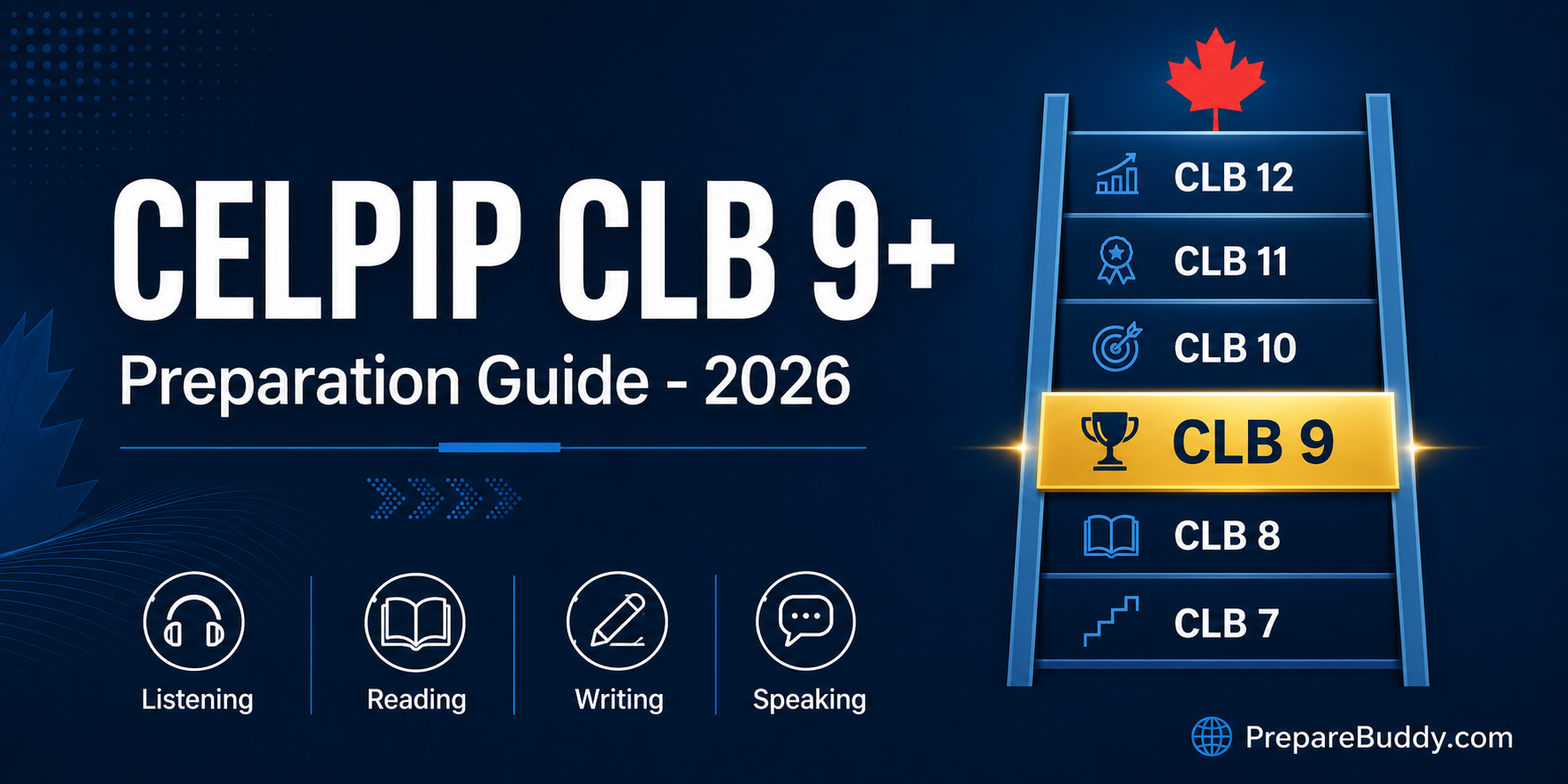
CELPIP-General reports a single CLB score from 1 to 12 for each of the four skills: Listening, Reading, Writing, and Speaking. Different immigration programs need different CLB minimums, and the points you earn climb sharply once you hit CLB 9.
| Program / Goal | CLB Required | CELPIP Score | Why CLB 9+ Matters |
|---|---|---|---|
| Express Entry — Maximum CLB Points | CLB 9+ | 9-12 | Maximum 136 language points (CRS) |
| Express Entry — Strong Profile | CLB 9 | 9 | 124 points; needed for most ITAs |
| Provincial Nominee Programs (PNPs) | CLB 7-9 | 7-9 | Threshold varies by province / stream |
| Canadian Citizenship | CLB 4+ | 4-12 | Listening + Speaking only |
| Designated Healthcare Roles (some PR streams) | CLB 7+ | 7+ | Many regulated bodies require CLB 7-9 |
The takeaway: if you're aiming at Express Entry, anything below CLB 9 leaves significant CRS points on the table. CLB 10 unlocks even more — and it isn't reserved for native speakers; it's reserved for test-takers who prepare with the right material.
CELPIP Test Format: 4 Sections in 180 Minutes
CELPIP is a fully computer-delivered test. Everything — including all 8 speaking responses — is recorded into the computer. There's no live examiner, no paper booklet, and no break between Reading and Listening unless you take the optional pause before Writing.
| Section | Time | Tasks | CLB Range |
|---|---|---|---|
| Listening | ~47-55 min | 6 parts (problem solving, daily life conversation, info dialogue, news item, discussion, viewpoints) | 1-12 CLB |
| Reading | 55-60 min | 4 parts (correspondence, diagrams, info, viewpoints) + practice section | 1-12 CLB |
| Writing | 53-60 min | Task 1: Email (150-200 words) · Task 2: Survey response (150-200 words) | 1-12 CLB |
| Speaking | 15-20 min | 8 tasks: advice, personal experience, scene description, prediction, comparison, opinion, unusual situation, unpleasant situation | 1-12 CLB |
The whole test runs about 3 hours. You can skip the speaking warm-up question (it's not scored), and the practice section in Reading doesn't count either — but the timer in scored sections is strict, and unanswered questions score zero.
The CLB 9+ Score Targets You're Really Aiming For
Here's what CLB 9+ looks like in real performance terms. Hit these thresholds in practice and you're test-ready.
| Skill | CLB 9 Target | CLB 10 Target | What Examiners Look For |
|---|---|---|---|
| Listening | ~33-37 / 38 | ~37+ / 38 | Inference, tone, speaker attitude — not just literal facts |
| Reading | ~33-37 / 38 | ~37+ / 38 | Identifying purpose, viewpoint, implied meaning under time pressure |
| Writing | Both tasks at CLB 9 | Both tasks at CLB 10 | Audience-appropriate tone, clear structure, varied grammar, precise vocabulary |
| Speaking | All 8 tasks at CLB 9 | All 8 tasks at CLB 10 | Fluency, vocabulary range, content depth, listenability under 60-90 sec response time |
One weak section drags your overall band down. CLB 9 in three skills and CLB 7 in Speaking still gives you only CLB 7 on your CRS calculation. Train every section equally.
Section-by-Section CLB 9+ Strategy
Listening — Train for Canadian English, Not Just "Native" English
CELPIP's listening passages use Canadian accents, idioms, and conversational pacing. Many test-takers who score CLB 9 on IELTS Listening underperform on CELPIP simply because the speech patterns are different. Daily life conversations move quickly, news clips contain implied attitudes, and the viewpoints section asks you to track multiple speakers' positions.
What works for CLB 9+:
- Listen to CBC News, Canadian podcasts (The Current, Front Burner), and Canadian YouTubers for 30+ minutes daily
- Train inference questions, not just literal recall — most CLB 9-level questions require interpretation
- Take notes in shorthand during practice; the test allows scratch paper, and the speaker won't repeat
- Practice with platforms supporting 30+ English accents so Canadian-specific speech doesn't surprise you
Reading — Speed and Implied Meaning
Reading is the section where CLB 9 candidates lose points to time pressure. The 60-minute window covers four passages, including a multi-paragraph viewpoints section where four people argue different positions on the same topic. You'll need to match each comment to the correct opinion.
What works for CLB 9+:
- Read the questions before the passage for parts 1-3 to know what you're hunting for
- For viewpoints, identify each speaker's stance in one sentence as you read — don't try to remember it later
- Use process of elimination ruthlessly; CELPIP rarely tests on a single keyword
- Time-cap each part during practice (12-15 min max) so the real test pace doesn't shock you
Writing — Email and Survey, Both Need a Clear Structure
The Writing section is the easiest to engineer for CLB 9+ if you understand the rubric. Each task is 150-200 words in 27-30 minutes. CELPIP scores writing on content, vocabulary, readability, and task fulfillment — and there are task-specific differences between the email (Task 1) and the survey response (Task 2).
| Task | Format | Tone | Common Pitfall |
|---|---|---|---|
| Task 1: Email | 150-200 words, prompt sets context (apology, complaint, request, recommendation) | Match audience — formal for boss, friendly for friend | Wrong register (too casual to a manager, too stiff to a friend) |
| Task 2: Survey Response | 150-200 words, choose between two options and justify | Persuasive but balanced | Choosing both options or sitting on the fence — pick one and defend it |
For CLB 9+, your writing needs accurate complex sentences, varied connectors ("furthermore," "in contrast," "as a result"), precise vocabulary (not just "good" — try "effective," "reliable," "convincing"), and at least one paragraph break per task. Run your practice essays through an AI writing analyzer that uses CELPIP's CLB 0-12 task-specific criteria — generic essay graders will tell you a CLB 7 response is "great" because they're not calibrated for CELPIP-specific structure.
Speaking — 8 Tasks, 8 Different Mental Models
Speaking is where CLB 9+ candidates need the most preparation. You have 30 seconds to prepare and 60-90 seconds to respond, recorded into the computer, with no live examiner reaction to guide you. Each of the 8 tasks tests a different skill.
| Task | What You Do | CLB 9+ Strategy |
|---|---|---|
| 1. Giving Advice | Advise someone about a situation | State recommendation up front, give 2-3 reasons, end with encouragement |
| 2. Talking About a Personal Experience | 60 seconds on a memory | Use past tense consistently, include sensory detail, end with reflection |
| 3. Describing a Scene | Picture-based | Top-to-bottom or left-to-right; describe people, action, mood |
| 4. Making Predictions | Continue from same picture | Use future forms ("will," "is likely to," "might"); 2-3 specific predictions |
| 5. Comparing and Persuading | Compare two options, persuade a listener | Two-pro-two-con structure; finish with a clear recommendation |
| 6. Dealing with a Difficult Situation | Choose between conflicting options and explain to someone | Acknowledge other person's feelings, state your decision, explain |
| 7. Expressing Opinions | Take a stand on a topic | Clear position + 2 reasons + 1 example each |
| 8. Describing an Unusual Situation | Picture of something unexpected | Describe what's unusual, then explain or speculate why |
CLB 9+ speaking responses share three traits: smooth pacing (no long pauses past 2 seconds), audible word stress and intonation, and accurate vocabulary used in context. Because you're recording into a microphone, even small hesitation feels louder than it would in a live conversation. Voice AI practice platforms now use real-time pronunciation scoring with 48-emotion detection, so you can hear exactly where pacing or stress drops you a band — something a paper-based course physically cannot do.
Your 6-Week CLB 9+ Study Plan
Six weeks is the sweet spot for most candidates already at CLB 7-8. Less than that, you're skipping fundamentals; more than that, you're overpreparing and losing peak readiness.
| Week | Focus | Daily Time | Output |
|---|---|---|---|
| 1 — Diagnostic | Take a full timed practice test; identify weakest section | 3 hours (mock + review) | Per-section CLB baseline |
| 2 — Listening + Reading | Daily 1-hour Listening practice (Canadian audio), 1-hour Reading drills | 2-2.5 hours | Reduce errors by 30% |
| 3 — Writing Mechanics | 2 timed tasks daily — alternate Email/Survey. Use AI feedback every time. | 2 hours | 5+ graded essays per task type |
| 4 — Speaking Tasks 1-4 | Drill tasks 1-4 with voice recording. Listen back. Identify pacing/grammar issues. | 2 hours | 20+ recorded responses |
| 5 — Speaking Tasks 5-8 + Integration | Drill tasks 5-8. Add 2 mini-mocks (Listening + Speaking). | 2-3 hours | Full speaking drill set |
| 6 — Full Mocks | 2 full timed CELPIP mocks under exam conditions. Review with detailed feedback. | 3-4 hours per mock day | CLB 9+ on all sections in mocks |
Two non-negotiables: take at least three full timed mock tests (not just section-by-section drills) and review every wrong answer until you understand why it was wrong, not just what the correct answer was.
How AI Practice Accelerates CLB 9+ Prep
The biggest shift in CELPIP preparation in the past two years is realistic AI scoring. Self-study used to mean writing essays you couldn't grade and recording speaking tasks no one would evaluate. Today's AI assessment systems flip that.
What modern AI prep gives you that paper books and YouTube videos can't:
- Per-task CLB scoring calibrated to CELPIP's 8-task speaking rubric and email/survey writing criteria — not generic essay grading
- Voice AI conversation practice with Canadian-clear voice and 12-minute speaking sessions that mirror the test pace
- Multi-perspective feedback — examiner-style scoring plus coach-style suggestions plus peer-style readability checks
- 30+ English accents in listening practice so Canadian conversational speech feels familiar on test day
- Unlimited practice content generated by 120-billion-parameter AI models that match official CELPIP format compliance
This is the gap between scoring CLB 7 in self-study and CLB 9+ on test day: targeted, calibrated feedback you can act on the same day you generated the response.
CELPIP CLB 9+ FAQs
Is CELPIP easier than IELTS? Many test-takers find CELPIP's computer-delivered format and Canadian-English focus more comfortable, especially if they already live in Canada. But "easier" depends on your strengths — CELPIP's 8-task speaking section is more demanding than IELTS Speaking for some candidates.
Do I need CLB 9 in every section? For maximum Express Entry CRS points, yes. The CLB score for language points is calculated per skill, so one weak skill caps your points there.
How long should I study for CELPIP? 4-8 weeks is typical for candidates already at CLB 7-8. Below CLB 7, plan for 10-12 weeks of structured prep.
Can I retake just the speaking section? No — CELPIP requires a complete retake of all four sections, so train every section to your CLB 9 target.
How accurate is AI-based CELPIP scoring? Modern AI assessment platforms claim 95% scoring accuracy with task-specific rubrics for all 8 CELPIP speaking tasks and both writing tasks. The key is whether the platform actually uses CELPIP-calibrated criteria or generic English scoring.
Start Your CLB 9+ Practice Today
CLB 9+ on CELPIP isn't out of reach — it's a structured prep problem with known sections, known rubrics, and predictable task types. The candidates who hit it consistently do three things: take real timed mocks, get task-specific feedback they can act on, and drill speaking the way it's actually tested (recorded, timed, on a microphone).
Try a free CELPIP-style diagnostic to find your current CLB level on every section, then build your 6-week plan around the gaps.
→ Take a Free CELPIP-Style Practice Test — get a CLB-calibrated score on Listening, Reading, Writing, and Speaking in under 3 hours, with AI feedback on every response.


Join the Discussion