

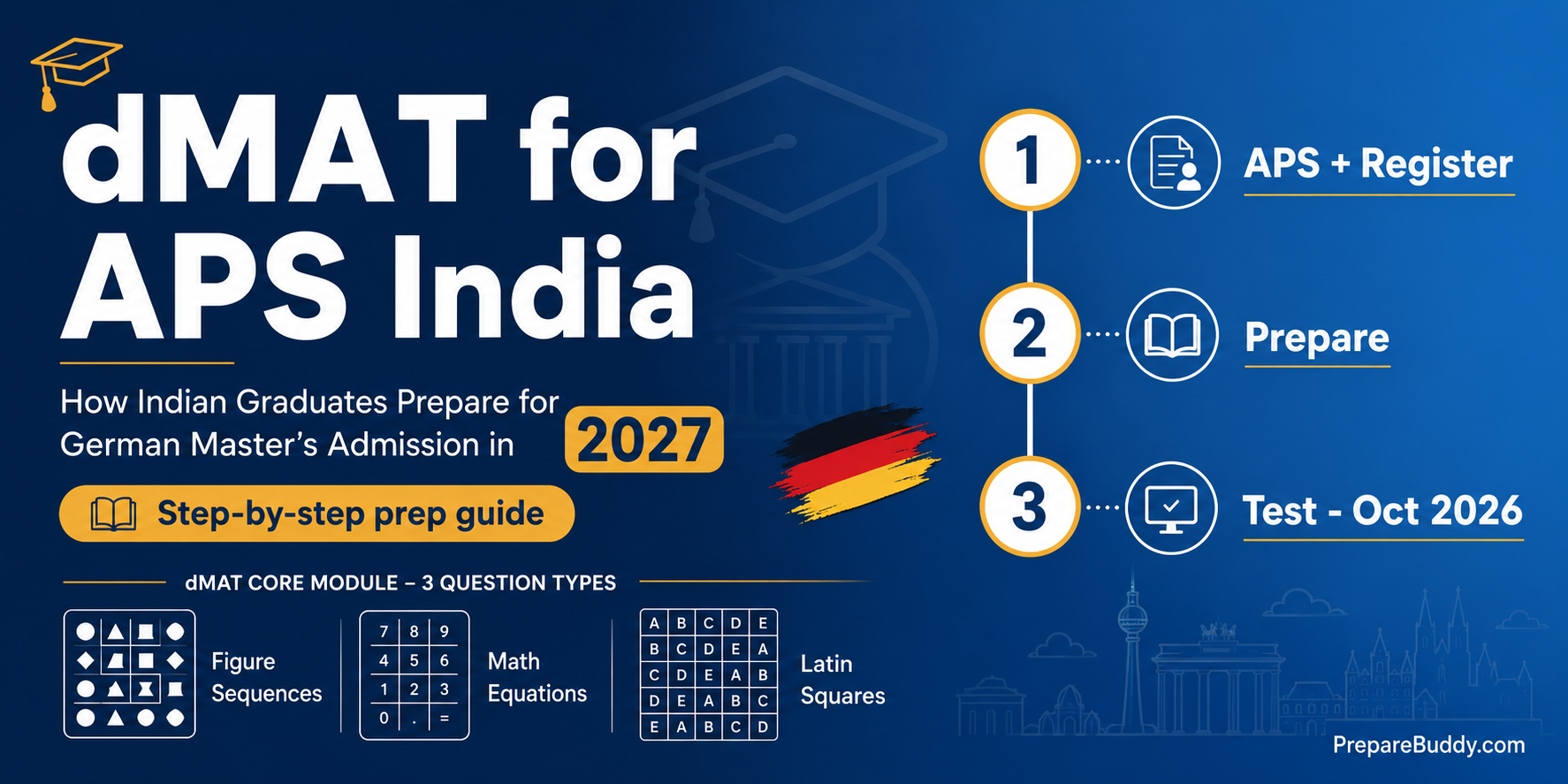
From the Summer Semester 2027 intake, most Indian graduates applying for a German Master's in engineering, business, or economics face a new step that did not exist a year ago: the dMAT. It slots directly into the APS India verification process, and without it your application file is incomplete. If you are planning to study in Germany, understanding how the dMAT fits alongside your APS certificate is now as important as your transcripts and your language score.
This guide breaks down exactly who needs the dMAT for APS India, how it fits into your application timeline, what the test looks like, and a step-by-step way to prepare so nothing catches you off guard.
What is the dMAT and why does APS India require it?
The dMAT (Digital Master Test) is a computer-based aptitude test developed by German universities together with g.a.s.t. (the Society for Academic Study Preparation and Test Development). For Indian graduates, it has been added as a new element inside the APS India process — the Academic Evaluation Centre that already verifies the academic documents of Indian students before they apply to German universities.
In plain terms: APS India used to check whether your degree and marksheets were genuine and eligible. From the 2027 summer intake onward, for many fields it also asks for a dMAT result. Importantly, the dMAT does not replace document verification, anabin database checks, or a university's own recognition of your qualifications — it sits alongside them as a measure of your general and subject study aptitude.
Who needs the dMAT for APS India in 2027?
In its first phase, the dMAT requirement is targeted, not universal. According to the official dMAT portal, it applies if all of the following are true:
| Condition | Does it apply to you? |
|---|---|
| Intake | You are aiming for the Summer Semester 2027 Master's intake or any later intake |
| Level | You are applying for a Master's (graduate) programme in Germany |
| Field of your bachelor's | Engineering (including Computer Science & IT), Commerce, Accounting, Finance, Economics, Business, or Management |
Who is exempt?
Per the official guidance, you are generally exempt from the dMAT requirement if you completed your APS online registration, or shipped your complete APS documents, before 29 June 2026. Students entering Germany through an official exchange, double-degree, or university partnership programme are also exempt. Because eligibility and exemption rules can be updated, always confirm your specific case directly with g.a.s.t. and APS India before you register.
The dMAT + APS + application timeline
The single biggest mistake Indian applicants make is treating the dMAT as an afterthought. It has its own registration, its own fee, and its own results window. Here is how the pieces fit together, step by step:
- Confirm you need it. Check your intended intake and field against the table above. If you are borderline, contact APS India directly.
- Start your APS India process. Gather your degree certificates, transcripts, and identity documents for academic verification as you normally would.
- Register for the dMAT via g.a.s.t. Registration and the test fee (reported at €150 on the official portal) are handled during sign-up.
- Prepare. This is the part you control most — build a study routine around the Core and General Academic modules (covered below).
- Take the dMAT. The official portal indicates the first dMAT certificates become available from 12 October 2026, aligned with Summer Semester 2027 applications.
- Submit to universities. Your dMAT certificate, showing your percentile rank and dMAT score, becomes part of your complete application file.
Because the results timeline is fixed, working backward from your university deadlines — not forward from today — is the safest way to plan. A structured pipeline tool such as PrepareBuddy's Student Journey module can keep test dates, document deadlines, and application milestones in one place with automated reminders and stall alerts, so a missed dMAT window never derails an otherwise strong profile.
What is on the dMAT? Test structure explained
The dMAT is delivered in two parts, with a total duration of roughly three and a half hours including a break: a Core Module that measures general study aptitude through cognitive subtests, and a General Academic / subject module that measures subject-specific aptitude. Indian applicants in the covered fields take the Core Module together with the General Academic Module.
| Module | What it measures | What to expect |
|---|---|---|
| Core: Figure Sequences | Abstract pattern reasoning | 4×4 matrix questions — spot the rule (rotation, colour cycles, border movement) and complete the sequence |
| Core: Mathematical Equations | Numerical reasoning | Numeric-entry problems using integers 1–20, solved on an on-screen virtual keyboard |
| Core: Latin Squares | Logical deduction | 5×5 A–E logic grids where each symbol appears once per row and column |
| General Academic Module | Academic aptitude for your field | Broader academic reasoning tied to your discipline (confirm the exact format on the official portal) |
Your result is reported on two scales: a percentile rank (how you did compared with other test-takers) and a dMAT score. There is no traditional pass or fail — universities interpret your standing when reviewing applications.
How Indian graduates can prepare for the dMAT
The dMAT rewards familiarity. None of the question types are impossible, but the numeric-entry interface, the timing pressure, and the abstract-reasoning formats feel unnatural the first time you meet them. The goal of preparation is to make test day feel routine.
- Learn the interface before the content. Practise the on-screen virtual keyboard for the Mathematical Equations section so entering answers never costs you time.
- Drill one subtest at a time. Master Figure Sequences, then Mathematical Equations, then Latin Squares — mixing them too early slows your progress.
- Simulate the clock. The Core subtests are tightly timed, so always practise against a timer rather than at a relaxed pace.
- Take full-length mocks. The official dMAT portal offers a free public sample plus six full-length mocks — use them to build stamina for the full 3.5-hour sitting.
Beyond the official mocks, an adaptive practice platform helps because it adjusts difficulty to your level, so weak areas surface early and you spend your limited prep time where it counts. You can begin with a free practice test to benchmark where you stand before building a study plan.
Your dMAT + APS readiness checklist
- ☐ Confirmed whether your intake and field require the dMAT
- ☐ Started the APS India document verification process
- ☐ Registered for the dMAT through g.a.s.t. and paid the fee
- ☐ Mapped your target university deadlines against the 12 October 2026 results window
- ☐ Practised all three Core subtests and the virtual keyboard
- ☐ Completed at least one full-length timed mock
- ☐ Shortlisted best-fit universities for your profile and scores
Once your scores are in hand, matching them to the right programmes matters just as much as earning them. PrepareBuddy's AI university recommendations group schools into Reach, Target, and Safety tiers based on your profile, so you apply where your chances are strongest rather than guessing.
Frequently asked questions
Is the dMAT mandatory for all Indian students applying to Germany?
No. In its first phase the dMAT applies to Master's applicants in engineering, commerce, accounting, finance, economics, business, and management who are targeting the Summer Semester 2027 intake or later. Applicants who registered or shipped their APS documents before 29 June 2026, and exchange or partnership students, are generally exempt. Always verify your case with APS India.
How much does the dMAT cost?
The official dMAT portal lists a fee of €150, paid to g.a.s.t. during registration.
Does the dMAT replace the APS certificate?
No. The dMAT is an additional element within the APS India process. It does not replace document verification, anabin checks, or a university's recognition of your degree — it is one more piece of your complete application.
When can I get my dMAT result?
According to the official portal, the first dMAT certificates become available from 12 October 2026, timed for Summer Semester 2027 applications. Plan your test date against your earliest university deadline.
How is the dMAT scored?
Your certificate shows a percentile rank and a dMAT score. There is no fixed pass mark — universities weigh your result alongside the rest of your application.
Get dMAT-ready in 2027
The dMAT is new, but it is preparable. Start early, learn the interface, drill each subtest, and keep your APS and application timeline organised. Benchmark yourself first with a free practice test on PrepareBuddy and build your German Master's plan from there.
Test structure, fees, dates, and eligibility rules for the dMAT are set by g.a.s.t. and APS India and may be updated. Always confirm the latest details with the official dMAT portal and APS India before registering.


Join the Discussion