

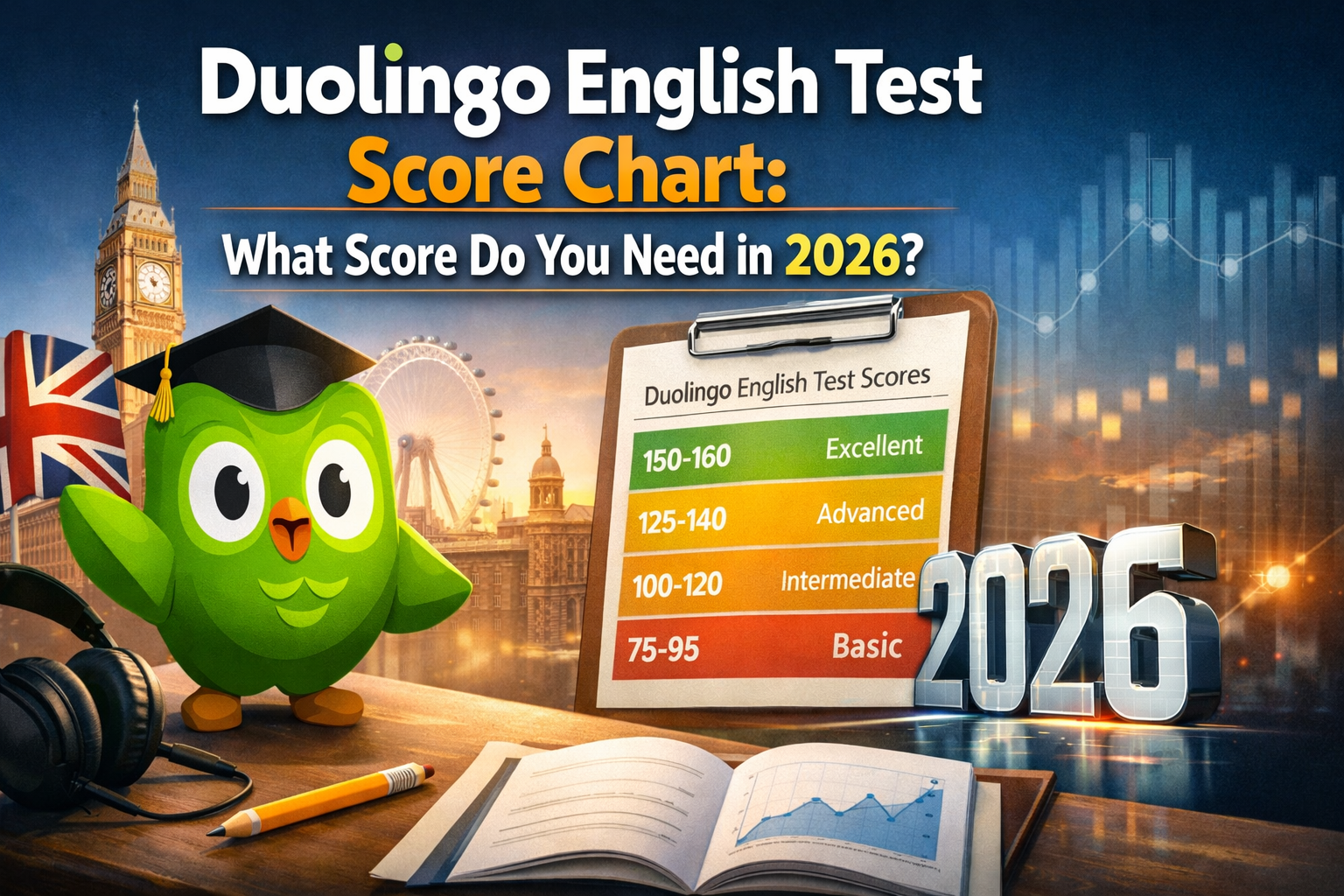
Over 4,000 universities now accept the Duolingo English Test — yet most test-takers have no idea what their score actually means. A DET score of 100 could mean acceptance at a regional university or rejection at a competitive graduate program. The difference comes down to knowing where your score sits on the scale and what your target institution actually requires.
This guide breaks down the complete Duolingo English Test score chart, explains what each range means, compares DET to IELTS and TOEFL, and shows you exactly what score you need for different university tiers and destinations in 2026.
What Is the Duolingo English Test Score Scale?
The Duolingo English Test uses a composite score scale of 10 to 160, reported in increments of 5. The test takes approximately 60 minutes and is structured around four subscore categories, each measuring a distinct language skill dimension:
- Literacy — Reading and writing proficiency
- Comprehension — Listening and reading comprehension
- Conversation — Speaking and listening in real contexts
- Production — Speaking and writing fluency
Your composite DET score is derived from performance across all four subscores. Crucially, universities receive both the overall score and the individual subskill breakdowns — so lopsided preparation (strong in one area, weak in another) is visible to admissions reviewers.
Duolingo English Test Score Chart: Score Ranges and What They Mean
Here is how DET score ranges map to English proficiency levels and their practical implications for applicants:
| DET Score Range | Proficiency Level | CEFR Equivalent | Practical Meaning |
|---|---|---|---|
| 10–45 | Beginning | A1–A2 | Very basic communication; not suitable for academic admission |
| 50–65 | Elementary | A2–B1 | Simple everyday tasks; below most university minimums |
| 70–85 | Intermediate | B1–B2 | ESL pathway programs and conditional admission |
| 90–100 | Upper-Intermediate | B2 | Minimum threshold for many undergraduate programs |
| 105–115 | Advanced | B2–C1 | Competitive for most graduate programs |
| 120–130 | Highly Advanced | C1 | Top-100 universities; selective professional programs |
| 135–160 | Mastery | C1–C2 | Near-native proficiency; elite and Ivy League programs |
DET Score Requirements by University Tier
Requirements vary significantly based on how selective a program is. Use this table as a planning benchmark — always confirm the exact threshold on each university's official admissions page, as policies change year to year.
| University Tier | Typical DET Minimum | Notes |
|---|---|---|
| Community Colleges / Pathway Programs | 75–85 | Some offer conditional admission below 75 |
| Regional / State Universities (Undergraduate) | 90–100 | Most general programs |
| Mid-Tier State Universities (Graduate) | 100–110 | STEM programs often require 105+ |
| Research Universities / Top 100 | 110–120 | Professional programs: 115+ |
| Highly Selective / Top 50 | 120–130 | Business and law: 125+ |
| Elite / Ivy League | 130–145 | MIT, Harvard, Stanford typically require 130+ |
DET Score Requirements for Visa and Immigration
The DET is accepted by more universities than ever, but immigration authorities are a separate matter. Here's where things stand for major study destinations:
| Destination | DET Acceptance Status | Typical Score Range |
|---|---|---|
| USA (F-1 Student Visa) | Accepted by most universities; visa itself depends on institution's test requirements | 90–115 (varies) |
| Canada (Study Permit) | Not directly accepted for IRCC immigration; IELTS/CELPIP preferred | N/A for visa |
| UK (Student Visa – Tier 4) | Not on UKVI approved list for visa purposes; check institution waiver | N/A for visa |
| Australia (Student Visa) | Not on DHA approved list; institutions may accept for admission only | N/A for visa |
| Germany / Netherlands / Ireland | Widely accepted at institution level | 100+ recommended |
Key takeaway: If you're applying to Canada, the UK, or Australia and need English proof for a visa application (not just university admission), you'll likely need IELTS, CELPIP, or PTE in addition to — or instead of — the DET. Check both the university's requirements and the immigration authority's approved list separately.
Understanding Your Four DET Subscores
The DET's subscore system is one of its most distinctive features — and one of the most misunderstood. Even a strong composite score won't save you if one subscore is significantly below the others, because admissions teams review all four dimensions.
Here's what each subscore actually measures and why it matters:
- Literacy: Your ability to read complex academic passages and produce written responses. This subscore is often weighted heavily by academic programs, where most assessments are reading and writing-based.
- Comprehension: How well you understand spoken and written English in real-world and academic contexts. Crucial for lecture-heavy and discussion-driven programs.
- Conversation: Whether you can engage naturally in back-and-forth spoken exchanges. Important for MBA programs, law schools, and anything with case-method teaching.
- Production: Your fluency in generating both spoken and written language on demand. This reflects how comfortably you'll contribute in seminars, presentations, and writing-intensive coursework.
A composite score of 110 with a Literacy subscore of 75 can still raise red flags. Balanced subscores matter as much as the composite number. Identify your weakest subscore early and target it specifically in your preparation.
DET vs. IELTS vs. TOEFL: Score Equivalency Chart
If you're choosing between English tests, this equivalency table helps you see how DET scores compare to IELTS bands and TOEFL iBT scores:
| DET Score | IELTS Band (Approx.) | TOEFL iBT (Approx.) | CEFR Level |
|---|---|---|---|
| 75 | 5.0 | 46–59 | B1 |
| 90 | 6.0 | 60–78 | B2 |
| 105 | 6.5–7.0 | 79–93 | B2–C1 |
| 120 | 7.0–7.5 | 94–109 | C1 |
| 135 | 8.0 | 110–120 | C1–C2 |
The DET's biggest practical advantages: it costs around $65 (compared to $250+ for IELTS or TOEFL), takes just 60 minutes (vs. 3+ hours), and results arrive within 48 hours. For students applying to multiple universities that accept the DET, this can translate into significant time and cost savings.
Deciding between tests? Our full DET vs. IELTS comparison and test comparison hub break down acceptance rates, difficulty, and which test suits your target country.
How to Reach Your Target DET Score
Once you know your target, the challenge is systematic practice. Three areas consistently hold students back from hitting their DET goal:
1. Adaptive question types. The DET adjusts difficulty in real time based on your responses. Students who only practice static, fixed-difficulty questions are often blindsided by how quickly the test escalates when they're performing well — or how differently it responds when they stumble. Practicing with an adaptive format is essential.
2. Speaking fluency under time pressure. DET speaking tasks are timed and there's no second chance to re-record. Many students who speak English comfortably in conversation freeze when the timer starts. Consistent AI-scored speaking practice — with real-time feedback on fluency, pronunciation, and coherence — is the most effective remedy.
3. Writing fluency with authentic prompts. DET writing tasks reward concise, fluent writing over padded responses. Students who write slowly or over-hedge their sentences consistently score below their actual ability level.
At PrepareBuddy's DET preparation module, students can practice full-length AI-scored DET mock tests that mirror the real exam's adaptive format. Our platform supports 50,000+ students across 200+ institutions worldwide and provides instant feedback across all four DET skill dimensions — speaking, writing, reading, and listening — so you know exactly what to fix before your real test date.
Start with a free DET practice test to establish your baseline score and pinpoint which subscores need the most work.
Frequently Asked Questions
What is a good DET score?
A score of 105–115 is competitive for most university programs. For highly selective schools, aim for 120 or above. For community colleges and pathway programs, 85–90 is often sufficient.
Is 90 enough for the Duolingo English Test?
A score of 90 meets the minimum for many undergraduate programs, but it's on the lower end. Most graduate programs require 105 or higher. Always verify the exact threshold on your target university's admissions page.
Does the DET score expire?
Yes. DET scores are valid for 2 years from the test date. Universities typically require scores taken within 2 years of your application date.
Can I retake the Duolingo English Test?
Yes. There is no cap on retakes, though Duolingo requires a waiting period (typically 21 days) between attempts.
What are the four DET subscores?
The DET reports four subscores: Literacy (reading and writing), Comprehension (listening and reading), Conversation (speaking and listening), and Production (speaking and writing fluency). All four subscores are shared with universities alongside your composite score.
Know Your Score. Build Your Plan.
The DET score chart gives you a map — but the real work is knowing where you stand today and building from there. Take a free practice test on PrepareBuddy and get an AI-scored assessment of your English across all four DET skill areas.
Start your free DET practice test →
Ready to build a full study plan? Sign up for PrepareBuddy and get access to AI-personalized study plans, unlimited adaptive practice tests, and real-time speaking analysis — all calibrated to your target DET score.


Join the Discussion