

A single half-band can decide whether an offer letter arrives or a rejection does. If you are applying to study in the UK, the first number the admissions team checks is your IELTS score — and the IELTS score requirements for UK universities are not one fixed figure. They shift by study level, by course, and by whether the university wants the standard Academic test or the UKVI version. This 2026 guide lays out the typical bands you will need, why the “no band below” rule catches so many applicants out, and how to close the gap to your target score.
What IELTS band do UK universities require in 2026?
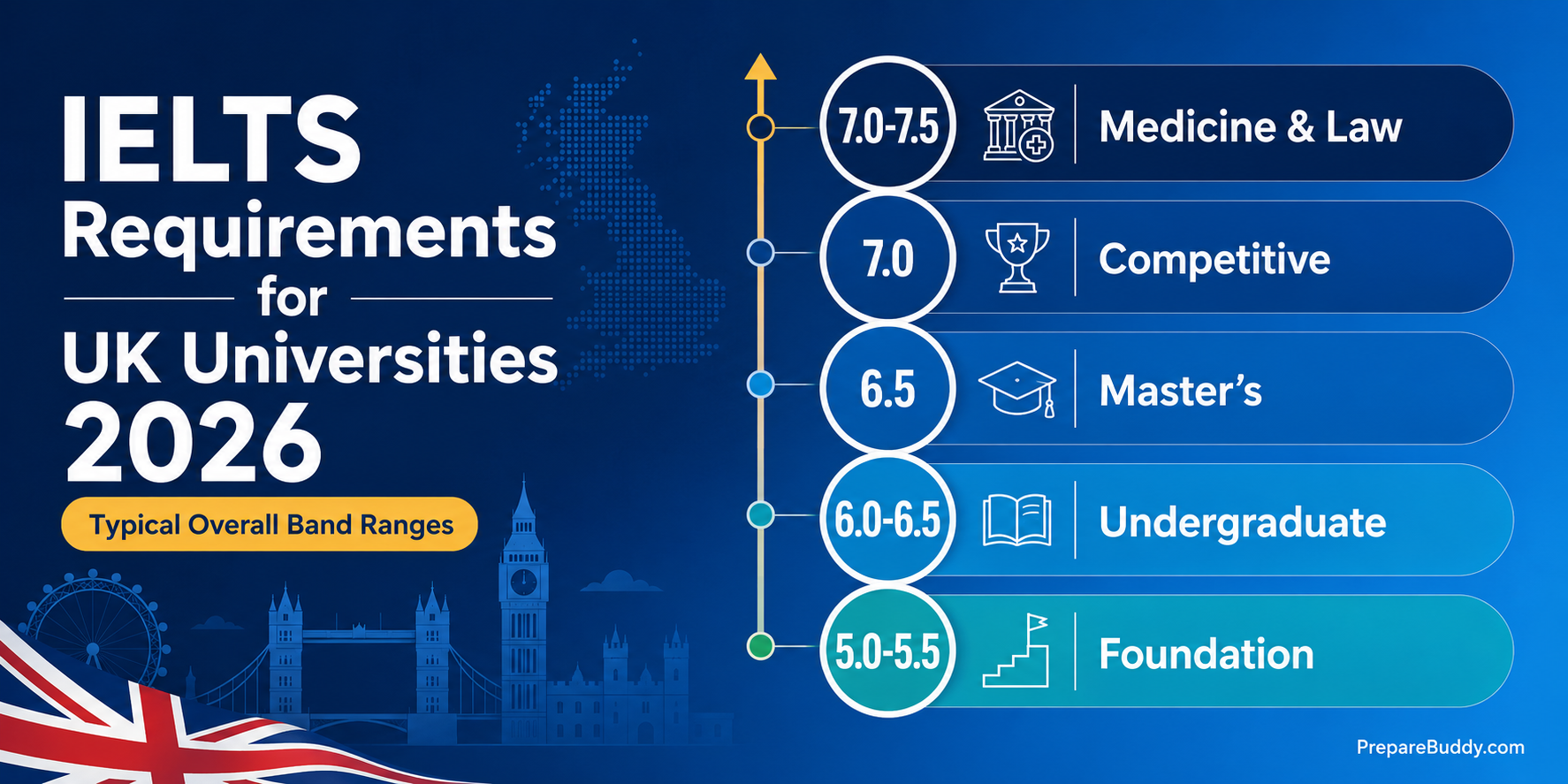
Most UK universities set their requirement by study level first, then raise it for competitive or regulated courses. As a rule of thumb, undergraduate programmes cluster around an overall 6.0–6.5, and postgraduate (Master's) programmes around 6.5–7.0. Here is how the typical requirements break down:
| Study level / course type | Typical overall band | Typical minimum per section |
|---|---|---|
| Foundation / pathway programmes | 5.0–5.5 | 5.0–5.5 |
| Undergraduate (most degrees) | 6.0–6.5 | 5.5–6.0 |
| Postgraduate taught (most Master's) | 6.5 | 6.0 |
| Competitive courses (business, engineering at top schools) | 7.0 | 6.5 |
| Medicine, dentistry, law, journalism | 7.0–7.5 | 7.0 |
| PhD / research | 6.5–7.0 | 6.0–6.5 |
These are typical ranges, not guarantees. Requirements vary by university and even by faculty, so always confirm the exact band on your specific course page before you book your test.
UKVI IELTS vs IELTS Academic: which do you need?
This is where applicants lose time and money. IELTS Academic is accepted by most universities for degree-level study. IELTS for UKVI is the same test content taken at a Home Office-approved centre under stricter conditions — some universities and most pre-degree pathway courses require it for visa purposes. The scoring is identical; the difference is administrative. Before booking, check two things on your offer: the minimum band, and whether the university specifies Academic or UKVI.
For reference, the UK Student visa (UKVI) minimums generally sit at 5.5 overall for foundation study, 6.0 for undergraduate degrees, and 6.5 for postgraduate degrees — but your university's academic requirement is often higher than the visa floor, and the higher of the two is what you must meet.
Why the “no band below” rule trips students up
An overall 6.5 does not mean you have met a 6.5 requirement. Most UK universities also set a minimum for each of the four sections — Listening, Reading, Writing, and Speaking. A candidate with 7.5 in Reading and Listening but 5.5 in Writing can still average 6.5 overall and be rejected because Writing fell below the per-section floor. Writing and Speaking are the two sections where applicants most often fall short, so balanced preparation matters more than a strong overall number.
How to close the gap to your target band
If a diagnostic puts you half a band under your target, the fix is targeted practice on your weakest section — not more of what you are already good at. PrepareBuddy's IELTS module mirrors the real exam format across all four sections and predicts your band as you practise, so you always know how far you are from the requirement on your offer.
For the two sections that most often hold applicants back, the platform's AI Writing Analysis scores your Task 1 and Task 2 responses against band descriptors and returns specific feedback in minutes, while Voice AI gives real-time pronunciation and fluency feedback across 30+ English accents so Speaking practice feels like the real interview. All AI scoring runs through multi-model verification for 95% accuracy, so the band you see in practice tracks what you can expect on test day.
Not sure which band you are starting from? Take a free diagnostic test to see your current band across all four sections, or try a free practice test before you commit to anything.
Frequently asked questions
What IELTS score do I need for a UK Master's degree?
Most taught Master's programmes require an overall 6.5 with no section below 6.0. Competitive or regulated courses can require 7.0 or higher. Confirm the exact band on your course page.
Is 6.5 enough for UK universities?
An overall 6.5 meets the requirement for many undergraduate and postgraduate courses, but only if you also meet the per-section minimum. Some competitive courses require 7.0 or 7.5.
Do all UK universities require IELTS for UKVI?
No. Many accept IELTS Academic for degree-level study, while pre-degree pathway courses more often require IELTS for UKVI. Check whether your offer specifies Academic or UKVI.
Which IELTS section is hardest for UK applicants?
Writing and Speaking are where candidates most often fall below the per-section minimum, which is why balanced, feedback-driven practice on those two sections is the highest-leverage way to lift your overall band.
Check your band, then close the gap
Meeting the IELTS requirement for a UK university is a matter of knowing your target, measuring your starting band, and practising the sections that hold you back. Start with a free scored IELTS practice test and see exactly where you stand against your offer.


Join the Discussion