

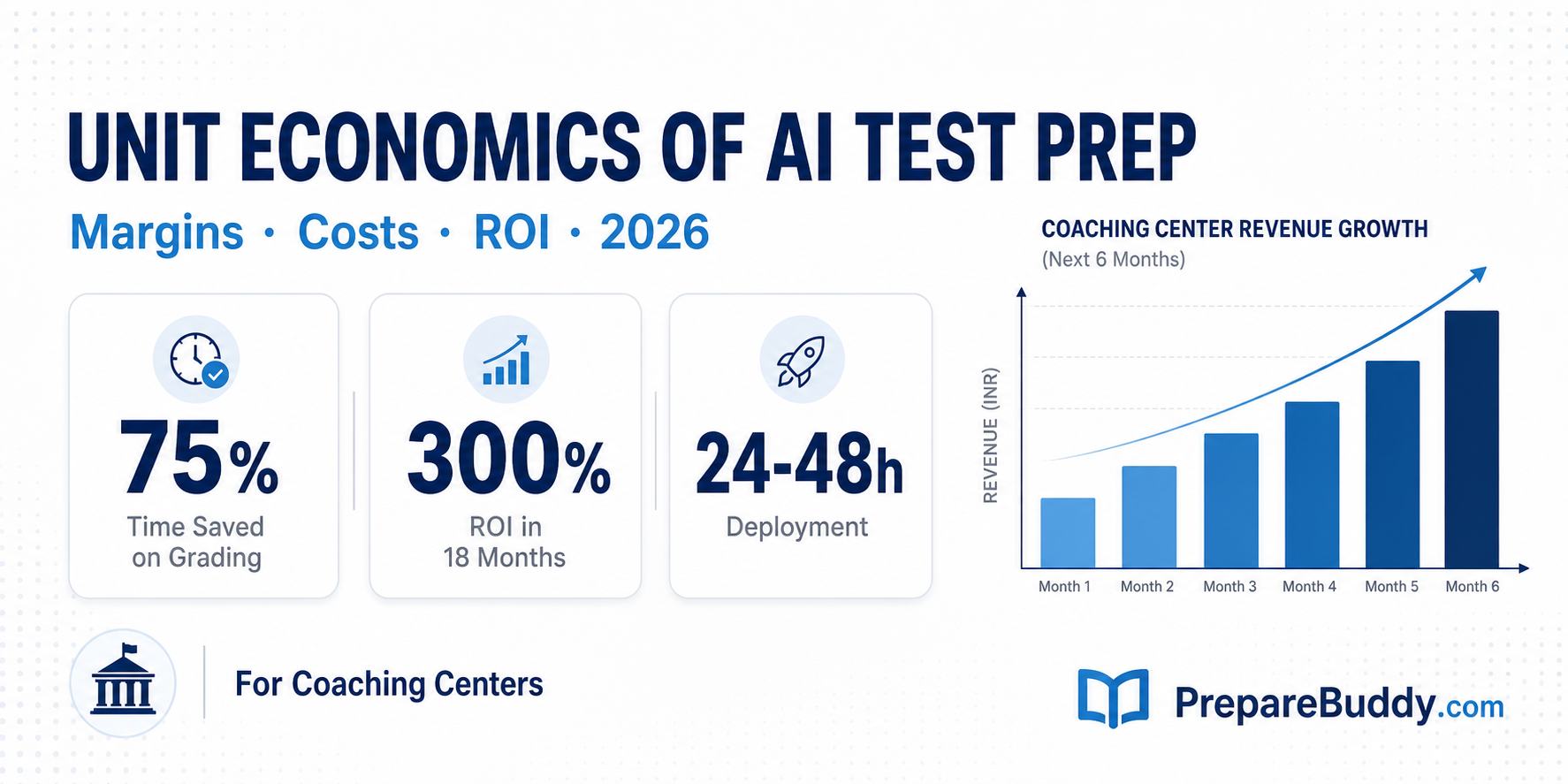
Most coaching center owners can quote their tuition fee from memory. Far fewer can answer a harder question: what does it actually cost you to graduate one student? In 2026, the gap between centers that grow and centers that stall is rarely about marketing budget — it is about understanding unit economics. AI-powered platforms have quietly rewritten that math. This guide breaks down the real cost-per-student, gross margin, and payback period of running a modern test prep center, and shows where the profit is hiding.
Why Unit Economics Matter More Than Top-Line Revenue
A test prep center can do INR 50 lakh of revenue and still be unprofitable. The reason is almost always the same: every new student adds a hidden bundle of variable costs — instructor time, mock-test grading, doubt-clearing, content updates, software subscriptions, payment-gateway fees — that quietly compress the margin. Unit economics force you to map those costs to a single student so you can answer three decisions confidently: what to charge, how many students one teacher can serve, and how long before a marketing rupee pays itself back.
The Two Operating Models in 2026
Before the numbers, the structural choice. Coaching centers in 2026 essentially run one of two models, and the unit economics differ sharply.
Model A — Manual / Hybrid
A senior teacher delivers live sessions, juniors grade mocks by hand, study material lives in printed booklets, and a mix of free YouTube and paid app subscriptions fills the gaps. Predictable, but the marginal cost per student stays stubbornly high because human time scales linearly.
Model B — AI-Powered White-Label
The center keeps brand, fees and counselors, but the assessment, scoring, mock generation and adaptive practice run on an AI platform branded as the center's own. Teachers focus on coaching, not grading. The marginal cost per student drops as enrolment scales because software cost is mostly fixed.
The economics below assume an average IELTS / PTE / TOEFL course of 8 weeks, INR 18,000 fee, and a steady-state batch of 100 active students.
Per-Student Cost Breakdown (2026)
Here is what one student actually consumes in a typical 8-week course, mapped against both models. All figures are direct variable cost — rent, electricity and core admin salary are fixed and excluded so you can see the marginal economics clearly.
| Cost Line (per student / 8 weeks) | Manual / Hybrid | AI-Powered White-Label |
|---|---|---|
| Instructor time (live + doubt clearing) | INR 4,200 | INR 1,800 |
| Mock test grading (4 full mocks) | INR 1,600 | INR 0 (AI-graded) |
| Speaking practice & feedback | INR 1,200 | INR 0 (Voice AI) |
| Study material & question bank | INR 600 | INR 0 (in platform) |
| Software / platform cost (allocated) | INR 250 | INR 1,400 |
| Payment gateway + admin | INR 350 | INR 350 |
| Total variable cost / student | INR 8,200 | INR 3,550 |
| Course fee | INR 18,000 | INR 18,000 |
| Gross margin per student | INR 9,800 (54%) | INR 14,450 (80%) |
That 26-percentage-point gap is the entire story of why AI-powered centers are out-pricing and out-spending traditional ones on lead generation in 2026.
Where the AI Savings Actually Come From
The savings are not magic. They are three specific operational shifts you can verify line-by-line.
Grading at zero marginal cost. A typical full-length IELTS or PTE mock takes a senior teacher 35–45 minutes to grade properly. A platform with AI scoring at 95% accuracy returns the same evaluation in under two minutes, with a written rubric the student can revisit. Across four mocks per student, that is roughly three hours of teacher time recovered — every single enrolment.
Speaking practice without a human partner. Speaking is the hardest section to scale because it needs a one-to-one conversation. Voice AI with 30+ English accents, real-time pronunciation scoring and 48-emotion detection lets one student practise for 45 minutes without any teacher in the room. The teacher reviews the AI's transcript later and intervenes only where needed.
Adaptive testing replaces filler classroom hours. Instead of every student sitting through the same 8-week curriculum, adaptive testing identifies what a specific student is weakest at and routes them to targeted drills. Teachers spend their hour on the 8 students who need help on Reading Section 3 — not on the 30 who already mastered it.
Build vs Buy: Why DIY Software Destroys Margin
Some center owners look at the INR 1,400 platform line and ask the obvious question: should we build our own? The math is brutal once you commit it to a spreadsheet.
| Cost Item (Year 1) | Build Your Own | White-Label Platform |
|---|---|---|
| Initial development | INR 25-40 lakh | INR 0 |
| AI / LLM infrastructure | INR 8-12 lakh / year | Included |
| Voice AI tooling | INR 3-5 lakh / year | Included |
| Content creation (12+ test types) | 12-18 months | Live Day 1 |
| Maintenance / DevOps | 1-2 FTE | 0 FTE |
| Time to launch | 9-15 months | 24-48 hours |
For a center under 1,000 active students, building rarely pencils out. The white-label model converts a six-figure capex into a predictable per-student opex — and you keep your brand, your domain and your pricing power. We expand on this in our deep-dive on the hidden cost of building your own platform.
Marketing CAC and the Real Payback Period
Unit economics aren't complete without customer acquisition cost. In Tier 1 Indian metros and competitive Australian / Canadian markets, the average CAC for an IELTS / PTE student in 2026 is INR 1,800 – INR 3,200 depending on channel mix.
Plug that into both models and the payback story becomes the real differentiator:
- Manual / Hybrid: INR 9,800 gross margin minus INR 2,500 CAC = INR 7,300 contribution per student. Each rupee of marketing spend pays back over roughly 3.4 students.
- AI-Powered White-Label: INR 14,450 gross margin minus INR 2,500 CAC = INR 11,950 contribution per student. Each rupee of marketing spend pays back over roughly 2.1 students — and you can outbid competitors on Google because your unit economics tolerate higher CAC.
This is why AI-powered centers can take an aggressive growth posture — running paid ads competitors cannot afford — without bleeding cash.
Scaling: When Adding Students Stops Costing You
The deepest advantage of the AI-powered model is what happens at the next 100 students. In a manual center, going from 100 to 200 students means hiring another senior teacher and another grader — variable cost stays roughly flat per student. In a white-label model, the platform fee is largely fixed and the platform's institute management features — automated lifecycle states, per-student AI feature toggles, multi-currency invoicing — handle the operational growth. Per-student cost actually declines as you scale.
This compounding margin is what turns a coaching center into a real business asset rather than a job.
How to Switch Without Disrupting Current Batches
Owners worry that moving to a new platform will confuse running batches. In practice, the migration is simpler than expected. White-label platforms deploy in 24-48 hours on your domain with your branding. Existing students are imported in bulk via invitations, course fees and tenures are preserved, and teachers get a one-day training. New batches start fully on the platform; running batches finish on whatever model they began. A clean cutover within one course cycle.
What to Do This Week
If you run a coaching center, three small actions will give you immediate clarity:
First, calculate your own per-student variable cost honestly — including the hours senior teachers spend on grading. Most owners under-count by 30-40%. Second, benchmark against a white-label platform's per-student cost on a real quote, not a brochure. Third, model your CAC payback under both scenarios. The numbers will speak for themselves.
Ready to see what the math looks like for your specific center? Book a 20-minute working session with our team — we will walk through your current cost structure and give you a side-by-side margin model. Or explore PrepareBuddy pricing directly. First month is free, no credit card, no lock-in.


Join the Discussion