

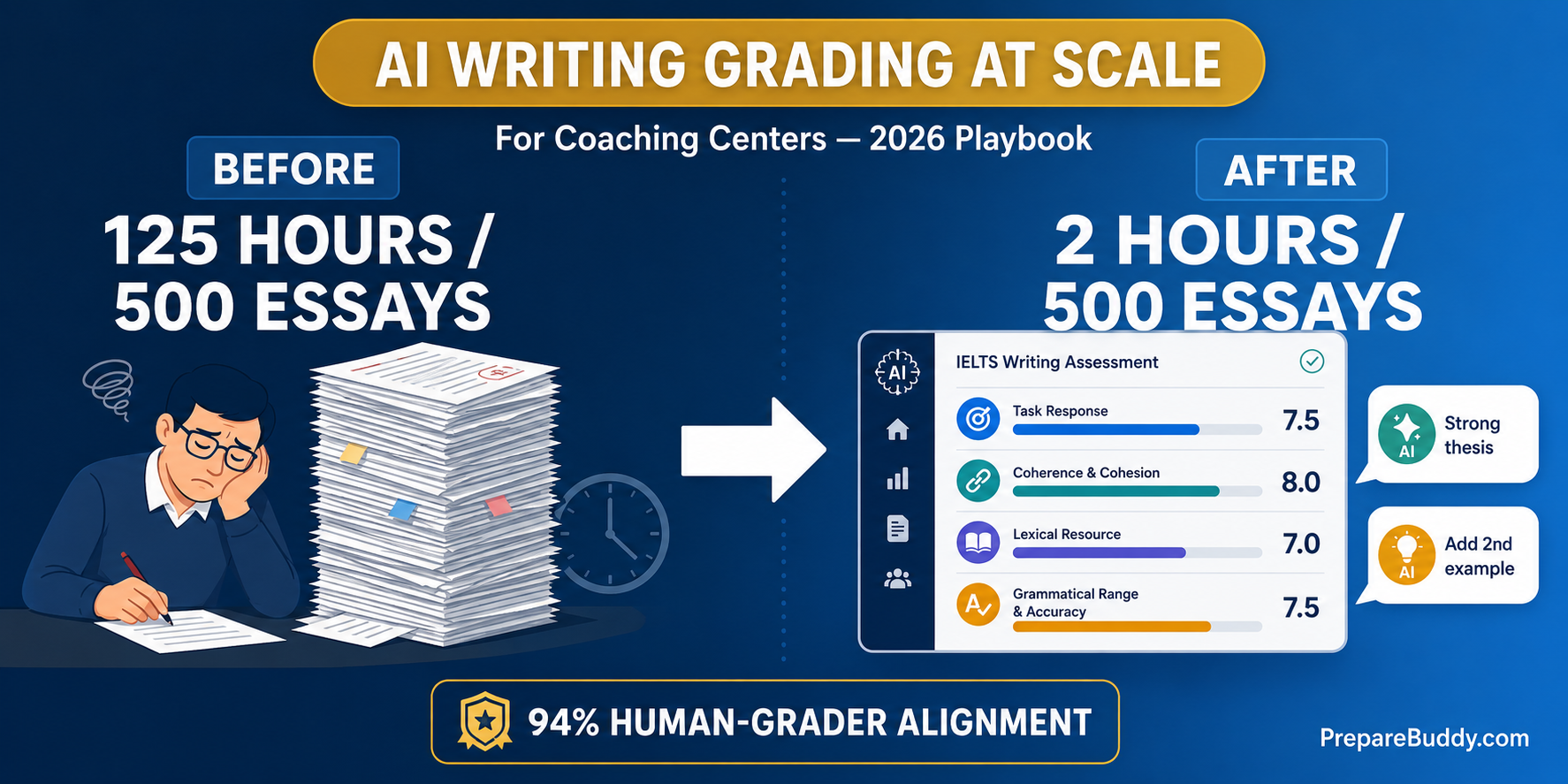
A 50-student IELTS batch with one Writing Task 2 essay each is 12.5 hours of teacher time when graded the traditional way — about fifteen minutes per essay for a careful read, evidence-tagged feedback, and a band score the student will not argue with. Run that batch twice a week across IELTS, PTE Academic, PTE Core, and TOEFL cohorts, and a single coaching center is asking two full-time teachers to do nothing but grade. The Writing section is where most coaching centers quietly break: students wait days for feedback, teachers cut corners, and renewal rates suffer because the one section students cannot self-correct (Writing) is also the one section they get the least help on.
This playbook is for coaching center owners and academic heads running 200 to 10,000+ active students across IELTS, PTE, TOEFL, CELPIP, and DET preparation who want to deliver next-day writing feedback at scale without hiring another teacher. It draws on PrepareBuddy's AI Writing Analysis and Assessment Module, which 200+ institutions now use to grade essays with 94% alignment to human raters and 75% less teacher time.
The Math of Writing Grading at Scale
The first step is to size the problem honestly. Most center owners underestimate the writing-grading load because they only count one cohort at a time.
| Center size | Active students | Writing submissions/month* | Manual grading time | FTE teachers needed |
|---|---|---|---|---|
| Small | 200 | ~800 | 200 hours | 1.2 |
| Mid | 1,000 | ~4,000 | 1,000 hours | 6 |
| Multi-branch | 3,000 | ~12,000 | 3,000 hours | 18 |
| Franchise | 10,000 | ~40,000 | 10,000 hours | 60 |
*Assumes ~4 writing submissions per student per month across IELTS Task 1+2, PTE Essay+SWT, TOEFL Integrated+Independent, CELPIP Task 1+2 mixes. Manual baseline: 15 minutes per submission. FTE = 35 grading hours/week.
At 1,000 students, writing alone consumes the equivalent of six full-time teachers. At 10,000, you are running a grading factory. No coaching center on earth can hire that headcount profitably — which is why most centers either skip detailed writing feedback (and lose retention) or charge a premium that prices them out of the market.
Where Manual Writing Grading Actually Breaks
Three failure modes show up in every center that scales past a few hundred students:
1. Inconsistent band scores between teachers
Teacher A gives an essay a Band 6.5; Teacher B gives the same essay a Band 7.5. Students compare scores in WhatsApp groups, lose trust in the center, and start treating mock band scores as suggestions.
2. Generic, copy-paste feedback
Under time pressure, teachers fall back on "more examples," "better linking words," "work on cohesion." Students cannot act on it. The same essay weakness reappears in the next mock.
3. 3-to-5 day turnaround
By the time the essay comes back, the student has already taken the next mock with the same mistakes. The feedback loop is dead.
An AI writing-grading stack that solves these three problems — consistency, evidence-specific feedback, and same-day turnaround — is what flips writing from a coaching center's biggest cost center into its biggest retention lever.
The Three-Layer AI Writing Stack
PrepareBuddy's AI Writing Analysis is not one model deciding a band score. It is three layers that together hit 94% human-grader alignment.
Layer 1: Per-test rubric grading (test-aware AI)
Each essay is scored against the official rubric for that test — IELTS 4-criterion (Task Response, Coherence & Cohesion, Lexical Resource, Grammatical Range & Accuracy), PTE Essay/SWT scoring traits, TOEFL Integrated/Academic Discussion rubric, CELPIP Task 1/2 criteria. The AI is not generic; it knows the test.
Layer 2: RAG-enhanced consistency (learns YOUR standards)
Before grading any submission, the system retrieves the 5 most similar essays from your own institution's reference library — previous high-scoring and low-scoring essays your teachers have already graded. The AI is shown how YOU grade similar work, then writes its evaluation grounded in those references. This is what closes the gap from generic AI grading (about 85% human alignment) to 94% alignment — the same accuracy as a second human rater.
Layer 3: Multi-model verification on high-stakes batches
For mock tests and final-band predictions, two independent models grade the same essay and the system flags disagreement >1 band level for teacher review. Routine practice essays go through single-pass scoring for speed; high-stakes scoring uses double or triple verification.
Manual vs Basic AI vs RAG-Enhanced AI: Side by Side
| Capability | Manual teachers | Generic AI grader | RAG-enhanced AI (PrepareBuddy) |
|---|---|---|---|
| Human-grader alignment | 100% (1 rater) | ~85% | 94% |
| Turnaround per essay | 15 min | 30 sec | 30 sec |
| 500-essay batch time | 125 hours | ~4 hours | ~2 hours |
| Consistency across teachers | Low (subjective) | Medium | High (anchored to your library) |
| Evidence-specific feedback (quotes from essay) | Sometimes | Rare | Always |
| Appeal-ready audit trail | No (teacher's memory) | No | Yes (reference snapshot versioning) |
| Cost per essay (institute view) | $3–$6 | $0.30–$0.50 | $0.20–$0.40 |
The accuracy gap matters more than the time gap. A grader that returns feedback in 30 seconds but is wrong 30% of the time creates more work, not less — teachers have to re-grade and students lose trust. The 94% alignment is the number that actually makes the system stand on its own.
The 5-Step Coaching Center Rollout
Step 1: Pick the first 50 reference essays (Week 1)
Choose 50 already-graded essays per test (IELTS Task 2, PTE Essay, TOEFL Independent, etc.) spanning your full band range. Tag each as excellent / good / average / poor. This becomes your RAG reference library.
Step 2: Calibrate against 20 known essays (Week 1)
Re-grade 20 recent essays where you have a teacher's band score on file. Compare AI score to teacher score. Tune the rubric weights and add 5–10 more reference essays if any criterion is consistently off.
Step 3: Soft launch on one cohort (Week 2)
Run AI grading in parallel with your teachers for one IELTS batch. Teachers see AI feedback before finalizing their grade. This builds teacher trust before you remove the human review step for practice essays.
Step 4: Switch routine practice to AI-only (Week 3–4)
For non-mock writing practice (homework, daily essays, on-demand attempts), AI grades unassisted. Teachers review only the 5–10% of essays flagged by multi-model disagreement or low-confidence scoring.
Step 5: Keep human review on high-stakes mocks (ongoing)
Final pre-test mock essays still get a teacher review on top of AI grading. The teacher reviews the AI's evidence and rubric scores, then approves or adjusts — a 2–3 minute task instead of a 15-minute grading task.
30-Day Deployment Timeline
| Week | Goal | Owner | Outcome |
|---|---|---|---|
| Week 1 | White-label setup, rubric upload, reference library | Academic head + PrepareBuddy CS | Branded platform live, 50×5 reference essays loaded |
| Week 2 | Calibration + soft launch on 1 cohort | 1 lead teacher | AI scores within 0.5 band of teacher on 90% of essays |
| Week 3 | Roll out to all IELTS & PTE practice essays | All teachers | Writing turnaround drops from 3–5 days to same day |
| Week 4 | Add TOEFL, CELPIP, DET cohorts | All teachers | One grading workflow across all writing-bearing tests |
White-label deployment for PrepareBuddy is 24 to 48 hours from contract to a fully branded platform under the center's own domain, logo, and colors. The 30-day timeline above is the operational rollout — teacher onboarding, reference-library build, and cohort migration — not infrastructure setup.
The ROI Math: Cost Per Essay
For a mid-size coaching center grading 4,000 writing submissions per month, manual grading at a fully-loaded teacher cost of about $4 per essay is $16,000 per month, or roughly $192,000 per year — before factoring in the retention loss from slow turnaround. The same volume on an AI-graded workflow with teacher review only on high-stakes mocks runs about 80% lower in marginal cost while producing same-day feedback and consistent, evidence-tagged grades. That's why PrepareBuddy customers see 300% ROI within 18 months and teachers report saving 18+ hours per week on grading.
What Teachers Do Instead
The most common worry when a center owner introduces AI writing grading is: "Will my teachers feel replaced?" In practice, the opposite happens. Teachers move from grading (the work they liked least) to:
- 1:1 speaking practice and high-stakes mock review — the work they actually trained for
- Curriculum design and test-strategy classes
- Reviewing the 5–10% of AI-flagged essays where their judgment really matters
- Working with the AI Tutor as a co-teacher rather than the only source of feedback
Retention goes up, not down, when teachers stop spending evenings grading essays and start spending classroom time on the high-leverage parts of the job.
Frequently Asked Questions
Will the AI grade IELTS, PTE, TOEFL, and CELPIP differently?
Yes. Each test has its own rubric — IELTS uses 4 band-descriptor criteria, PTE uses scoring traits per task type, TOEFL uses ETS Integrated and Academic Discussion rubrics, CELPIP uses CLB-aligned criteria. PrepareBuddy's AI Writing Analysis is test-aware, so an IELTS Task 2 essay is graded against the IELTS Writing band descriptors and a PTE Essay is graded against PTE scoring traits.
How accurate is 94% human-grader alignment, really?
It means the AI agrees with the human rater's band score (within the rubric's normal tolerance) on 94% of essays — which is roughly the same agreement rate you would see between two independent human raters on the same essay. The remaining 6% is mostly borderline essays where two humans would also disagree.
What about appeals and grade disputes from students?
Every AI evaluation stores the rubric, the reference essays used, the evidence quoted from the student's submission, and the criterion-level scores. If a student appeals, the academic head can reproduce exactly how the grade was reached — something that is rarely possible with manual grading.
Can we still customize the rubric?
Yes. The default rubrics ship with the platform, but coaching centers can adjust criterion weights, add institute-specific criteria, or upload their own rubric (PDF, DOCX, or scanned image — the system extracts and structures it).
How do we get started?
White-label deployment is 24 to 48 hours. The first month is free with no credit card and no lock-in contract. Schedule a demo at /contact to see the AI writing grading workflow with your own essay set, or sign up at /signup to start a free trial.
Start Grading at Scale
Writing is the section that students need the most help on and that coaching centers can least afford to give well. An AI writing-grading workflow built on a test-aware rubric, a RAG reference library, and multi-model verification turns 12.5 hours of teacher time into 15 minutes — with consistency, evidence, and an audit trail that manual grading cannot match.
Schedule a 20-minute demo to see how PrepareBuddy grades a 100-essay IELTS Writing batch in front of you, or start a free trial — the first month is free and there's no lock-in. View the full coaching-center platform or compare us with other options at /compare/.


Join the Discussion