

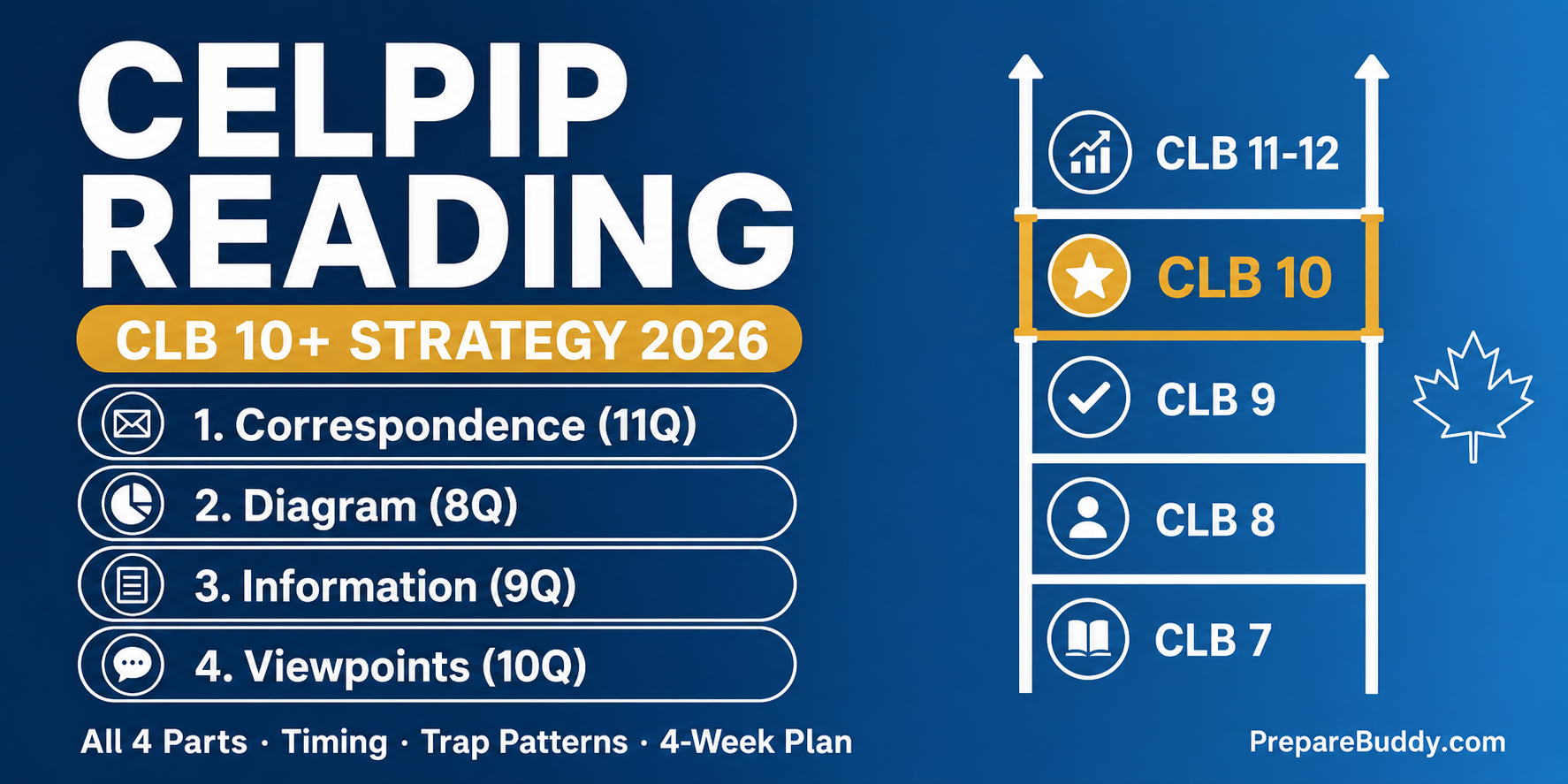
If you need CLB 10 on CELPIP Reading for Express Entry, professional licensing, or a competitive Canadian PR profile, the gap from a high CLB 8 to a CLB 10 is rarely a vocabulary problem. It is a timing, evidence-tracking, and answer-discipline problem. On a 55-minute test with 38 questions across four very different reading task families, every wasted minute on Part 1 quietly steals from Part 4 — which is exactly where most CLB 9 candidates lose their CLB 10.
This guide breaks down the CELPIP Reading section the way examiners actually score it: part by part, with a per-part timing budget, the trap patterns that recur, and a four-week practice plan you can run on PrepareBuddy's AI-graded CELPIP engine. Every score reference and feature claim below comes from verified PrepareBuddy data and CELPIP's published exam format.
CELPIP Reading at a Glance (2026 Format)
CELPIP Reading runs 55-60 minutes and has 38 scored questions split across four parts. Each part tests a different reading skill — correspondence comprehension, applied diagram reading, information synthesis, and viewpoint analysis. The CLB scale runs 1-12, but everything above CLB 10 requires near-perfect accuracy.
| Part | Skill Tested | Questions | Suggested Time | What You Read |
|---|---|---|---|---|
| Part 1 | Reading Correspondence | 11 | ~9 min | Email + reply (personal context) |
| Part 2 | Reading to Apply a Diagram | 8 | ~9 min | Diagram/chart + email response |
| Part 3 | Reading for Information | 9 | ~10 min | 4-paragraph encyclopedia-style article |
| Part 4 | Reading for Viewpoints | 10 | ~13 min | News article + reader comment |
| Unscored Practice Task | 10 | ~5 min | Warm-up (does NOT count) | |
The 5-minute practice task at the start does not affect your score. Treat it as a warm-up and move on quickly — do not over-invest.
CLB Conversion: What CLB 10+ Actually Requires
CELPIP uses a 1-12 scoring scale, with CLB 9 being the minimum for most professional licensing bodies and CLB 10 being the threshold for maximum Express Entry CLB points (4 points per ability under CRS for CLB 10).
| CELPIP Reading Score | Approx. Raw (out of 38) | CLB Level | Express Entry Use |
|---|---|---|---|
| 11-12 | 36-38 | CLB 11-12 | Maximum English ability points |
| 10 | 33-35 | CLB 10 | 4 CRS points per ability (target for most PR applicants) |
| 9 | 30-32 | CLB 9 | Minimum for most regulated professions |
| 8 | 26-29 | CLB 8 | Federal Skilled Worker eligible |
| 7 | 22-25 | CLB 7 | CEC minimum (NOC TEER 0/1) |
The takeaway: to safely land CLB 10, you cannot afford to miss more than 5 of 38 questions. Three wrong on Part 4 alone — the part with the densest text and the most subtle distractors — is enough to pull you from CLB 10 to CLB 9.
Part 1: Reading Correspondence — The Speed Round
Part 1 gives you a personal email (around 200 words), then a reply. You answer 6 questions on the email and 5 fill-in-the-blank questions on the reply, with the blanks asking you to pick from word choices that match tone, register, and meaning in context.
The trap: The fill-in-the-blank options for the reply are often grammatically interchangeable — they all "fit." The correct answer requires you to match the writer's register (formal vs informal), emotional tone (apologetic, enthusiastic, neutral), and the relationship implied in the first email.
CLB 10 strategy:
- Read the original email once, fast. Identify: who is writing, to whom, about what, and what they want.
- For the 6 email questions: most are detail or inference. Scan back to confirm — do not answer from memory.
- For the reply fill-ins: read the entire reply sentence first, then pick the word. Never pick a word in isolation.
- Time budget: 9 minutes flat. If a question is taking more than 45 seconds, mark and move on.
Part 2: Reading to Apply a Diagram — Where Visual Thinkers Win
Part 2 shows you a diagram, schedule, chart, or workplace flyer plus a short email asking you to make a decision using the diagram. The 8 questions split between diagram-interpretation and email-context items.
The trap: The email writer's preferences are stated as constraints ("anything but Tuesday," "must be under $50," "needs to be wheelchair accessible"). The correct option must satisfy all stated constraints simultaneously. CLB 9 candidates often pick the option that satisfies most but not all.
CLB 10 strategy:
- Read the email FIRST. List the constraints in your head: "Friday only, vegetarian, max $30, parking required."
- Use the diagram as a checklist. Cross out options that fail any single constraint.
- Watch for word swaps in answer choices (a popular distractor pattern: the diagram says "from 6 PM" and the wrong answer says "starting at 5 PM").
- Time budget: 9 minutes. Part 2 rewards focus, not speed-reading.
Part 3: Reading for Information — The Synthesis Test
Part 3 hands you an encyclopedia-style article broken into 4 labeled paragraphs (A, B, C, D), then asks you to match 9 statements to the paragraph each statement comes from — or choose "not given" when the statement is not supported.
The trap: "Not given" is a real option here. Candidates targeting CLB 10 often force-fit a statement into the closest-sounding paragraph rather than admitting it is not supported by the text. CELPIP often plants statements that sound like a paragraph's topic but make a claim the paragraph never actually makes.
CLB 10 strategy:
- Skim each paragraph for 60 seconds to get the topic sentence and main idea.
- For each statement: locate specific evidence in one paragraph. If you cannot point to the sentence that proves it, "not given" is the answer.
- Beware of paraphrases — the right answer almost never reuses the article's exact wording.
- Time budget: 10 minutes. If you finish faster, do not move on — re-verify your three least-confident answers.
Part 4: Reading for Viewpoints — Where CLB 10 Is Won or Lost
Part 4 is the longest and densest part. You read a news article (around 400 words) presenting a debate, then a reader-comment response. You answer 5 questions on the news article and 5 fill-in-the-blank questions on the comment.
The trap: Two viewpoints often appear in the same paragraph. CELPIP asks you to identify whose viewpoint is being expressed — the author's, an expert's quoted in the article, or an opposing voice. CLB 9 candidates conflate these. CLB 10 candidates track whose voice every sentence belongs to.
CLB 10 strategy:
- On the first read of the article, annotate (mentally): which paragraphs contain which speaker's view.
- For the 5 article questions: every answer must be attributable to a specific speaker in the text. The author's framing is not the same as a quoted expert's position.
- For the comment fill-ins: the comment-writer has a clear stance. Pick words that maintain that stance throughout — switching tone mid-comment is a distractor pattern.
- Time budget: 13-14 minutes. Save the most time for Part 4; do not start it with less than 12 minutes on the clock.
The Master Timing Plan
| Clock | Action | Buffer |
|---|---|---|
| 0:00 - 0:05 | Unscored practice task (warm-up) | 5 min |
| 0:05 - 0:14 | Part 1: Correspondence (11Q) | 9 min |
| 0:14 - 0:23 | Part 2: Diagram (8Q) | 9 min |
| 0:23 - 0:33 | Part 3: Information (9Q) | 10 min |
| 0:33 - 0:46 | Part 4: Viewpoints (10Q) | 13 min |
| 0:46 - 0:55 | Review flagged questions | 9 min |
If you cannot finish Parts 1-3 in 28 minutes during practice, your bottleneck is decoding speed, not strategy. Drill timed Part 1 sets until 9 minutes feels comfortable — then layer in Parts 2 and 3.
Seven Habits That Separate CLB 10 from CLB 9
- Read the questions before the long passages (Parts 3 and 4). Knowing what you are hunting for cuts re-reading by 30%.
- Never answer from memory. Every answer should be locatable in a specific sentence or diagram cell.
- "Not given" is the right answer when there is no evidence — not when you cannot find evidence. Train this distinction.
- Track speaker voice in Part 4. Author ≠ quoted expert ≠ opposing view.
- Match register in fill-in-the-blanks. A casual email reply does not use "henceforth" or "to wit."
- Flag and skip ruthlessly. A 90-second question in Part 1 will cost you a Part 4 question worth twice as much.
- Use the unscored practice task as a warm-up. Do not skip it — it tunes your eyes to the test pace.
The 4-Week CLB 10 Practice Plan
| Week | Focus | Daily Practice (60 min) | Weekly Goal |
|---|---|---|---|
| 1 | Part 1 + Part 2 timing | 4 Part 1 sets + 3 Part 2 sets | Part 1 under 9 min, Part 2 under 9 min |
| 2 | Part 3 evidence discipline | 2 full Part 3 sets + paraphrase drills | Score 7/9 or better with evidence noted |
| 3 | Part 4 speaker tracking | 2 Part 4 sets + 1 full reading mock | Identify speaker for every question |
| 4 | Full mocks under timing | 3 full 55-min mocks, AI-scored | CLB 10 on 2 of 3 mocks |
How PrepareBuddy Helps You Hit CLB 10
Generic question banks give you static practice questions and a percentage at the end. PrepareBuddy's CELPIP module is built specifically for the four-part Reading format with three things you cannot get from a PDF:
- Unlimited authentic CELPIP-format generation. Our 120B-parameter AI model produces fresh Part 1-4 passages indistinguishable from official material in blind tests — so you stop memorizing answers and start training the underlying skill.
- RAG-enhanced AI scoring with 94% alignment to human raters. Each Reading attempt gets a CLB-mapped score plus per-question diagnostics: which question type cost you points, where you ran over time, and which paragraph you misattributed in Part 4.
- Adaptive difficulty. Our adaptive testing engine routes you to weaker question types until you can clear them at CLB 10 pace — instead of practicing what you are already good at.
Pair Reading practice with our AI Writing Analysis for CELPIP Writing and our Voice AI for Speaking practice — students preparing across all four CELPIP skills on one platform save 18+ hours weekly compared to stitching together separate tools.
Frequently Asked Questions
What raw score do I need to get CLB 10 on CELPIP Reading?
You need roughly 33 of 38 questions correct (about 87%) to safely land CLB 10. Anything below that drops you into CLB 9 territory.
Is CELPIP Reading harder than IELTS Reading?
They test different skills. CELPIP is shorter (55 minutes vs 60), has fewer questions (38 vs 40), and the content is North-American workplace and daily-life focused. IELTS Reading uses more academic passages. Most candidates find CELPIP's question types more familiar but the timing tighter.
How much time should I spend on each CELPIP Reading part?
Use 9 minutes for Part 1, 9 minutes for Part 2, 10 minutes for Part 3, and 13-14 minutes for Part 4 — with the remaining time as a review buffer. Part 4 is densest and deserves the largest budget.
Is the unscored practice task at the start worth doing?
Yes — but only for warm-up. It does not count toward your score, so do not spend more than 5 minutes. Use it to settle into the test interface and pace.
How long does it take to go from CLB 8 to CLB 10 on Reading?
Most candidates need 3-4 weeks of focused, timed practice — about 60 minutes a day — plus AI-graded mocks for diagnostic feedback. Strategy work (Part 4 speaker tracking, "not given" discipline) matters more than vocabulary cramming at this level.
Start Practicing Today
Reading CLB 10 is a discipline test as much as a language test. Drill the four parts with strict timing, score every attempt with rubric-based AI feedback, and review every wrong answer for the underlying trap pattern — not just the right answer.
Ready to start? Take a free PrepareBuddy CELPIP Reading practice test — get an AI-graded CLB score and a per-question diagnostic in under 60 minutes, no credit card required. Coaching centers and immigration consultants offering CELPIP prep can also book a demo of the white-label CELPIP platform and deploy it under their own brand within 24-48 hours.


Join the Discussion