

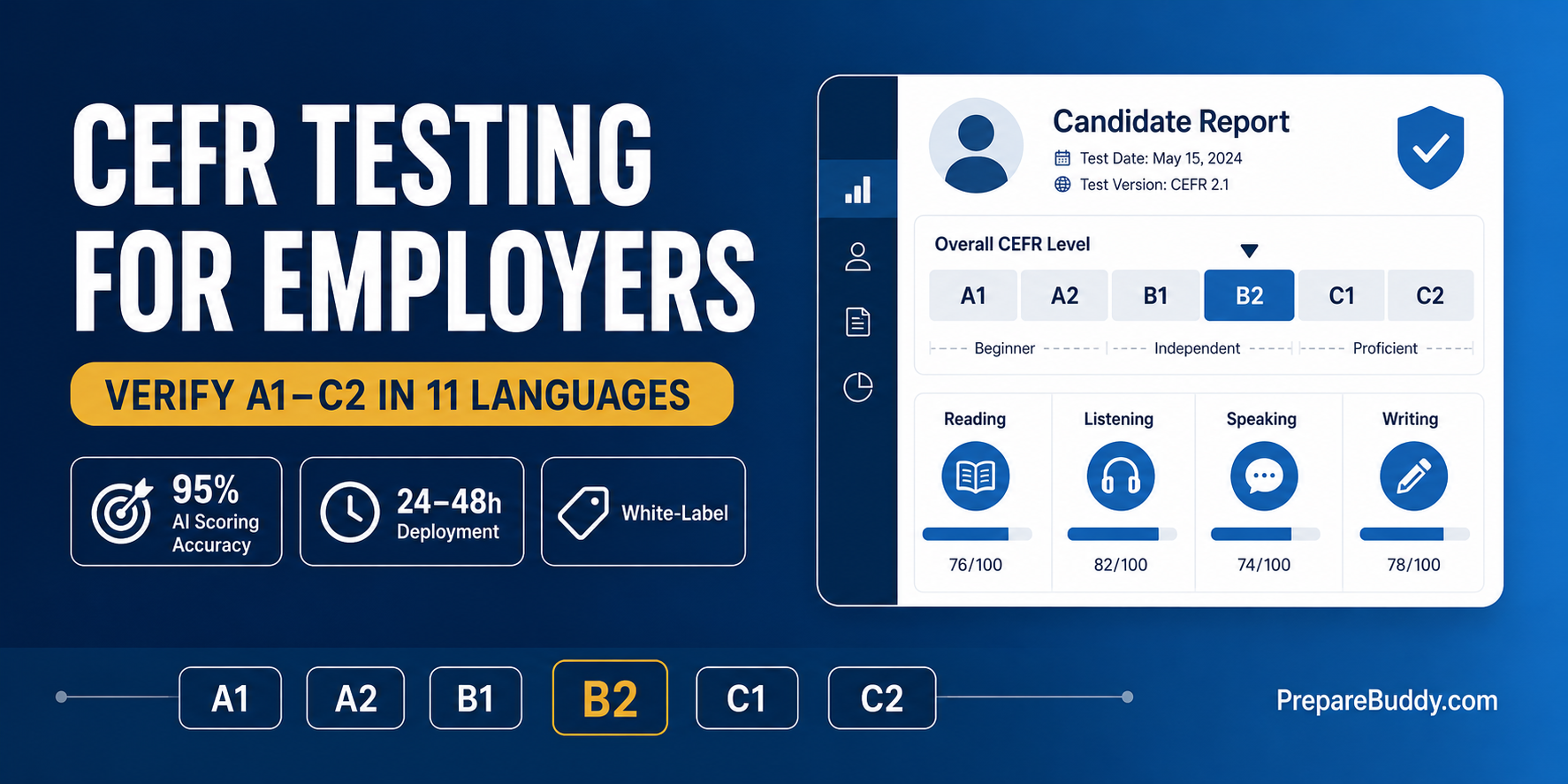
A candidate's CV says “Spanish — C1.” The role is a customer-success seat covering Madrid and Mexico City. Nobody on the hiring team speaks Spanish, external certificates take weeks you don't have, and the phone-screen-with-a-bilingual-colleague method tests small talk — not the ability to write a clear, correct complaint response. This is the gap a CEFR test for employers closes: an AI-scored assessment that places every candidate on the international A1–C2 scale across reading, listening, speaking and writing — in 11 languages, on one platform, with results you can compare across applicants.
This guide covers how CEFR-based hiring assessment works, what each level means in a workplace context, and how HR and staffing teams run it at volume without becoming language examiners themselves.
Why Self-Reported Language Skills Break Down in Hiring
“Fluent” is not a standard. One candidate uses it to mean they grew up bilingual; another means they survived a semester abroad. Interviewer judgment doesn't rescue the situation: an improvised chat with a bilingual colleague measures conversational confidence, misses writing entirely, and varies with whichever colleague happened to be free that day.
The Common European Framework of Reference (CEFR) exists precisely to fix this — six levels from A1 (beginner) to C2 (mastery), understood by employers, universities and immigration authorities worldwide. The scale was never the problem. The problem was that testing against it traditionally required certified human examiners for every language you hire in — impractical for a support hub screening in Spanish, Portuguese and German in the same week.
What a CEFR Test for Employers Measures
PrepareBuddy's adaptive language proficiency testing assesses all four skills using 18 purpose-built question types — from dictation and highlight-the-answer reading tasks to photo-description speaking prompts and extended writing samples. Every response is AI-evaluated and mapped to a CEFR level, both overall and per skill.
| CEFR Level | Score Range (0–100 scale) | What It Means for Work |
|---|---|---|
| C2 | 85–100 | Mastery — understands virtually everything; handles nuance, negotiation and idiom |
| C1 | 68–84 | Advanced — expresses ideas fluently and spontaneously; suited to client-facing and leadership roles |
| B2 | 51–67 | Upper intermediate — interacts with fluency and spontaneity; a common bar for professional roles |
| B1 | 34–50 | Intermediate — deals with most routine situations; workable with escalation paths |
| A2 | 17–33 | Elementary — communicates in simple, routine exchanges only |
| A1 | 0–16 | Beginner — familiar everyday expressions |
Because scoring is per skill as well as overall, a candidate report can show B2 overall with C1 reading and B2 speaking — exactly the detail that matters when you are deciding between a written-support seat and a phone-support seat.
No Level Guessing: Placement Mode Detects A1–C2 Automatically
Most testing tools ask the employer to choose the level first: pick B2, then find out whether the candidate passes B2. That forces HR to guess — and a wrong guess means retesting.
PrepareBuddy's placement mode removes the guess. The assessment draws content from all six CEFR bands — roughly nine items per band — and detects the candidate's level from their actual performance, with real-exam scoring and no pre-selection. For high-volume funnels, a quick diagnostic format (about 10–20 minutes) gives a fast first-pass read on large applicant pools, with a fuller assessment reserved for shortlisted candidates.
11 Languages, One Standard
The same framework — same 18 question types, same scoring engine, same CEFR mapping — runs in all 11 supported languages, so results are comparable across candidates and across languages:
| Language | Script | Notes |
|---|---|---|
| Spanish, French, Italian, Portuguese, German | Latin | Native-quality TTS audio |
| Chinese (Mandarin) | Simplified Han | Script-aware rendering |
| Hindi | Devanagari | Native-quality TTS audio |
| Japanese | CJK | Native-quality TTS audio |
| Korean | Hangul | Native-quality TTS audio |
| Russian | Cyrillic | Native-quality TTS audio |
| Arabic | Arabic | Full right-to-left support |
Two details matter for assessment integrity. First, the entire test interface is localized into the target language — instructions, question labels, buttons and prompts — so a candidate's English ability never contaminates their Japanese result. Second, speaking is not record-and-hope: candidates hold a live conversation with Voice AI, which analyzes responses in real time, including 48-emotion detection alongside fluency and pronunciation.
The Business Case for AI-Scored CEFR Assessment
| Hiring Problem | With AI-Scored CEFR Testing |
|---|---|
| External certificates take weeks and cost per candidate | AI evaluation with 95% scoring accuracy (multi-model verification), delivered as part of your own screening flow |
| Certified examiners needed for every language | One platform covering 11 languages with identical standards |
| Interviewer judgments vary by interviewer | Every candidate measured against the same CEFR engine |
| Third-party tools dilute your employer brand | Full white-label: your logo, colors and domain — zero PrepareBuddy branding visible to candidates |
| Long procurement-to-live cycles | 24–48 hour deployment |
PrepareBuddy already powers assessment for 200+ institutions. The same language proficiency testing engine that language schools use for placement works for employment screening — and staffing agencies and training providers can run it under their own brand as a service to their clients.
How to Get Started
- See it live. Schedule a demo and walk through the assessment flow in the languages you hire for.
- Configure your assessment. Choose languages, targeted levels or placement mode, and apply your branding.
- Invite candidates. Add the assessment to your screening stage; candidates take it online.
- Read per-skill reports. Each candidate gets an overall CEFR level plus reading, listening, speaking and writing sub-levels.
The first month is free, with no credit card required and no lock-in contracts.
Frequently Asked Questions
Which languages can employers test with CEFR levels?
Eleven: Spanish, French, German, Italian, Portuguese, Chinese (Mandarin), Japanese, Korean, Hindi, Russian and Arabic — all scored on the same A1–C2 framework across reading, listening, speaking and writing.
Do we need to know a candidate's level before testing?
No. Placement mode draws content from all six CEFR bands and detects the level from performance — no pre-selection required. A quick 10–20 minute diagnostic is available for first-pass screening.
How accurate is the AI scoring?
PrepareBuddy's AI scoring runs multi-model verification and reaches 95% scoring accuracy, with per-skill CEFR breakdowns in every report.
Can a staffing agency offer this under its own brand?
Yes. The platform is fully white-label — custom domain, logo, colors and branded emails, with no PrepareBuddy branding visible to candidates.
Hiring across languages shouldn't depend on the CV's honesty. Schedule a demo to see CEFR testing for your hiring flow — or experience the candidate side yourself with a free practice test.


Join the Discussion