

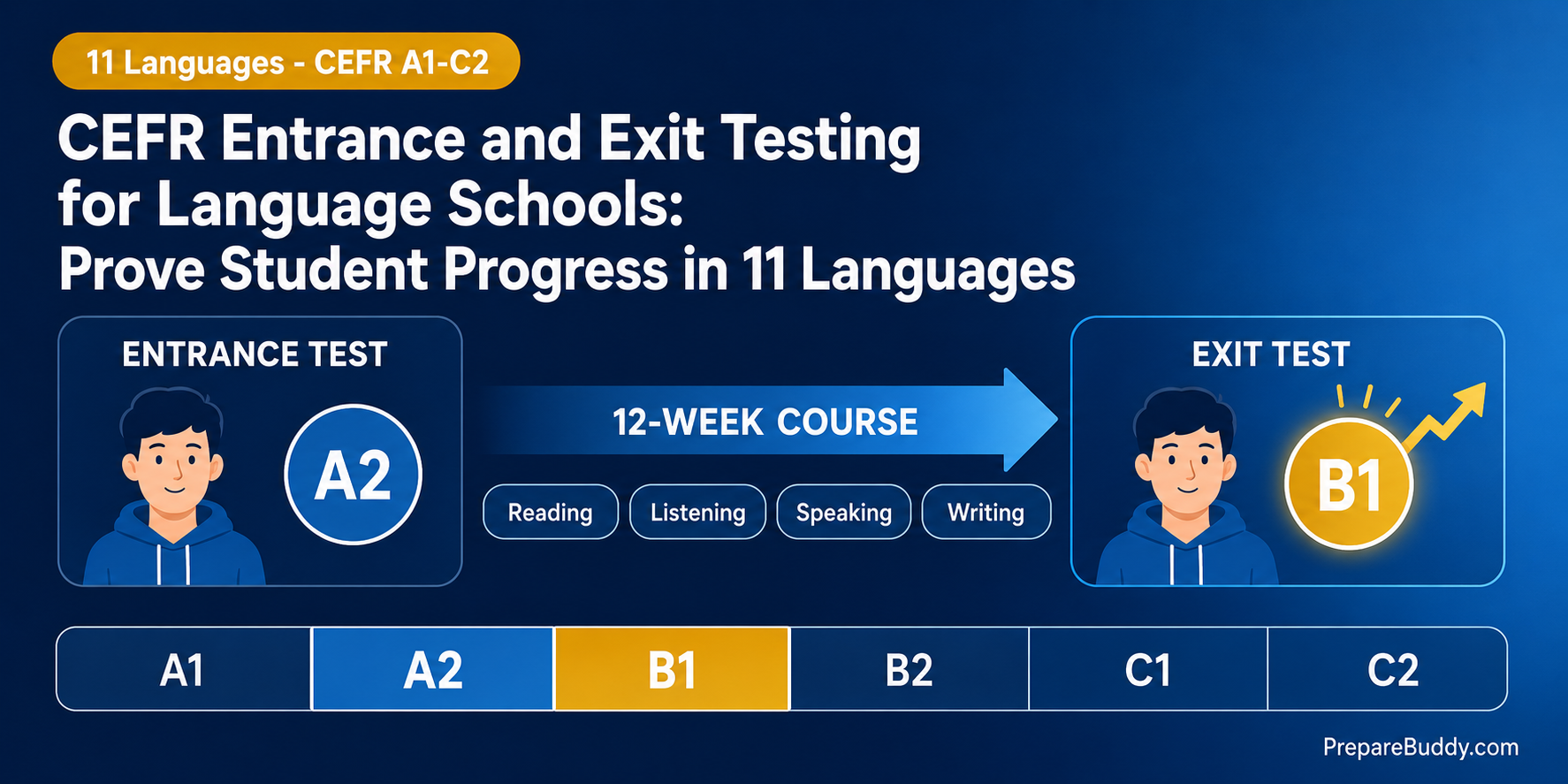
Ask a language school director how they place a new student and you will usually hear some version of the same answer: a short written quiz, maybe a five-minute chat with whichever teacher is free, and a best guess. Ask the same director to prove — on paper, to a parent or a corporate client — that a student moved from A2 to B1 over a twelve-week course, and the answer gets much quieter.
That gap is the problem CEFR entrance and exit testing solves. Test at intake, test again at the end, and the difference between the two scores becomes the single most persuasive sales and retention asset a language school owns. This guide covers how to run entrance and exit testing across 11 languages, what to measure, and how to turn the results into renewals.
Why a CEFR entrance and exit test beats a placement quiz
A placement quiz answers one question: which class does this person join? A proper entrance/exit framework answers four, and three of them are commercial.
| Question | Placement quiz | CEFR entrance + exit testing |
|---|---|---|
| Which class does the student join? | Roughly | Yes — A1–C2, per skill |
| Did the course actually work? | No | Yes — measured delta |
| Can we show a parent or employer proof? | No | Yes — CEFR is internationally recognised |
| Which students should be upsold to the next level? | No | Yes — exit level maps to the next course |
The last row is where the revenue sits. A student who finishes a course with no evidence of progress is a churn risk. A student who is shown a documented move from A2 to B1, alongside a recommendation for the B1–B2 course, is a renewal conversation that writes itself.
What "genuine level detection" means (and why it matters at intake)
Most placement tools ask the operator to pick a level first, then measure the student against it. That only works if your guess was already close. PrepareBuddy's adaptive language testing supports both approaches:
- Targeted mode — you select a CEFR level and the test measures the learner against it. Useful when a cohort's rough level is already known.
- Placement mode — you select nothing. The test generates content spread across all six CEFR bands (roughly nine items per band, 54 total), tags each item with its band, and detects the level from performance across the full range.
Placement mode is the recommended default for enrolment and streaming, because it removes the guess entirely. Scoring is full-denominator, real-exam style: every question counts and unanswered questions score zero. A student who answers half the test brilliantly cannot place high — which is exactly the behaviour you want when the result determines which class they pay for.
Alongside the headline level, the result page shows a comprehension-by-band diagnostic: per-band success rate on objective questions, plus the highest difficulty the learner sustained. For a teacher receiving a new student, that is far more actionable than a single number.
The CEFR scoring scale your reports will use
| CEFR Level | Score Range | What the student can do |
|---|---|---|
| C2 | 85–100 | Mastery — understands virtually everything |
| C1 | 68–84 | Advanced — expresses ideas fluently and spontaneously |
| B2 | 51–67 | Upper intermediate — interacts with fluency and spontaneity |
| B1 | 34–50 | Intermediate — handles most situations while travelling |
| A2 | 17–33 | Elementary — communicates in simple, routine tasks |
| A1 | 0–16 | Beginner — uses familiar everyday expressions |
Scores are reported overall and per skill, so a student can be C1 in reading and B2 in speaking — a profile that tells a teacher precisely where to spend class time.
All four skills, in 11 languages, on one framework
Entrance and exit testing only proves progress if it covers productive skills. Reading-only tests flatter students who cannot speak. The platform runs 18 purpose-built question types across four skills:
| Skill | Question types | Examples |
|---|---|---|
| Reading | 7 | Read and Select, Complete Sentences, Identify Main Idea, Title the Passage |
| Listening | 2 | Listen and Type, Interactive Listening |
| Speaking | 6 | Read Aloud, Speak About Photo, Read Then Speak, Interactive Speaking |
| Writing | 3 | Write About Photo, Interactive Writing, Writing Sample |
The same framework runs across 11 languages — Chinese, Spanish, French, Hindi, Italian, Portuguese, Japanese, Korean, German, Russian and Arabic — with native-quality text-to-speech audio and script-aware rendering including Arabic right-to-left support. Critically, the entire test interface is localised, not just the content: a student taking a German test sees German instructions, German question labels and German buttons, rather than the jarring English-wrapper experience common to other engines.
For a school teaching four or five languages, this means one testing standard instead of five incompatible ones — and one report format for every parent conversation.
Running it as a two-point measurement
- Entrance (week 0): run a placement-mode test. Use the overall CEFR level to stream the student and the per-skill breakdown to brief the teacher. Store the result as the baseline.
- Midpoint (optional): a quick 10–20 minute diagnostic catches students who have been misplaced before the course ends and the refund conversation starts.
- Exit (final week): run a targeted-mode test at the level the course was designed to reach. Compare against the baseline.
- Report and upsell: issue the progress report, and pair the exit level with a recommendation for the next course.
Because speaking and writing responses are AI-evaluated rather than teacher-marked, the exit round does not consume a week of staff time. Institutions on the platform report roughly 75% time saved on grading. Written and spoken responses also receive multi-perspective feedback — an examiner view with CEFR descriptor gaps, a coach view with a before/after rewrite, and a peer view with score impact — which gives students something substantive to read rather than a bare number.
Under your brand, not ours
Language schools sell trust, and a third-party login undermines it. The white-label platform for language institutes puts your logo, colours and domain in front of students, with 30+ customisable branding fields and no PrepareBuddy branding visible to end users. Deployment runs in 24–48 hours.
The analytics dashboard aggregates entrance and exit data at cohort level, so you can see which courses and which teachers move students most reliably — the operational question most schools currently answer by instinct.
The business case
| Outcome | What changes |
|---|---|
| Placement accuracy | Genuine A1–C2 detection replaces a teacher's five-minute guess |
| Grading load | ~75% time saved; speaking and writing evaluated by AI |
| Renewals | Documented CEFR progress converts into next-level enrolment |
| Language coverage | One framework across 11 languages, no extra hires |
| Time to launch | 24–48 hour deployment, fully branded |
Across the platform, 200+ institutions and 50,000+ students have used PrepareBuddy, with a 95% satisfaction rate and 95% AI scoring accuracy from multi-model verification.
How to get started
Start by testing one cohort. Run a placement-mode entrance test on your next intake in a single language, brief teachers from the per-skill breakdown, then run the exit test at course end and look at the delta. If the numbers hold up, extend it to every language you teach.
You can try the assessment engine yourself with a free practice test, or schedule a demo to see the entrance/exit workflow and branded reporting on your own cohort data. The first month is free, with no credit card and no lock-in contract.


Join the Discussion