

The cut-off between a CLB 9 and a CLB 10 on CELPIP Writing is brutal — and it has direct consequences. CLB 10 is what physicians need for medical licensing in several Canadian provinces, what Express Entry candidates target for the maximum Comprehensive Ranking System (CRS) language points, and what some employer-driven nominee streams quietly use as their internal "fluent" threshold. The gap between a CLB 9 and a CLB 10 Writing score is not vocabulary list size. It is structural — how you organise an email, how you anticipate a counter-argument, and how you maintain a single coherent register across 200 words without slipping.
If you have already cleared CLB 9 and the next score band keeps eluding you, this guide is for you. We cover both CELPIP Writing tasks (Email + Responding to Survey Questions), the four scoring dimensions Paragon Testing Enterprises uses, the most common ceiling traps at CLB 9, and a 4-week practice plan you can run on PrepareBuddy's CELPIP module or any focused study set.
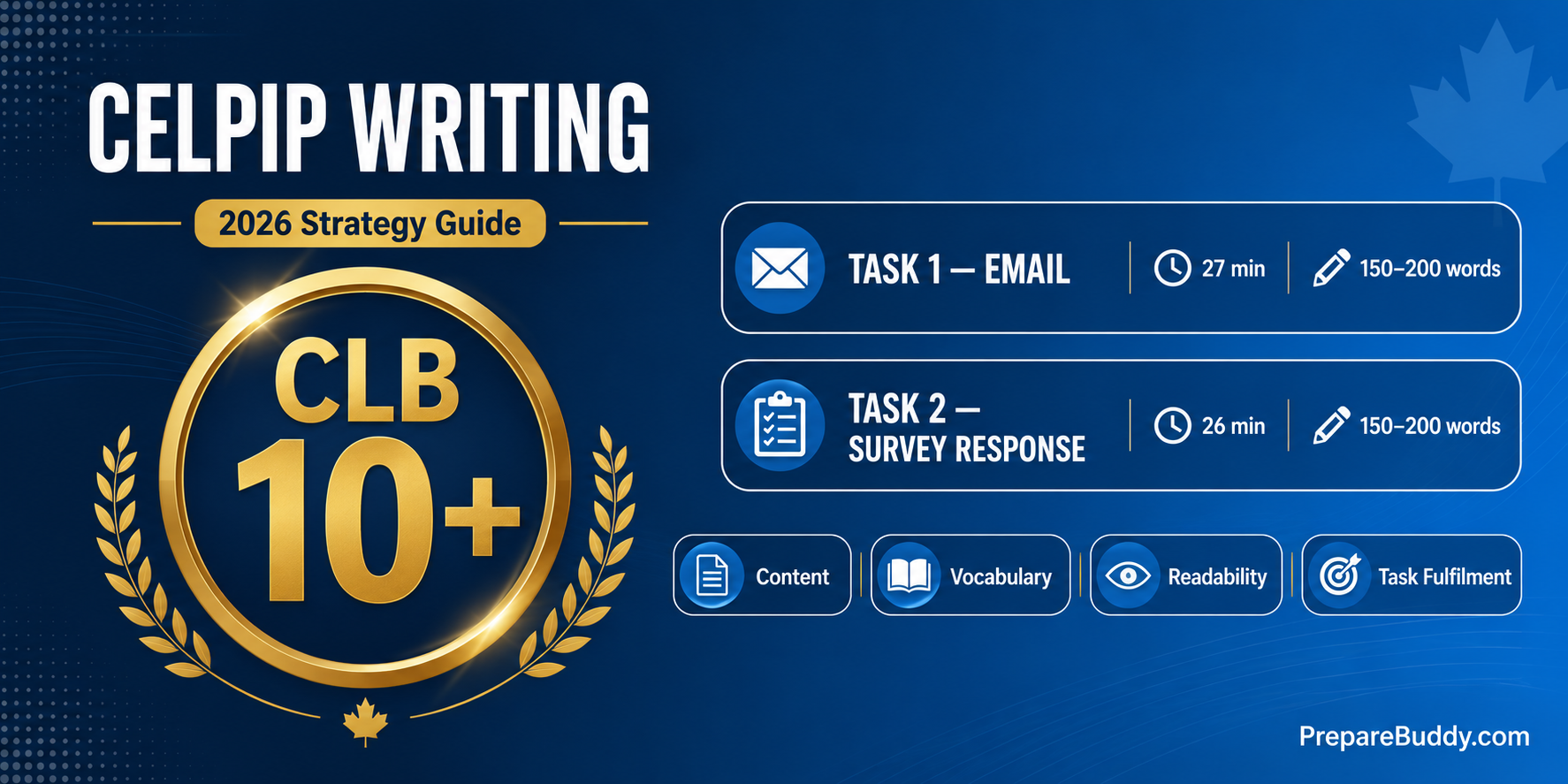
CELPIP Writing at a glance (2026 format)
CELPIP General Writing has two tasks delivered back-to-back inside the computer-delivered test. Both are scored on a 0–12 CLB scale, then averaged with your other skills.
| Component | Task 1: Email | Task 2: Survey Response |
|---|---|---|
| Time | 27 minutes | 26 minutes |
| Recommended length | 150–200 words | 150–200 words |
| Prompt type | Real-life scenario (complaint, request, follow-up) | Two opinion options + survey result data |
| Register | Formal, semi-formal, or informal — you decide | Persuasive / argumentative, semi-formal |
| Word counter | Visible on screen | Visible on screen |
| Spell-check | None | None |
Total Writing section time is 53–60 minutes including a brief instruction page. No spell-check is the part many test-takers underestimate — a single misspelled high-frequency word in your opening paragraph telegraphs "non-fluent" to the rater.
What CLB 10 actually means on the Writing rubric
CELPIP uses a 12-point Canadian Language Benchmark scale. The jump from CLB 9 to CLB 10 corresponds to a shift from "Effective Communicator" to "Advanced Communicator." That distinction shows up directly on the Comprehensive Ranking System and on professional licensing.
| CLB Score | Express Entry CRS Language Points (per ability) | Real-world use case |
|---|---|---|
| CLB 7 | 17 points | Minimum for Express Entry; entry-level professional roles |
| CLB 9 | 29 points | "Initial advanced" — most regulated professions, university admission |
| CLB 10 | 32 points | Maximum CRS language points; medical, legal, senior management roles |
| CLB 11+ | 32 points (capped) | No additional CRS benefit; signals near-native ability |
For Express Entry candidates, the marginal CRS gain from CLB 9 to CLB 10 across all four skills is 12 points — frequently the difference between an Invitation to Apply and another six-month wait.
Task 1: Writing an Email — the CLB 10 framework
Task 1 gives you a 2–3 sentence scenario plus 1–3 bullet points you must address (e.g., "explain the problem, suggest a solution, request a refund"). Test-takers stuck at CLB 9 usually nail the bullets but lose marks on register consistency and tone control.
The 5-paragraph email skeleton that scores CLB 10
- Greeting (1 line): Match the recipient. "Dear Mr. Henderson" (formal) vs. "Hi Sarah" (informal). Never start with the bullet-point content.
- Opening line (1–2 lines): State why you are writing. "I am writing to follow up on the order I placed last Tuesday (#4892)…"
- Body paragraph 1 (3–4 lines): Address the first bullet with one specific detail. Concrete > generic.
- Body paragraph 2 (3–4 lines): Address the second bullet. Use a linking phrase ("In addition," "On a related note,") so the email reads as one continuous thought, not two stapled sections.
- Closing (1–2 lines + sign-off): State the next action and a polite close. "I would appreciate your response by Friday. Best regards, [Your Name]"
Register: pick once, stay consistent
Inconsistent register is the single biggest CLB 9 ceiling trap. If you open with "Dear Mr. Henderson" and later write "Anyway, just let me know," that single slip drops your Vocabulary and Readability sub-scores. Decide your register in the first 60 seconds, then check every sentence against it.
Task 2: Responding to Survey Questions — the CLB 10 framework
Task 2 presents two options (e.g., "Should the city build a new library OR repair existing roads?"), shows you survey result data, and asks you to choose one and defend it. The trap: test-takers treat this as a "balanced essay" with two sides. It is not. The prompt explicitly asks you to pick a side.
The 4-paragraph survey response that scores CLB 10
- Opening (2 sentences): Restate the dilemma in your own words. State your choice clearly: "After careful consideration, I support Option A — building a new library."
- Main argument (4–5 sentences): Your strongest reason, supported by a specific example. Reference the survey data if relevant ("As the survey shows, 62% of residents under 30 lack reliable internet at home…").
- Counter-argument acknowledgement + rebuttal (3–4 sentences): Briefly acknowledge the other option's appeal ("Road repair is, of course, a legitimate concern"), then explain why your choice still wins ("…but pothole-driven vehicle damage is a one-time expense, while educational infrastructure compounds over decades").
- Closing (2 sentences): Restate your position with a forward-looking statement. Avoid "In conclusion" — too templated. Try "For these reasons" or "Given these realities."
The 4 scoring dimensions Paragon uses
| Dimension | What raters check | How to push from CLB 9 to CLB 10 |
|---|---|---|
| Content / Coherence | All bullets addressed; ideas flow logically | Use explicit linking words; never leave a bullet half-answered |
| Vocabulary | Range, precision, appropriacy for register | Replace generic verbs ("get," "do," "make") with precise ones ("obtain," "execute," "construct"); avoid idioms in formal register |
| Readability | Sentence variety, grammar accuracy, punctuation | Mix simple, compound, and complex sentences in a 1:2:1 ratio; proofread the last 90 seconds |
| Task Fulfilment | Format appropriate, word count met, audience addressed | Always include greeting, sign-off, and full closing in emails; hit 175–200 words to give raters enough to assess |
7 ceiling traps that keep test-takers at CLB 9
- Register slip mid-email. Starting formal and ending casual.
- Empty intensifiers. "Very very important" instead of "critical."
- Bullet-by-bullet structure with no transitions. Reads like a checklist, not a letter.
- Hedge-fence on Task 2. Trying to defend both options. Pick one.
- Under-length. Below 150 words signals incomplete development; aim for 175–200.
- Over-length. Past 220 words you accumulate errors that pull Vocabulary and Readability down.
- Unproofread final 90 seconds. Most CLB 9 papers contain 2–3 easily-fixable errors that the test-taker would catch with a re-read.
The 4-week practice plan for CLB 10
| Week | Focus | Practice volume | What success looks like |
|---|---|---|---|
| Week 1 | Master the email skeleton across formal, semi-formal, informal | 9 emails (3 of each register) | You can write 175 words in 22 minutes without re-planning |
| Week 2 | Master the survey response structure | 7 survey responses | You commit to a side in under 90 seconds |
| Week 3 | Vocabulary upgrade — replace 50 generic verbs/adjectives in your usual writing | 5 emails + 5 survey responses, scored | AI scoring (or human rater) reports CLB 9.5 average |
| Week 4 | Full timed mocks under exam conditions | 4 full Writing sections (53 min each) | Consistent CLB 10 on both tasks across at least 2 of 4 mocks |
How AI-powered practice accelerates CLB 10
The biggest practice bottleneck for CELPIP Writing is feedback. A human tutor takes 24–48 hours to return a graded essay, which means a typical four-week prep cycle gives you only 8–12 useful feedback loops. With AI scoring, that drops to under a minute per submission — you can run 30–40 feedback loops in the same four weeks.
PrepareBuddy's AI Writing Analysis module is built specifically to score against rubric-based criteria like CLB. Our AI scoring achieves 95% accuracy against human raters via multi-model verification, so the feedback you get on a Tuesday afternoon practice email maps to what an actual Paragon rater would say. The AI Tutor is available 24/7 to explain why a particular sentence dropped your Readability sub-score, and our adaptive testing engine sequences harder prompts as you improve.
If you want to benchmark your current CELPIP Writing level before committing to a 4-week plan, you can take a free practice attempt on the PrepareBuddy free practice tests page — first month is free, no credit card required.
Frequently asked questions
How long does it take to move from CLB 9 to CLB 10 in CELPIP Writing?
Most test-takers who already have a stable CLB 9 see CLB 10 within 4–6 weeks of focused, feedback-driven practice (30–40 graded submissions). Without scored feedback, the same gain typically takes 3–4 months.
Is CELPIP Writing easier than IELTS Writing?
Different, not easier. CELPIP rewards everyday Canadian English fluency and register control. IELTS Academic Writing rewards formal academic argumentation and visual data description. Test-takers comfortable with informal communication often find CELPIP Writing more natural; those from academic backgrounds often prefer IELTS. Compare specifics in our CELPIP vs IELTS for Canada immigration guide.
How much does the no-spell-check rule actually hurt scores?
More than test-takers expect. Two or more misspelled common words anywhere in Task 1 typically cap your Readability sub-score at CLB 8, regardless of how strong your structure is. Plan 90 seconds at the end of each task for proofreading.
Do I need to use the survey data shown in Task 2?
You don't have to reference every number, but at least one explicit reference to the survey result strengthens your Content / Coherence score. Avoid copying the statistic verbatim — paraphrase it.
What word count should I target?
175–200 words on both tasks. Below 150 the rater has too little evidence to assign CLB 10; above 220 you accumulate small grammar errors that pull Readability down.
Start your CLB 10 prep
If you are ready to start a focused 4-week run at CLB 10, head to sign up for a free month or take a benchmarking attempt at our free CELPIP practice test. The AI scoring will tell you where you currently land on the CLB scale and which of the seven ceiling traps above are pulling you down.


Join the Discussion