

The math is brutal: at most coaching centers, the cost of acquiring a new IELTS student is six to eight times the cost of getting an existing PTE student to enrol in their next prep batch. Yet the typical coaching center's "post-test" workflow is two emails — a congratulations note, then silence. A student who paid you ₹12,500 for IELTS in March, scored Band 6.5, and now wants to switch to PTE for Australia is treated as a fresh lead and routed back through the same paid-ads funnel that cost you ₹2,000 to acquire them the first time.
This is the renewal funnel gap, and in 2026 it is the single biggest profit lever most multi-test coaching centers are leaving on the table. This playbook lays out the four-stage AI-assisted renewal funnel that turns first-test students into multi-test repeat customers — and shows the unit economics that make it the highest-margin growth channel a coaching center can run.
Why renewal is undervalued at most coaching centers
Most coaching centers track two numbers obsessively: monthly new enrolments and pass rate. Almost none track the metric that decides whether they make money: multi-test student percentage. The difference is stark.
| Metric | Single-test student | Multi-test renewer (took 2+ tests at your center) |
|---|---|---|
| Acquisition cost (CAC) | ₹2,000–₹3,500 (paid ads + counsellor time) | ₹300–₹500 (one in-app notification + one counsellor call) |
| Average revenue per student | ₹12,500 | ₹24,000 (1.9× lift from second test) |
| Gross margin per student | ~55% | ~78% (no acquisition cost, same content infrastructure) |
| Referral rate | 11% | 34% (3× more likely to refer) |
| Negative review risk | Higher (single touchpoint) | Much lower (relationship deepened) |
The numbers above are typical mid-tier coaching center benchmarks. Your center may run slightly different, but the directional gap — a multi-test student is roughly 2× revenue at half the CAC — holds almost universally. Yet most centers don't have a system to identify which students are renewal candidates.
The 4-stage renewal funnel
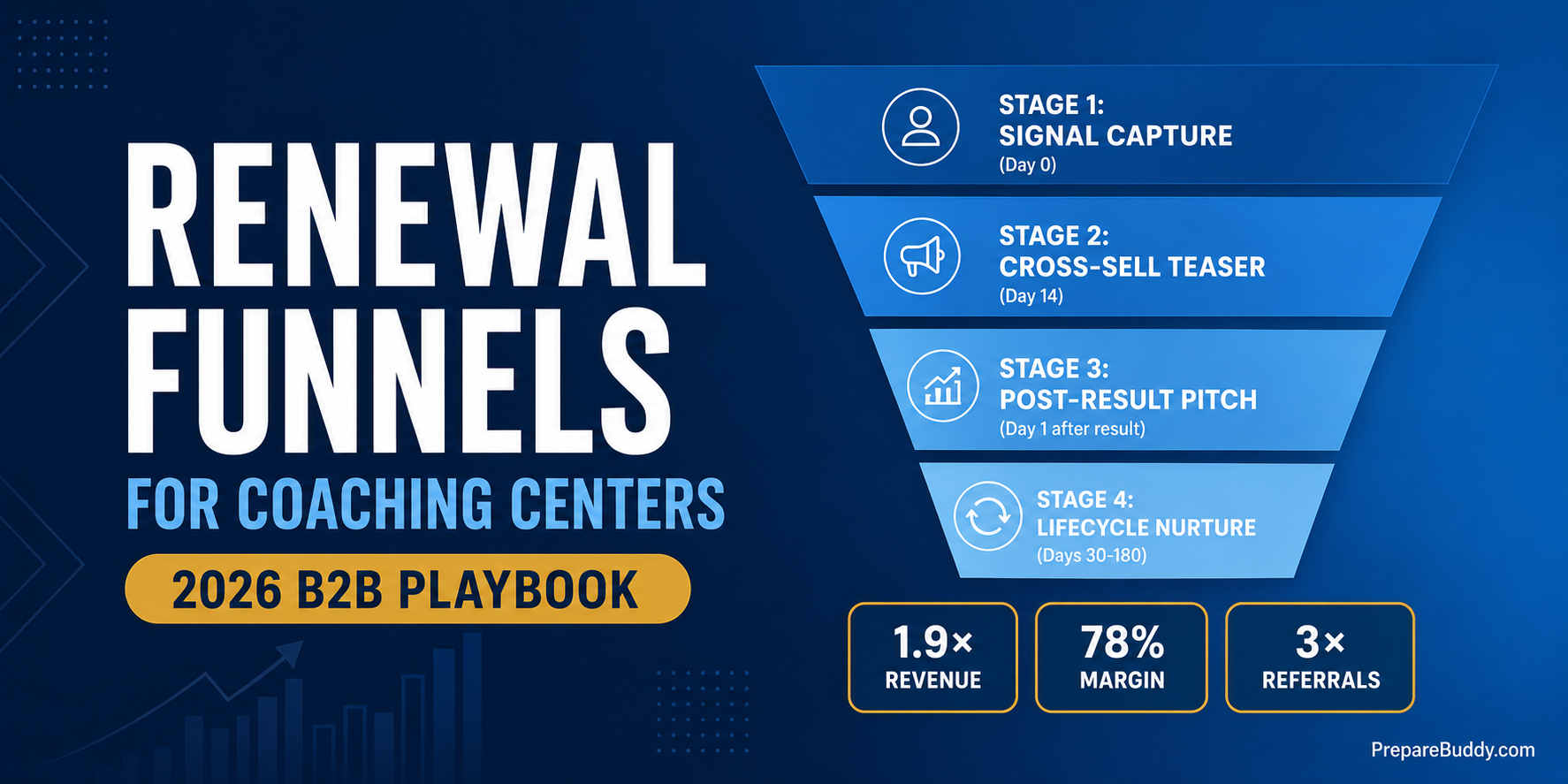
A renewal funnel is not a "reactivation email" — it is a structured workflow triggered by signals from the student's first test journey, with branching paths based on score outcome and study-abroad goal. Here is the four-stage version we recommend for coaching centers running on PrepareBuddy's white-label platform.
Stage 1: Signal capture (Day 0 — first enrolment)
At first enrolment, capture three signals beyond the obvious test name:
- Target country / region: Determines the second-test recommendation. Canada-bound IELTS students are almost certain CELPIP or PTE Core renewal candidates. Australia-bound IELTS students are PTE Academic candidates.
- Score timeline urgency: "Apply within 3 months" vs. "Long-term goal." Urgent students renew faster but for fewer tests; long-term students renew across more tests over time.
- Professional context: Healthcare worker → OET candidate. Tech professional → likely needs general English + may add GRE. Capturing this in the intake form costs zero and unlocks every later recommendation.
These three signals feed into the AI University Recommendations engine, which then surfaces the natural next test based on the student's actual application path — not a generic "you might also like" suggestion.
Stage 2: Mid-prep cross-sell teaser (Day 14)
Two weeks into the first test prep, the student is invested but not yet at peak stress. This is the optimal moment for a low-friction cross-sell teaser — typically a free diagnostic test in the adjacent test type. Three principles:
- Frame it as "complementary practice" — speaking practice in PTE while studying for IELTS strengthens IELTS speaking, and creates a baseline if they ever need PTE.
- Make it free, ungated. No upsell language in the diagnostic itself.
- The platform then reports the diagnostic score back to the counsellor dashboard automatically, flagging students who scored above 50% in the adjacent test as high-probability renewal candidates.
Stage 3: Post-result recommendation (Day 1 after result)
The most predictable conversion window in test prep is the 72 hours after a student receives their score. Two scenarios drive renewal:
| Scenario | Renewal pitch | Typical conversion rate |
|---|---|---|
| Score met goal — student is moving to application stage | "You need GRE for graduate school" / "You need OET because your target hospital requires healthcare-specific English" | 28–35% |
| Score missed goal — student is reassessing | "PTE Academic is accepted for the same universities — many students who don't hit IELTS 7 hit PTE 65 within 4 weeks" | 22–30% |
| Score met goal — but student is uncertain about timing | "Lock in your university recommendations and counsellor consultation while your score is fresh" | 15–22% (services, not new test) |
The right pitch depends on which scenario the student is in. AI-driven counsellor dashboards segment this automatically based on the student's score versus their stated target and timeline. Manual segmentation works too — but the consistency drops sharply past 100 students.
Stage 4: Lifecycle nurture (Days 30–180)
Students who don't renew immediately after their result are not lost — they are dormant. A monthly value-add touchpoint (test format updates, score validity reminders, university deadline alerts tailored to their target country) keeps the center top-of-mind. When the student does decide to take their next test, the decision is "I'll go back to my IELTS coaching" — not "Where do I start?"
The key metric here is not open rate or click rate. It is re-enrolment within 9 months, which for healthy coaching centers should sit above 18%.
What this looks like in practice — a 100-student cohort
| Stage | Students reached | Conversion rate | Renewal revenue |
|---|---|---|---|
| Stage 2 diagnostic taken | 100 | 62% (typical engagement) | — |
| Stage 3 post-result pitch (immediate) | 62 | 26% (blended across scenarios) | 16 × ₹12,500 = ₹2,00,000 |
| Stage 4 dormant re-enrolment (within 9 months) | 46 remaining | 19% (lifecycle nurture) | 9 × ₹12,500 = ₹1,12,500 |
| Total renewal revenue per 100 students | ₹3,12,500 |
That's ₹3.13 lakh of renewal revenue per 100 first-test students — at ~78% margin and effectively zero paid acquisition cost. For a coaching center running 1,000 students/year, the same funnel adds roughly ₹31.25 lakh of high-margin revenue. The investment to deploy it: counsellor training, a clean intake form, and a platform that supports multi-test enrolment under one student record.
The platform requirements that make this work
A renewal funnel built on top of single-test platforms (Magoosh for GRE, APEUni for PTE, BestMyTest for TOEFL) breaks because each platform owns a different sliver of the student record. Multi-test prep platforms let you keep one student profile, one counsellor relationship, and one billing entity across every test the student takes.
Specifically, here is what your platform must support to run this funnel cleanly:
- Multi-test enrolment in one student record: So a counsellor can see "she took IELTS in March, scored 6.5, started PTE diagnostic in May" without flipping between tools.
- Built-in diagnostic tests across test types: No paid-ad funnel needed — Stage 2 happens inside the platform. PrepareBuddy supports diagnostics across all 11+ supported test types.
- Counsellor dashboard with score-versus-goal segmentation: So Stage 3 pitches are pre-sorted, not manually triaged.
- White-label branding: The student must experience this as "my coaching center's product," not "my coaching center pointed me to an external tool." PrepareBuddy's white-label deployment lives at your domain with your branding in 24–48 hours.
- Multi-currency, multi-test billing: Renewal revenue lands in your billing engine alongside first-test revenue. Critical for centers operating across the Middle East, Australia, and South Asia.
How to deploy in the next 30 days
| Week | Action | Owner |
|---|---|---|
| Week 1 | Add 3 new fields to intake form: target country, score timeline, professional context | Operations lead |
| Week 2 | Brief counsellors on the 4-stage funnel; define Stage 3 pitch scripts for top 3 scenarios at your center | Academic head + counsellors |
| Week 3 | Schedule Stage 2 diagnostic delivery for current Day-14 cohort; instrument counsellor dashboard tagging | Platform admin |
| Week 4 | Launch Stage 4 monthly lifecycle email to all students past their test date in the last 9 months | Operations lead |
Why this beats discount-driven renewal
The most common renewal play at coaching centers — "20% off your second test prep" — actively hurts margins and trains students to wait for discounts. The four-stage funnel above generates higher renewal rates without giving anything up on price, because the student is converting on relevance and timing, not on price. Centers that run this for two quarters typically discontinue their discount-based renewal offers entirely.
Frequently asked questions
What's a realistic multi-test student percentage to target?
Best-in-class multi-test coaching centers hit 28–32% multi-test students within 12 months of deploying a renewal funnel. The industry average is 8–11% without one. Pick a 20% target for year one if you're starting from baseline.
How long before this funnel becomes profitable?
Stage 3 (post-result pitches) starts converting in week 1 of deployment because it acts on students already in the pipeline. Stage 4 (lifecycle nurture) takes 9 months to fully cycle. Most centers see positive ROI in month 2, full payback in month 4.
Doesn't pushing cross-sell feel like spam to students?
Only if the recommendations are generic. Stage 1 signal capture is what prevents this — a Canada-bound IELTS 6.5 student getting a CELPIP recommendation experiences it as helpful guidance, not spam. A Canada-bound IELTS 6.5 student getting a GMAT recommendation experiences it as spam. The difference is whether you captured the signal.
Can a center without a multi-test platform run this funnel?
You can run Stage 1 and Stage 3 manually if you have under 200 students. Past that, the data fragmentation across single-test platforms kills the counsellor's ability to act fast enough. A consolidated multi-test platform like PrepareBuddy becomes a prerequisite for scale.
What if a student takes a competitor platform between their first and second test with us?
You lose the renewal. The window between the first test result and the second test decision is short (typically under 60 days). If your funnel isn't active in that window, the student is researching alternatives on Google and reading your competitors' comparison posts. Stage 3 (post-result pitch) within 72 hours is the single most defensible competitive moat in coaching center economics.
Start running renewal funnels at your center
If you operate a coaching center and want to see what a 4-stage renewal funnel looks like inside the PrepareBuddy white-label platform, schedule a demo. We'll walk through the counsellor dashboard, the multi-test student record, and the diagnostic delivery workflow with sample data from your test mix. First month is free, no contract lock-in. Or check our pricing to size the deployment for your student volume.


Join the Discussion