

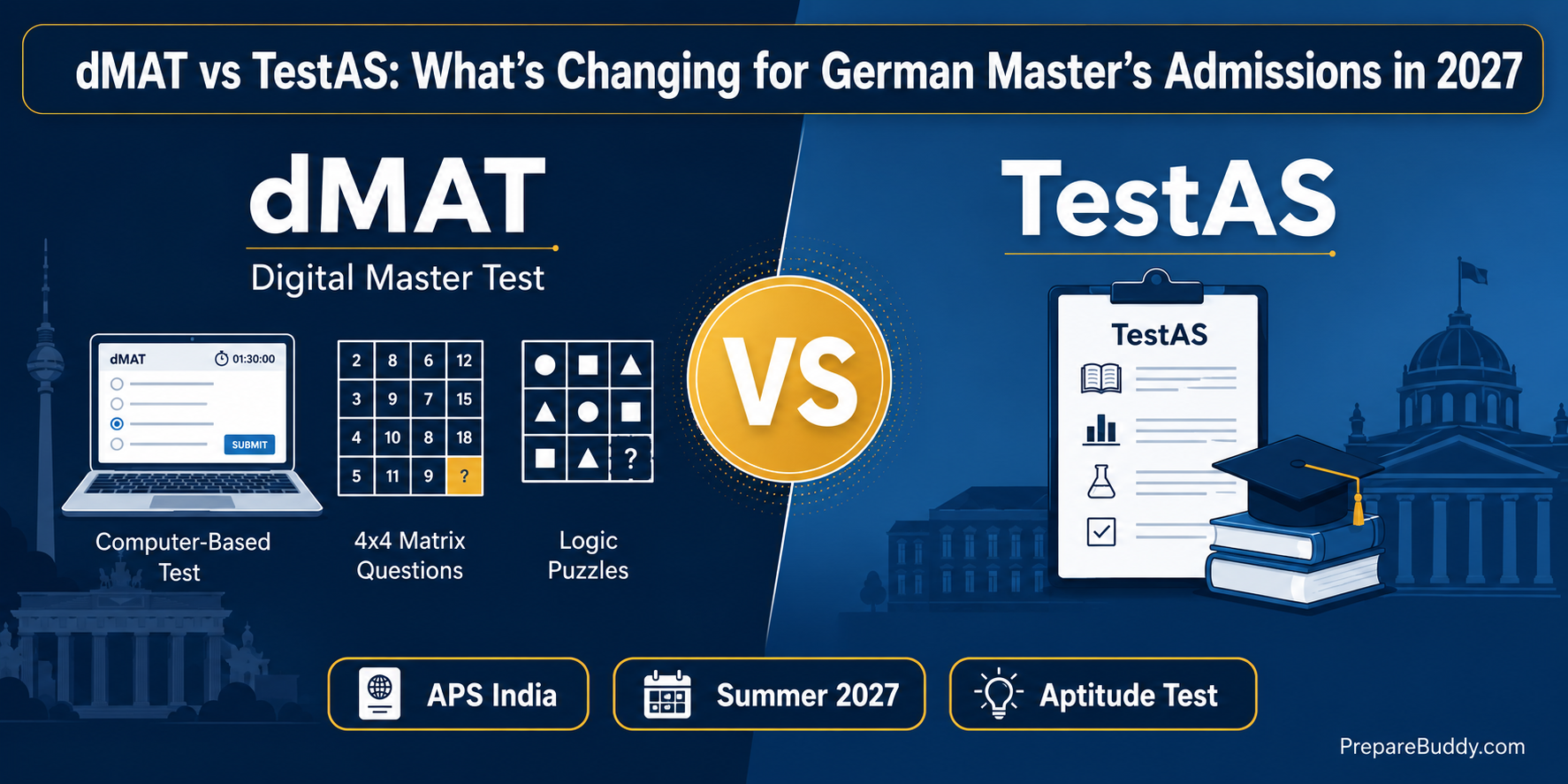
If you have read that the dMAT is "replacing" TestAS, start here: it isn't. That single sentence is the most common misconception circulating about German Master's admissions in 2027, and getting it wrong can cost you weeks of misdirected preparation. The Digital Master Test (dMAT) is a new, additional aptitude test for selected Master's applicants — not a swap-in for TestAS, and not a replacement for your APS certificate. This guide breaks down dMAT vs TestAS plainly: what each test is, what genuinely changes from the Summer Semester 2027 intake, and what stays exactly the same.
dMAT vs TestAS: the one-line difference
Both tests are built by g.a.s.t. (the same organisation behind TestAS and TestDaF), but they serve different applicants at different stages. TestAS has long been an aptitude test associated with undergraduate (Bachelor's) applicants. The dMAT is a digital aptitude test for Master's applicants, and from the Summer Semester 2027 intake it becomes part of the APS India documentation process for Indian graduates in specific disciplines. Taking the dMAT does not exempt you from TestAS if a particular university still asks for it, and it does not replace the APS certificate itself.
Side-by-side comparison
| Feature | dMAT (Digital Master Test) | TestAS |
|---|---|---|
| Level it serves | Master's applicants | Associated with Bachelor's / undergraduate applicants |
| Administered by | g.a.s.t. | g.a.s.t. |
| Format | Fully digital | Standardised aptitude test |
| What it measures | General study aptitude + subject aptitude | General and subject-specific academic aptitude |
| India / APS relevance | Part of APS India documentation from Summer Semester 2027 (selected fields) | Not part of the APS India requirement; required only where a university asks for it |
| Who must take it (India) | Bachelor's in Engineering, Business, Commerce, Finance, Economics or Management | Depends on the individual university's admission rules |
| Replaces APS certificate? | No — additional to APS | No |
| Replaces the other test? | No — separate from TestAS | No — separate from dMAT |
| Stakes | Aptitude score; a low score does not fail your APS | Used by universities as part of selection where required |
| When it applies | Summer Semester 2027 intake and thereafter | Unchanged and still available |
What is actually changing in 2027
The concrete change is narrow and specific. For the Summer Semester 2027 intake and later, Indian graduates applying to a German Master's through APS India whose Bachelor's is in Engineering, Business, Commerce, Finance, Economics or Management will normally sit the dMAT with the General Academic Module as part of their APS documentation. In other words, for these applicants the dMAT becomes a step in the APS process that did not exist before. Because it is an aptitude test, a weaker score does not, on its own, fail your APS documentation — but you will still want to walk in prepared, because universities can consider it during selection.
What is NOT changing
Three things stay exactly as they were, and they are the parts most people get wrong:
- TestAS is not discontinued. If your target university requires TestAS, that requirement stands independently of the dMAT.
- The APS certificate still exists. The dMAT is an additional requirement layered onto APS — it does not replace the certificate or the document verification process.
- They are two separate tests. Sitting the dMAT does not cover a TestAS requirement, and vice versa. Different purpose, different audience, same testing body.
Inside the dMAT: format at a glance
The dMAT is organised around a Core Module that measures general study aptitude through three subtests, plus a General Academic Module. Programme-specific routes add a discipline module — but even then, the Core Module accounts for roughly three-quarters of that exam, so mastering the Core sections is the highest-leverage thing you can do.
| Section | What it looks like | Tasks / Time |
|---|---|---|
| Figure Sequences | 4×4 matrix pattern questions (rotation, colour cycles, border circulation) | 20 tasks / 25 min |
| Mathematical Equations | Integers 1–20, numeric-entry answers via an on-screen virtual keyboard | 20 tasks / 25 min |
| Latin Squares | 5×5 logic grids using letters A–E | 20 tasks / 25 min |
| General Academic Module | Broader academic reasoning (format estimated; confirm with official sources) | ~90 min |
End to end, a full sitting runs to roughly 165 minutes and around 80 questions. Because the test is digital and pattern-heavy, familiarity with the interface — especially the numeric-entry keyboard and the matrix grids — matters almost as much as the underlying reasoning. For exact registration windows, fees and test dates, always confirm directly with g.a.s.t. and APS India, since those details are set officially and can change.
Which test should you focus on?
Use this quick decision guide:
- Applying for a Master's via APS India in a listed field (Engineering, Business, Commerce, Finance, Economics, Management) for Summer 2027 or later? Plan for the dMAT as part of your APS documentation.
- Does a specific university on your list ask for TestAS? Then you prepare for TestAS too — independently of the dMAT.
- Applying for a Bachelor's? The dMAT is not aimed at you; check whether TestAS is required by your programme.
How to prepare for the dMAT with PrepareBuddy
Because the dMAT rewards pattern recognition under time pressure, the most effective preparation is repeated, timed practice on realistic questions with instant feedback — not passive reading. PrepareBuddy's adaptive testing engine adjusts question difficulty to your performance in real time, so you spend your practice minutes where they actually move the needle. You can start with a free practice test to benchmark where you stand, and use the platform's AI scoring to see exactly which pattern types (figure sequences, equations, logic grids) are costing you points.
Students applying to Germany also use PrepareBuddy's university recommendations to build a realistic Reach / Target / Safety list, and study-abroad counsellors run the whole applicant pipeline through the Student Journey system. Explore the full language and aptitude test system to see what is included.
Frequently asked questions
Is the dMAT replacing TestAS?
No. The dMAT is a separate, additional test for Master's applicants. TestAS continues to exist and is required only where a university asks for it.
Do I still need TestAS if I take the dMAT?
Only if a university on your list requires TestAS. The two tests are independent — one does not cover the other.
Does the dMAT replace the APS certificate?
No. From Summer Semester 2027 the dMAT becomes part of the APS India documentation for selected fields, but it is additional to the APS certificate, not a substitute for it.
Is the dMAT mandatory for all Master's applicants?
For India, it applies to APS applicants with a Bachelor's in Engineering, Business, Commerce, Finance, Economics or Management from the Summer Semester 2027 intake. Requirements can vary, so confirm your specific case with APS India.
Will a low dMAT score fail my application?
The dMAT is an aptitude test, and a low score does not by itself fail your APS documentation. However, universities may still consider it during selection, so preparation is worthwhile.
Get dMAT-ready
The fastest way to know where you stand is to sit a timed practice test today. Try a free practice test to benchmark your figure-sequence, equation and logic-grid skills, or create your free account — the first month is free, no credit card required. Questions about preparing a batch of students? Talk to our team.


Join the Discussion