

Reaching German B2 turns a single line of your Opportunity Card application into three points — half of everything you need to qualify. German A1 only gets you through the door. The level above it is what actually wins the card. If you are weighing German for Germany's Opportunity Card (Chancenkarte) and wondering which CEFR level you really need, this guide breaks down the points, the math, and how to practise your way to the level that matters.
What the Opportunity Card (Chancenkarte) Actually Rewards
The Chancenkarte is a points-based residence permit that lets qualified non-EU skilled workers move to Germany for up to one year to look for a job — without a job offer already in hand. There are two ways in:
- Full recognition route: if your foreign qualification is already fully recognised in Germany (or you are licensed to practise a regulated profession), you are eligible directly — no points needed.
- Points route: if your qualification is only partially recognised, you qualify by scoring a minimum of 6 points across six categories.
Either way, you must clear three basic requirements first: a qualification of at least two years of vocational training (or a recognised university degree), proof you can support yourself (around €1,091 per month, roughly €13,092 for 2026), and a baseline language level — German A1 or English B2. That language baseline is a gate, not a score. The points only start once your German climbs above it.
The German CEFR Points Table: Which German Level Earns What
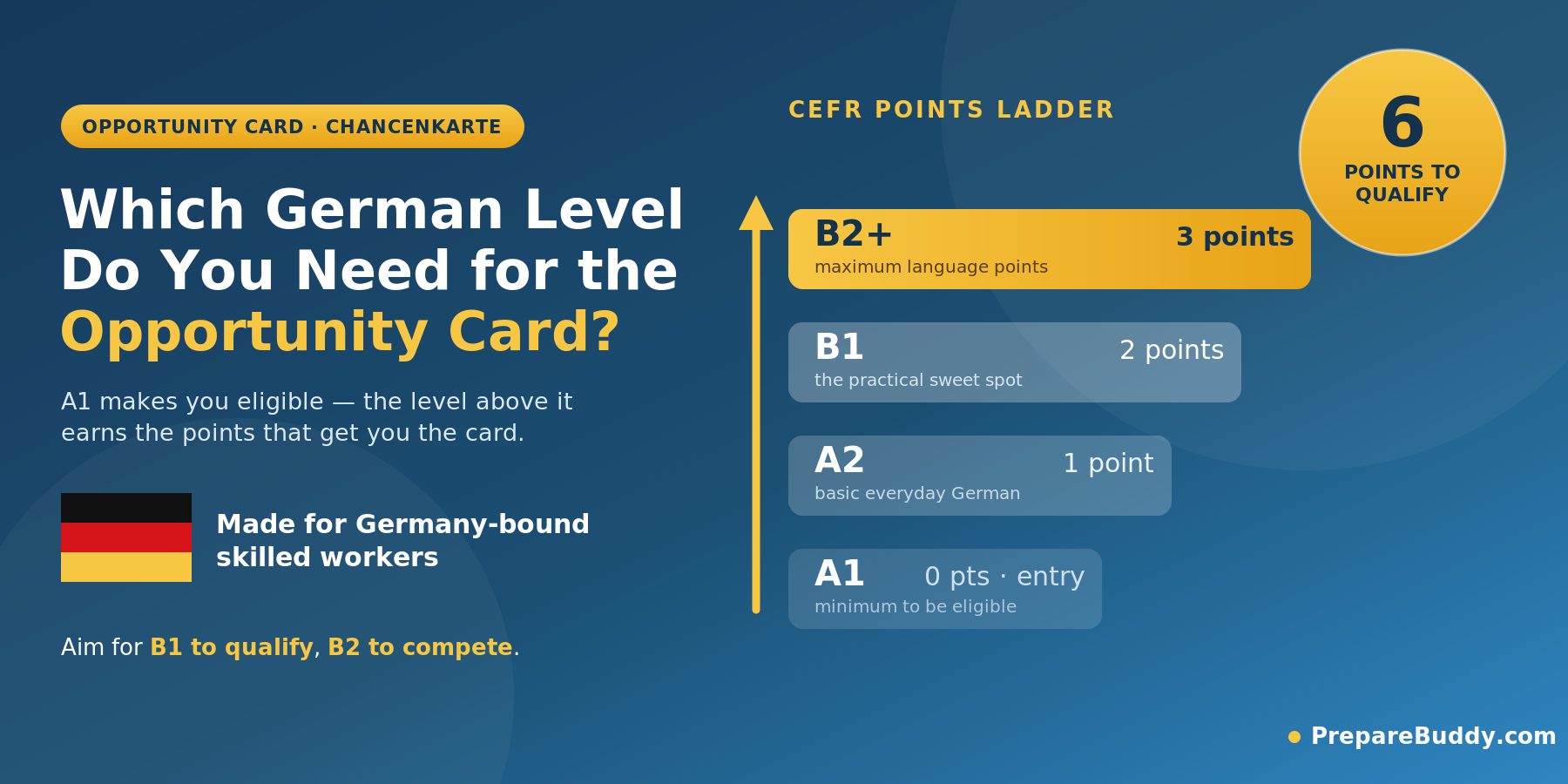
This is the part most applicants get wrong. A1 makes you eligible, but earns zero points. Every CEFR level above A1 adds to your score — and English can stack on top:
| Your German (CEFR) | Points toward the Chancenkarte | What it means |
|---|---|---|
| A1 | 0 (entry threshold only) | Meets the basic language requirement; scores nothing |
| A2 | 1 | First scoring level — basic everyday German |
| B1 | 2 | The practical sweet spot for most applicants |
| B2 or higher | 3 | Maximum language points; opens far more jobs |
| English C1 or higher | +1 (stacks on top of German) | An extra point if your English is strong |
Read that bottom row carefully: a candidate with German B1 (2) plus English C1 (1) walks in with 3 language points before any other category is counted. Language is the single most controllable lever on the whole sheet — you cannot change your age, but you can study your way from A2 to B1.
How Many Points Do You Actually Need?
You need 6 points. Here is the full scoring grid so you can see exactly where German fits among the other categories:
| Category | Points |
|---|---|
| Qualification: partial recognition, or licence to practise a regulated profession | 4 |
| Qualification in a recognised shortage occupation (Engpassberuf) | 1 |
| Work experience: at least 2 years in the last 5 | 2 |
| Work experience: at least 3 years in the last 7 | 3 |
| German A2 / B1 / B2+ | 1 / 2 / 3 |
| English C1 or higher | 1 |
| Age: 35 or under / 40 or under | 2 / 1 |
| Previous legal stay in Germany of at least 6 months | 1 |
| Applying together with a spouse or partner who also qualifies | 1 |
Now watch how German becomes the deciding factor in real profiles:
- Profile A — the near-miss. A 31-year-old nurse with 2 years of experience scores 2 (experience) + 2 (age, under 35) = 4 points. Stuck. Add German B1 and they jump to 6 and qualify. German is the whole difference.
- Profile B — the buffer. An IT specialist in a shortage occupation (1) with 3 years of experience (3) and age 34 (2) already has 6. But pushing German to B2 (3) gives a safety margin and, more importantly, makes them actually employable once they land.
- Profile C — the over-40 applicant. Age now earns 0–1, so language has to carry more weight. German B2 (3) + English C1 (1) delivers 4 language points on its own — often the bulk of the score.
Which CEFR Level Should You Target?
Points are only half the story. The level you pick also decides whether you can actually find work after you arrive:
- A1 — the minimum to be eligible. Be honest with yourself: jobs open to A1-only candidates are scarce, and you score nothing.
- A2 — 1 point and basic survival German. A start, rarely enough on its own.
- B1 — 2 points and the most common target. Enough to handle daily life and many workplace conversations; frequently the level that tips an applicant over 6.
- B2 — 3 points (the maximum) and the level that unlocks professional and regulated roles. For most serious applicants, B2 is the best return on effort on the entire points sheet.
The pattern is clear: aim for B1 to clear the threshold, and B2 to be genuinely competitive in the German job market.
How to Practise German to Each CEFR Level with AI
The hard part isn't knowing you need B1 or B2 — it's getting there efficiently, and proving it. PrepareBuddy's Adaptive Language Proficiency system tests and trains German across all four skills (reading, listening, speaking, and writing) on the same CEFR A1–C2 framework the Chancenkarte uses — German is one of 11 languages on the platform. Every result comes back as a per-skill CEFR breakdown, so you might see Reading B1, Listening B1, but Speaking A2 — and know exactly where to focus.
Three steps map cleanly onto the Opportunity Card journey:
- Find your real level. A free AI CEFR diagnostic places you in 10–20 minutes and returns an A1–C2 level for each skill — no guessing whether you're "around B1."
- Fix speaking first. Speaking is the skill you can't drill from a textbook, and it's exactly what employers test in interviews. PrepareBuddy's Voice AI holds a live German conversation with you, adapts to your level in real time, and scores fluency, vocabulary, grammar, and comprehension against CEFR — with 48-emotion detection that even reads the nerves most candidates carry into a real interview.
- Build to your target. Adaptive practice across 18 question types keeps difficulty calibrated to your current CEFR level, nudging you from A2 toward B1, then B1 toward B2, with native-quality audio throughout.
You can start with a free German practice test — first month free, no credit card — and see your CEFR level today.
Frequently Asked Questions
What German level do I need for Germany's Opportunity Card?
German A1 is the minimum to be eligible (you can also use English B2 as the language baseline). To score points, you need A2 (1 point), B1 (2 points), or B2 and above (3 points). You must reach 6 points in total to qualify through the points route.
Is B1 German enough for the Chancenkarte?
B1 German is worth 2 points. Whether that's "enough" depends on your other categories — experience, age, qualification, and English. Many applicants reach the 6-point threshold with B1 plus work experience and an age bonus. If you're short, moving from B1 to B2 adds a third point and widens your job options.
Can I qualify with English instead of German?
The basic language requirement can be met with English at B2. English C1 or higher also adds 1 point. But German earns far more — up to 3 points — and it's what actually helps you find and hold a job once you're in Germany. Strong German is the better long-term investment.
How do I check my current German level for free?
Take a free AI CEFR diagnostic. PrepareBuddy's 10–20 minute placement test assesses reading, listening, speaking, and writing in German and returns your level on the A1–C2 scale for each skill, so you know precisely where you stand before you build your study plan.
How long is the Opportunity Card valid?
The Chancenkarte is issued for up to one year to search for skilled employment in Germany. If you find qualifying work, you can switch to a work-based residence permit. Always confirm the latest rules with the official German authorities before you apply.
This article explains the Opportunity Card (Chancenkarte) points system as a general guide and is not immigration advice. Eligibility rules and thresholds can change — verify current requirements with official German government sources before applying.
Ready to see your German CEFR level? Take a free German practice test and find out exactly which level you're at — and how far you are from the points you need.


Join the Discussion