

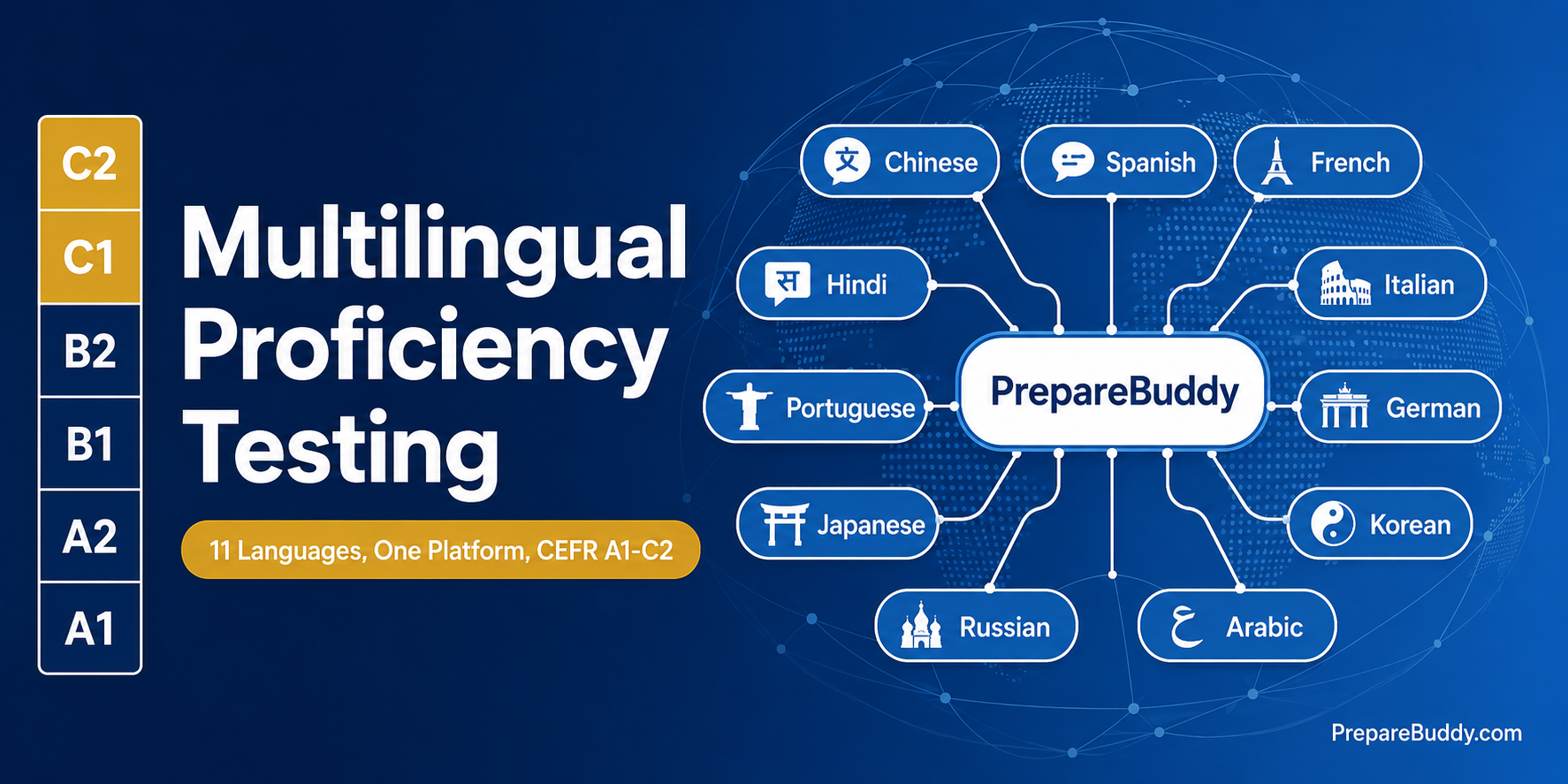
Three students walk into your institute in the same month. One needs certified Japanese for a Tokyo transfer, one needs French for a Canadian PR application, and one needs Spanish for a semester in Madrid. Can your platform place all three at the right CEFR level today — testing reading, listening, speaking and writing, under your own brand? For most test-prep providers the honest answer is no. Multilingual proficiency testing is where English-only platforms hit a wall, and it is exactly where institutes lose high-value students to someone else.
PrepareBuddy's Adaptive Language module closes that gap. The same assessment framework runs across 11 languages, every result mapped to the internationally recognised CEFR scale from A1 to C2. This guide covers what multilingual testing actually demands, how one platform delivers it end to end, and what it means for your revenue, your grading hours, and your students' outcomes.
Why most "language testing software" stops at English
The assessment market is overwhelmingly English-focused. A student preparing for a French, Mandarin or Arabic proficiency exam has very few AI-powered options with authentic audio and genuine speaking assessment. So institutes bolt together a different tool for each language — separate question banks, incompatible scoring scales, no shared reporting. That patchwork creates administrative overhead, inconsistent student experiences, and a platform that feels like a reseller's storefront rather than your own.
The fix is not "more content." It is one framework that treats language as a setting, not a separate product. That is the architectural decision behind PrepareBuddy's Adaptive Language testing.
11 languages, one framework
Rather than a different engine per language, PrepareBuddy runs a single system — 18 purpose-built question types across four skills, one CEFR scoring model — and swaps the target language. Same questions, same scoring, same CEFR mapping, in any of these 11 languages:
| Language | Code | Script | Audio |
|---|---|---|---|
| Chinese (Mandarin) | zh | Simplified Han | Named voices |
| Spanish | es | Latin | Named voices |
| French | fr | Latin | Named voices |
| Hindi | hi | Devanagari | Named voices |
| Italian | it | Latin | Named voices |
| Portuguese | pt | Latin | Named voices |
| German | de | Latin | Multilingual AI |
| Japanese | ja | CJK | Multilingual AI |
| Korean | ko | Hangul | Multilingual AI |
| Russian | ru | Cyrillic | Multilingual AI |
| Arabic | ar | Arabic (RTL) | Multilingual AI |
Every language tests all four skills — Reading (7 question types), Listening (2), Speaking (6) and Writing (3). Crucially, the entire test interface is localised into the target language, not just the passages: instructions, question-type labels, on-screen buttons, recording prompts and confirmation dialogs all render in the language being tested, including full right-to-left layout for Arabic. That removes the jarring "English instructions on a German test" experience that undermines credibility on gamified apps.
Multilingual proficiency testing that detects the level, not just measures it
A universal scale is what makes results portable. PrepareBuddy maps every performance to CEFR, so a B2 in Spanish means the same thing to a university, an employer or an immigration officer as a B2 in Portuguese:
| CEFR level | Score (0–100) | What it signals |
|---|---|---|
| C2 | 85–100 | Mastery |
| C1 | 68–84 | Advanced |
| B2 | 51–67 | Upper intermediate |
| B1 | 34–50 | Intermediate |
| A2 | 17–33 | Elementary |
| A1 | 0–16 | Beginner |
The platform runs in two modes. In targeted mode you pick a level and measure a cohort against it. In placement mode you pick nothing: the test spans all six bands (roughly nine items per band, around 54 in total) and the learner's level is detected from performance across the whole range — not measured against a level someone guessed up front. Scoring is full-denominator, like the Duolingo English Test it mirrors: unanswered questions count as zero, so a half-finished test cannot place high. A 10–20 minute diagnostic is enough to stream new enrolments into the right class on day one, with a comprehension-by-band breakdown for the counsellor.
Live speaking practice in every language
Written items cannot measure conversational ability, so PrepareBuddy adds real-time Voice AI conversation practice in all 11 languages. The AI greets the student in the target language, holds a natural ~10-minute conversation, adapts its vocabulary to the learner's level, and returns a CEFR-aligned report scoring Fluency, Vocabulary, Grammar and Comprehension — alongside 48-emotion detection and a full annotated transcript. Instead of record-and-submit, students get a conversation partner that is available around the clock.
The business case for institutes
Multilingual coverage is the hook; the operating model is what protects your margin. On the white-label platform, students see your logo, colours and domain across 30+ branding fields — never PrepareBuddy's. A 120-billion-parameter AI model generates unlimited, authentic, CEFR-calibrated tests on demand, so you are not funding a separate content team for every language. Built-in billing supports 10 currencies, student lifecycle management automates enrolment through offboarding, and psychometric assessments add a high-margin career-guidance upsell for study-abroad students.
| Business outcome | PrepareBuddy |
|---|---|
| Deployment time | 24–48 hours |
| Time saved on grading | 75% |
| Return on investment | 300% within 18 months |
| Satisfaction rate | 95% |
| Institutions on the platform | 200+ |
| Students prepared | 50,000+ |
How to get started
Launching multilingual testing under your brand is a short project, not a build:
- Book a demo. Tell us the languages and CEFR levels your students need, and we map them to the platform — schedule a demo.
- Brand it. Add your logo, colours and domain; the white-label environment deploys in 24–48 hours.
- Stock your tests. Use ready CEFR test pools or the custom test builder — choose sections, topic, level and language — to spin up a branded test in minutes.
- Stream and scale. Place new students with a 10–20 minute diagnostic, then let automated lifecycle management handle enrolment, access and renewals.
Frequently asked questions
How many languages does PrepareBuddy support for proficiency testing?
Eleven: Chinese, Spanish, French, Hindi, Italian, Portuguese, German, Japanese, Korean, Russian and Arabic — all scored on the CEFR A1–C2 scale using the same framework.
Is the platform genuinely white-label?
Yes. Students interact entirely with your brand across 30+ configurable fields — logo, colours, domain, emails and more. No "powered by" branding is visible to end users.
Can it assess speaking, or only reading and writing?
All four skills. Beyond written items, live Voice AI conversation practice is available in every one of the 11 languages, with CEFR-aligned scoring and 48-emotion detection.
How quickly can we launch?
Deployment takes 24–48 hours once your branding and language mix are confirmed.
Do we have to create our own content?
No. The AI content engine generates unlimited, authentic, CEFR-calibrated tests on demand, and you can also build custom branded tests yourself by picking sections, topic, level and language.
Test the platform yourself
See multilingual, CEFR-aligned assessment in action: try a free test, or book a demo to plan your white-label rollout. Questions? Email contact@preparebuddy.com.


Join the Discussion