

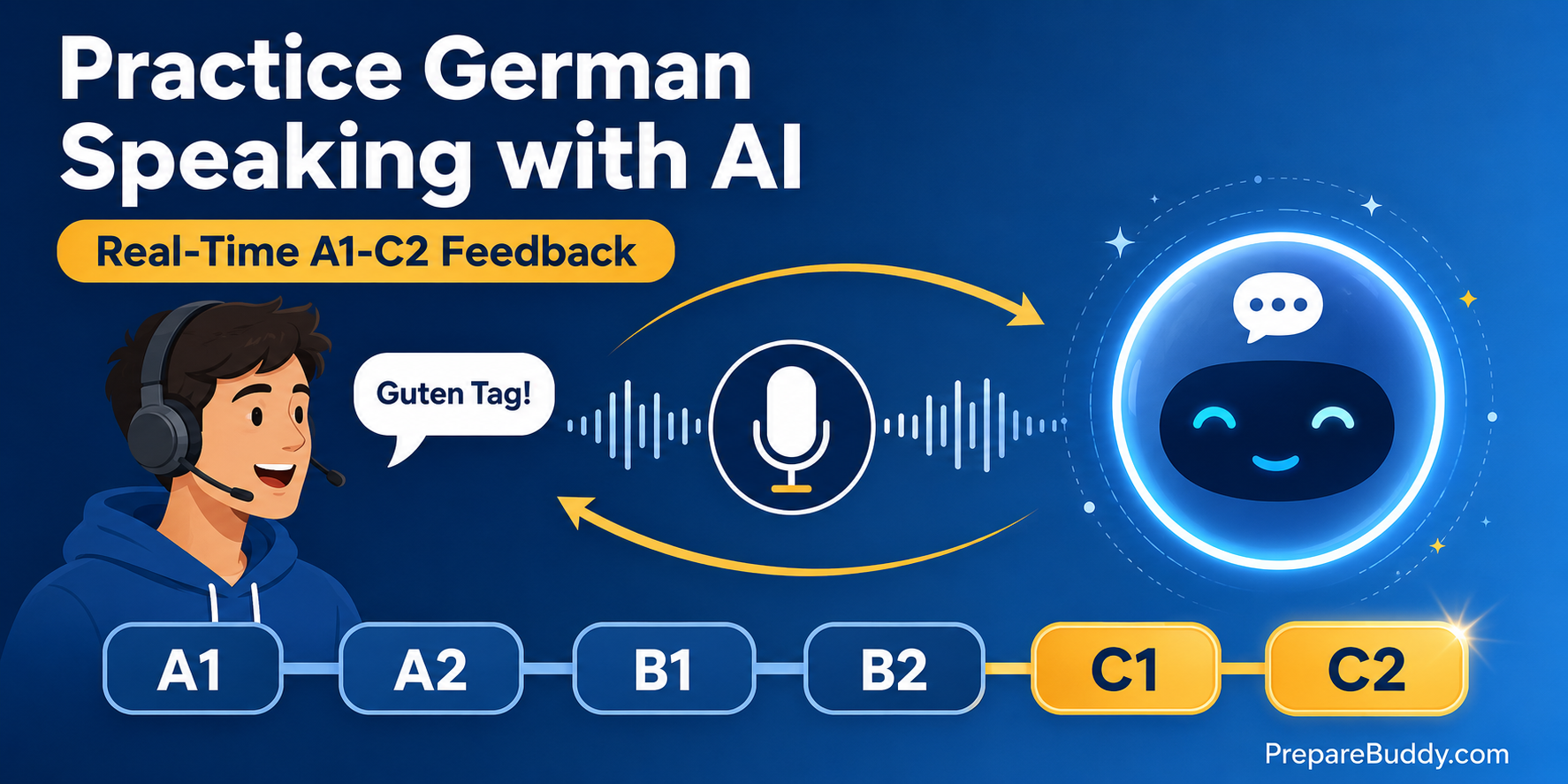
You can read German menus, follow along in class, and pass written quizzes — and then a real conversation starts and the words freeze. Speaking is the one German skill most learners practice the least, because it needs something the other three don't: a patient partner who is always available and willing to correct you without making it awkward. That gap is exactly what AI fills, and it's why more learners now practice German speaking with an AI conversation partner between classes.
This guide explains how real-time AI speaking practice works, what to focus on at each CEFR level from A1 to C2, how your German speaking is scored, and a simple weekly routine you can start today.
Why speaking is the hardest German skill to practice alone
Reading, listening, and writing are all things you can do by yourself. Speaking isn't. It needs a responsive partner who reacts to what you say, and that requirement quietly stalls most learners. Private tutors are effective but expensive and scheduled around someone else's calendar. Language-exchange partners are inconsistent, and half the session often drifts into English. The predictable result is the plateau every intermediate learner knows: you understand a great deal but can say very little under pressure.
AI speaking practice removes that friction. An AI partner is available at 2 a.m. or during a lunch break, never loses patience when you repeat a sentence five times, and adjusts instantly to your level. It won't replace real human conversation — but it gives you the reps you need so that when you do talk to a person, you're fluent instead of frozen.
How AI German speaking practice works
PrepareBuddy's Voice AI runs a real-time spoken conversation — you talk, it listens, and it replies out loud in natural German within seconds. It is not a record-and-submit exercise or a text chatbot; it's a live back-and-forth. Here is what happens in a typical session:
- It greets you in German and lets you pick the topic. The AI speaks entirely in German and holds a natural conversation about whatever you choose — your weekend, your job, travel plans, or a topic it suggests.
- It adapts to your level, A1 to C2. Beginners get simpler words and a slower pace; as you improve, the AI raises the vocabulary and tempo to keep you challenged.
- It corrects you without breaking the flow. When you make a mistake, the AI naturally rephrases it correctly in its reply, so you absorb the right form in context instead of being stopped and lectured.
- It keeps you talking. Follow-up questions push you past one-word answers into real production.
- It reads how you're doing. With 48-emotion detection, the AI notices hesitation or nervousness and softens its tone, so a stumble doesn't derail the session.
- Every session is saved. Conversations run about ten minutes, the full transcript is stored for review, and you get feedback at the end.
German is one of 11 languages supported by PrepareBuddy's Adaptive Language engine, all built on the same CEFR framework. New learners can start with free trial minutes — no credit card needed.
What to practice at each CEFR level (A1–C2)
Speaking goals change dramatically as you climb the CEFR ladder. Matching your practice to your level is the fastest way to improve. Use this as a target map for your AI conversations.
| CEFR Level | Where you are | What to practice speaking |
|---|---|---|
| A1 – Beginner | Familiar everyday expressions | Introduce yourself, order food, ask simple questions, exchange basic personal details |
| A2 – Elementary | Simple, routine tasks | Describe your day, family, and last weekend in short connected sentences |
| B1 – Intermediate | Most situations while travelling | Give opinions, tell a story, handle an unexpected turn in the conversation |
| B2 – Upper Intermediate | Fluent, spontaneous interaction | Argue a point, discuss abstract topics, self-correct mid-sentence |
| C1 – Advanced | Fluent and spontaneous | Handle nuanced discussion, idiomatic usage, and a professional register |
| C2 – Mastery | Understand virtually everything | Near-native precision, subtle humour, complex sustained argument |
Not sure where you stand? A quick free diagnostic detects your CEFR level across reading, listening, speaking, and writing before you start, so you practice at the right difficulty instead of guessing.
Six ways to structure your German speaking practice
Free conversation is the core, but variety builds different muscles. The Adaptive Language engine includes six speaking task types you can drill deliberately:
| Speaking task | What it builds |
|---|---|
| Read Aloud | Pronunciation and fluency from a set text |
| Listen and Speak | Responding to spoken German in real time |
| Speak About a Photo | Describing an image spontaneously, without a script |
| Read Then Speak | Turning what you've just read into spoken output |
| Interactive Speaking | Sustained, back-and-forth conversational production |
| Speaking Sample | An extended, uninterrupted monologue on a topic |
How your German speaking is scored
PrepareBuddy scores speaking on an internal 0–100 scale mapped to the CEFR standard, broken down across four dimensions: Fluency, Vocabulary, Grammar, and Comprehension. Because the result is a CEFR level rather than a proprietary number, it means the same thing to a university, an employer, or an immigration office anywhere in Europe.
| CEFR Level | Score range | What it means |
|---|---|---|
| C2 | 85–100 | Mastery — can understand virtually everything |
| C1 | 68–84 | Advanced — expresses ideas fluently and spontaneously |
| B2 | 51–67 | Upper Intermediate — interacts with fluency and spontaneity |
| B1 | 34–50 | Intermediate — handles most everyday situations |
| A2 | 17–33 | Elementary — communicates in simple, routine tasks |
| A1 | 0–16 | Beginner — uses familiar everyday expressions |
A simple weekly German speaking routine
Consistency beats intensity. This five-step routine takes under an hour a week and produces measurable progress:
- Find your level. Take the free diagnostic once to lock in your CEFR starting point.
- Talk three times a week. Do a 10-minute Voice AI conversation on a topic you actually care about — motivation matters more than the topic.
- Drill one task type weekly. Pick a structured task such as Speak About a Photo or Read Aloud to target a specific weakness.
- Review your transcript. Read back the saved conversation and mark the two or three errors you keep repeating.
- Re-record after two weeks. Speak on the same topic again and compare — hearing your own progress is the best motivator there is.
Not just German — 11 languages on one platform
The same AI speaking engine works across 11 languages, including German, French, Spanish, Italian, Portuguese, Hindi, Chinese, Japanese, Korean, Russian, and Arabic, all with CEFR-aligned scoring. For language schools and universities that test more than one language, that means a single language proficiency platform instead of a different tool for every language.
Frequently asked questions
Can I practice German speaking for free?
Yes. New learners get free trial minutes with no credit card required, so you can try a full AI conversation before deciding. Start with a free practice test.
Does the AI speak in German or English?
Entirely in German. It greets you in German and holds the whole conversation in German, adjusting its vocabulary and pace to your level so beginners aren't overwhelmed.
Which CEFR levels does it support?
All six, from A1 (beginner) through C2 (mastery). The AI adapts in real time, and scoring is mapped to the CEFR standard.
Is AI practice better than a language exchange?
They're complementary. A language exchange gives you cultural nuance and real human connection; AI practice gives you unlimited, patient, judgment-free reps that are available whenever you are. Most fast learners use both.
How is my German speaking scored?
On a CEFR-aligned scale across four dimensions — fluency, vocabulary, grammar, and comprehension — with a transcript and feedback saved after every session.
Practice German speaking today — start free
The only way to get fluent is to speak, and the fastest way to speak more is to remove the friction of finding a partner. Have your first real-time German conversation with AI in the next five minutes: try a free German speaking session or create your free account. Language schools that want to offer AI speaking practice to their students can reach the team at contact@preparebuddy.com.
Related reading: How to Practice and Test Your German Online (A1–C2) and CEFR Levels Explained.


Join the Discussion