

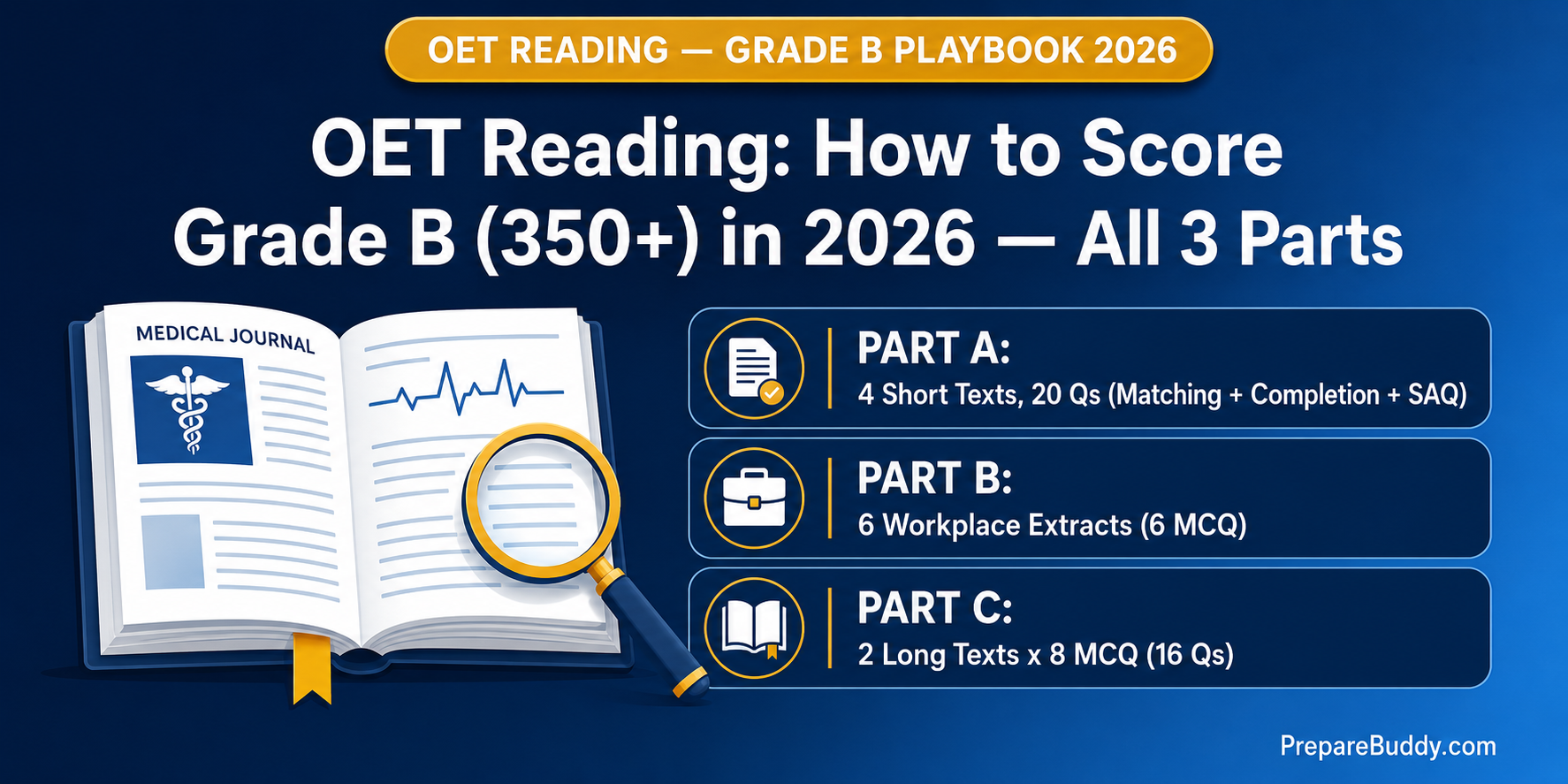
Fewer than 35% of healthcare candidates hit Grade B (350+) on OET Reading on their first sitting — not because the texts are hard, but because the section runs three completely different question formats back-to-back in 60 minutes. Miss the format shift, lose the band.
This guide breaks down the 2025-format OET Reading paper exactly as you’ll see it on test day, gives you a per-part strategy that has worked for nurses, doctors, dentists, and pharmacists targeting Australia, the UK, Ireland, New Zealand, and the US, and shows you how to drill the patterns with AI-graded practice that mirrors the real exam.
What Grade B (350+) Actually Requires on OET Reading
OET reports each sub-test on a 0–500 scale that maps to letter grades A–E. Grade B is the registration threshold for nursing and medical councils across all OET-accepting countries.
| Grade | Score Range | Roughly = IELTS | Typical Use Case |
|---|---|---|---|
| A | 450–500 | 8.0–9.0 | Top-tier academic / specialist roles |
| B | 350–440 | 7.0–7.5 | Nursing & medical registration (NMC, AHPRA, NMBI, MCNZ, ECFMG) |
| C+ | 300–340 | 6.5 | Some allied-health councils |
| C | 200–290 | 5.5–6.0 | Below registration threshold |
To clear 350, you typically need around 30 out of 42 questions correct with a balanced spread across the three parts. Missing one part badly — even if the other two are strong — is the most common reason candidates miss Grade B.
The 2025 OET Reading Paper at a Glance
| Part | Texts | Questions | Time | Format |
|---|---|---|---|---|
| Part A | 4 short texts on one theme | 20 | 15 min (strict) | Matching, sentence completion, short-answer (NOT MCQ) |
| Part B | 6 workplace extracts (policies, memos, manuals) | 6 | ~10 min | 1 MCQ per extract |
| Part C | 2 long texts (~800 words each) | 16 | ~35 min | 8 MCQs per text |
Total: 42 questions in 60 minutes. The clock on Part A is strict — you cannot carry time over into Part B or C.
Part A Strategy: Win the 15-Minute Sprint
Part A is the part most candidates underestimate. You get four short texts on a single clinical theme (e.g., wound care, diabetes management, post-operative recovery) and 20 questions that mix three sub-formats: “Which text mentions X?” matching, sentence-completion blanks, and short-answer fill-ins.
The 4-Minute-Per-Question Trap
15 minutes / 20 questions = 45 seconds per question. You cannot read all four texts cover-to-cover. The winning approach is question-first scanning:
- 0–60 seconds: Skim the four text headings only. Identify which text is the “background,” which is “treatment,” which is “guidelines,” which is “case study.”
- 60 seconds–5 min: Read each matching question, identify the keyword (a number, a drug name, a specific condition), then scan the most likely text first.
- 5–12 min: Sentence-completion blanks — these require exact-word answers from the text. Spelling counts. Plurals count.
- 12–15 min: Short-answer questions. Keep responses to 3 words max where possible — longer answers risk the “extra information” penalty.
Common Part A Killers
- Synonyms, not exact words: The question says “rapid heart rate” — the text says “tachycardia.” OET tests medical-synonym recognition heavily.
- Wrong text choice: The answer is in Text B, but the keyword appears once in Text A as a distractor. Always verify in the “treatment” or “guideline” text first when the question is about procedure.
- Misspelled clinical terms: Anti-coagulant vs anticoagulant, oedema vs edema. OET accepts both UK and US spellings but they must be internally consistent and correctly spelled.
Part B Strategy: 6 Workplace Extracts, 6 MCQs, 10 Minutes
Part B is short but tightly worded. Each extract is 100–150 words from a real workplace document — a policy update, a hand-over note, an equipment manual, an email from administration. Each has one MCQ with three options.
The MCQ usually tests one of three things: the main purpose of the document, a specific procedure mentioned, or what a particular phrase means in context. Distractors are almost always “true but irrelevant” statements pulled verbatim from the extract.
Tactical rule: Read the question stem before the extract. Then read the extract once, slowly. Then re-read the question with all three options. If two options sound plausible, the correct one is the one that captures the main point, not a secondary detail.
Part C Strategy: Two Long Texts, 16 MCQs, 35 Minutes
Part C is where Grade B is won or lost. Two ~800-word texts — one usually a clinical opinion piece, one a research summary or case report — with 8 MCQs each. Questions test inference, tone, the writer’s opinion, and the meaning of specific phrases (“In paragraph 4, the phrase ‘a paradigm shift’ suggests that…”).
The Paragraph-Anchor Method
Most Part C questions reference a specific paragraph or line range. Use it. Don’t re-read the whole text for each question.
- Spend 4–5 minutes reading the first text once, fast, with a single-line summary of each paragraph in your head.
- Answer all 8 questions, jumping back to the referenced paragraph only.
- For inference questions: the correct answer is always supported by the text but never copied word-for-word. If an option is a direct quote, it’s usually a distractor.
- Tone questions: the writer is rarely “dismissive” or “celebratory.” Most academic-medical writing is “cautiously optimistic,” “measured,” or “critical with reservations.” Match register, not extreme.
The 6-Week Grade B Practice Plan
| Week | Focus | Daily Practice |
|---|---|---|
| 1–2 | Part A speed drills + medical vocabulary | 2 timed Part A sets + 30 min synonym flashcards |
| 3 | Part B inference + Part C skim-read | 1 Part B set + 1 Part C text daily, untimed |
| 4 | Full Part C under timing | 2 Part C sets daily, 17 min each |
| 5 | Full 60-min mocks, 3 per week | Mock + 30 min targeted review of weakest part |
| 6 | Taper + diagnostic re-check | 1 mock every other day + final vocabulary review |
How AI Practice Closes the Feedback Gap
The hardest part of OET Reading prep is knowing why you got something wrong. Traditional books give you the answer key — not the reasoning. PrepareBuddy’s OET module generates unlimited mock papers in the real 2025 format (Listening 42 Qs, Reading 42 Qs, Writing letter task, Speaking with 2 role-plays) and walks you through every wrong answer with the exact line in the text that disproves your choice.
Each test rotates across 12 healthcare professions and 30 OET-specific themes — that’s 360 distinct profession-and-topic combinations before you ever see a repeat. The AI generates Part A passages with grounded answers (every gap is verifiable in the source text), Part B extracts pulled from real workplace document types, and Part C long-form pieces written at the same C1 register as the real exam. Difficulty tiers (Intermediate / Advanced / Expert) let you train one band above your target before test day so the real paper feels easier than your practice.
Three Things to Do This Week
- Take a free diagnostic to find your weakest part. Most candidates assume it’s Part C — it’s usually Part A speed. Get your baseline grade prediction here.
- Drill Part A under strict 15-minute timing. Don’t practise it untimed. Speed under pressure is the only thing that matters in Part A.
- Read one real medical journal article per day (BMJ, The Lancet, NEJM perspectives section). Part C texts are written in this register — train your brain to skim it efficiently.
Start Practising OET Reading Today
You don’t need to spend £500 on a coaching centre or wait six months. Try a free OET mock test with AI-graded scoring across all four sub-tests, or sign up for unlimited practice with the first month free, no credit card required. For coaching centres preparing batches of nursing and medical candidates, schedule a demo to see how PrepareBuddy’s white-label OET platform handles 100–1,000 students with profession-specific test rotation.
Grade B is not a talent question. It’s a format-recognition-and-timing question. Drill the patterns, master the per-part strategy, and 350+ becomes the floor — not the ceiling.


Join the Discussion