

Hand the same IELTS Task 2 essay to five teachers at the same coaching center and you will get five different band scores. One teacher rewards strong vocabulary; another deducts for one comma splice; a third lets through arguments that the fourth would mark down as off-topic. The student gets a number — but the number depends on which teacher opened the booklet that morning. Multiply that across 800 essays a month and you have a quality problem that no amount of teacher training fully fixes.
This is the exact gap RAG-Enhanced AI Grading was built to close. Instead of replacing your teachers, the platform learns from them — and then applies their grading logic to every submission, consistently, in minutes.
What "RAG-Enhanced AI Grading" Actually Means
Generic AI grading uses the same rubric on every coaching center on the planet. Submit an essay, the model reads it against a generic IELTS band descriptor, and returns a score. The output sounds fluent but it has no idea how your coaching center grades — and no idea why your top-band students sound the way they do.
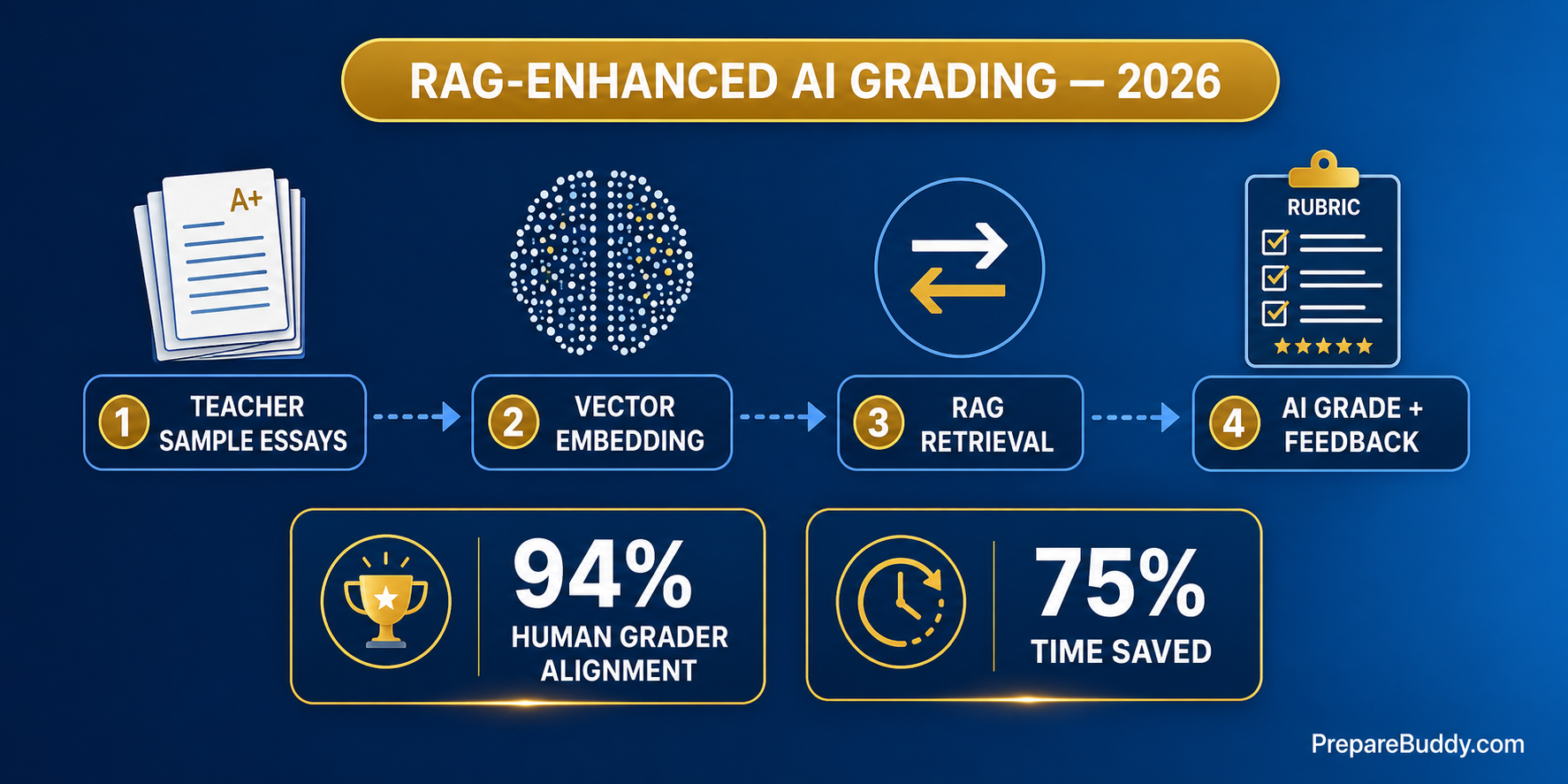
RAG (Retrieval-Augmented Generation) changes the pipeline. Before evaluating a new submission, the platform retrieves the most similar high-quality essays from your own graded library and feeds them to the model as context. The AI is no longer guessing. It is grading against your standards, using your past decisions as evidence. PrepareBuddy's RAG pipeline hits 94% alignment with human graders — compared with 85% for the same model running without retrieval, a 9-point lift driven entirely by feeding the model your institutional grading history.
Generic AI Grading vs RAG-Enhanced Grading
| Problem | Generic AI Grading | RAG-Enhanced Grading |
|---|---|---|
| No institutional context | Same rubric for every coaching center | Learns from your exemplary work |
| Consistency across teachers | Different output each run | References lock the standard |
| "AI doesn't get us" | Generic feedback boilerplate | Grounded in your exemplar essays |
| Evidence trail | Black-box score | Citations from your reference library |
| Reproducibility | Random — appeals are hard to defend | Snapshot versioning per cohort |
| Human grader alignment | ~85% | 94% |
How a Coaching Center Sets It Up (The 4 Steps)
The whole rollout sits inside the institute admin panel. No engineering work is needed on your side — deployment runs in 24–48 hours.
- Upload 50–100 exemplary graded essays. Tag each one as excellent / good / average / poor. These are usually your senior teacher's already-graded mocks from the last six months. Nothing extra to write.
- The system builds embeddings. Each essay is converted into a 1536-dimension semantic vector. You don't see this layer — you only see a "reference library ready" status.
- Configure a Smart Rubric. Pick the test (IELTS, PTE, TOEFL, OET, CELPIP) and add any custom guidelines your center uses ("we deduct half a band for over 320 words", "we always check Task Response before grammar"). The AI inherits your custom rules on top of the official band descriptor.
- Switch evaluation mode to RAG. From the next submission onward, every new essay retrieves 5 similar references, evaluates against your rubric, cites evidence from your library, and outputs a graded JSON with score + criterion-level feedback. Visit our AI Assessment feature page for the deeper technical detail.
What This Saves You at Coaching-Center Scale
| Class Size | Manual Grading Time | RAG-Enhanced Grading | Time Saved |
|---|---|---|---|
| 50 students (one batch) | ~12.5 hours | 15 minutes | 98% |
| 200 students (multi-batch) | ~50 hours | 45 minutes | 98.5% |
| 500 students (full mock day) | ~125 hours | ~2 hours | 98.4% |
Coaching centers running PrepareBuddy report saving 18+ hours per teacher per week, with 75% of total grading time freed up for live classes and one-on-one student review. Across the 200+ institutions on the platform, the 95% student satisfaction rate suggests students don't mind AI grading when the feedback is consistent and specific — they mind when it feels random.
Why Multi-Model Verification Sits On Top
RAG handles the "grade like our coaching center" half. The other half is making sure the grade itself is right. PrepareBuddy runs a second verification layer on top: independent AI models cross-check the score before it ships to the student. The error rate drops from 15% (single-model) to 6% (multi-model), and disagreements between models are flagged for human review instead of silently shipped. For appeals — and appeals do happen — you have an audit trail showing which references were retrieved, which rubric criteria matched, and where the score came from.
Where Coaching Centers Are Plugging This In
The three use cases we see most often:
- IELTS Task 1 and Task 2 grading — the highest-volume writing surface, and the place where teacher variance hurts most. Senior teacher's grading style gets cloned in week one. See the AI Writing Analysis module for the writing-specific scoring breakdown.
- PTE Essay and Summarize Written Text — Pearson's algorithm is strict; teachers struggle to mirror it manually. RAG-trained references built from your top scorers close that gap.
- TOEFL Integrated and Academic Discussion — multi-paragraph rubric weighting confuses generic AI; references resolve it.
The same engine also powers our coaching-institute solution for OET healthcare writing, CELPIP, and Duolingo. One library, every test format.
Implementation Checklist for Coaching Center Owners
- Identify your top 2 teachers whose grading you want the AI to mirror.
- Export 50–100 of their already-graded essays as the seed reference set.
- Schedule a 30-minute setup call with PrepareBuddy.
- Test the system on the next 20 fresh submissions — compare AI grades against your senior teacher's grades side-by-side.
- Roll out to one batch first, then full cohort, then multi-branch.
- Refresh the reference library every quarter as your team's grading evolves.
Frequently Asked Questions
Does RAG-Enhanced AI Grading replace teachers?
No. It replaces the most repetitive 75% of their grading workload — the first-pass scoring and feedback writing — so teachers spend their time on live classes, one-on-one coaching, and the edge cases that genuinely need a human eye.
How long until our AI grades essays the way our senior teacher does?
Deployment is 24–48 hours. With 50+ exemplar essays uploaded, the AI starts grading in your house style on Day 1. Most coaching centers reach near-full alignment with their senior teacher's calibration within two weeks of small refinements.
What if a student appeals an AI-graded score?
Every RAG evaluation outputs an evidence trail: which 5 reference essays were retrieved, which rubric criteria matched, and the exact citations used in the decision. Snapshot versioning means you can reproduce the exact grading state for any submission, even months later.
Can we still grade some sections manually?
Yes. Coaching centers commonly keep speaking and one or two writing tasks under teacher review, while RAG handles the high-volume writing and reading-comprehension grading. The system is configurable per task type.
Next Step
If your coaching center is grading more than 200 writing submissions a month and your teachers are still arguing about band-score consistency in WhatsApp groups, you are losing both teacher hours and student trust to a problem that has a solved technical answer. Schedule a demo to see RAG-Enhanced AI Grading on a sample of your own essays, or explore the coaching-center deployment guide to see what the 24–48 hour rollout actually looks like.


Join the Discussion