

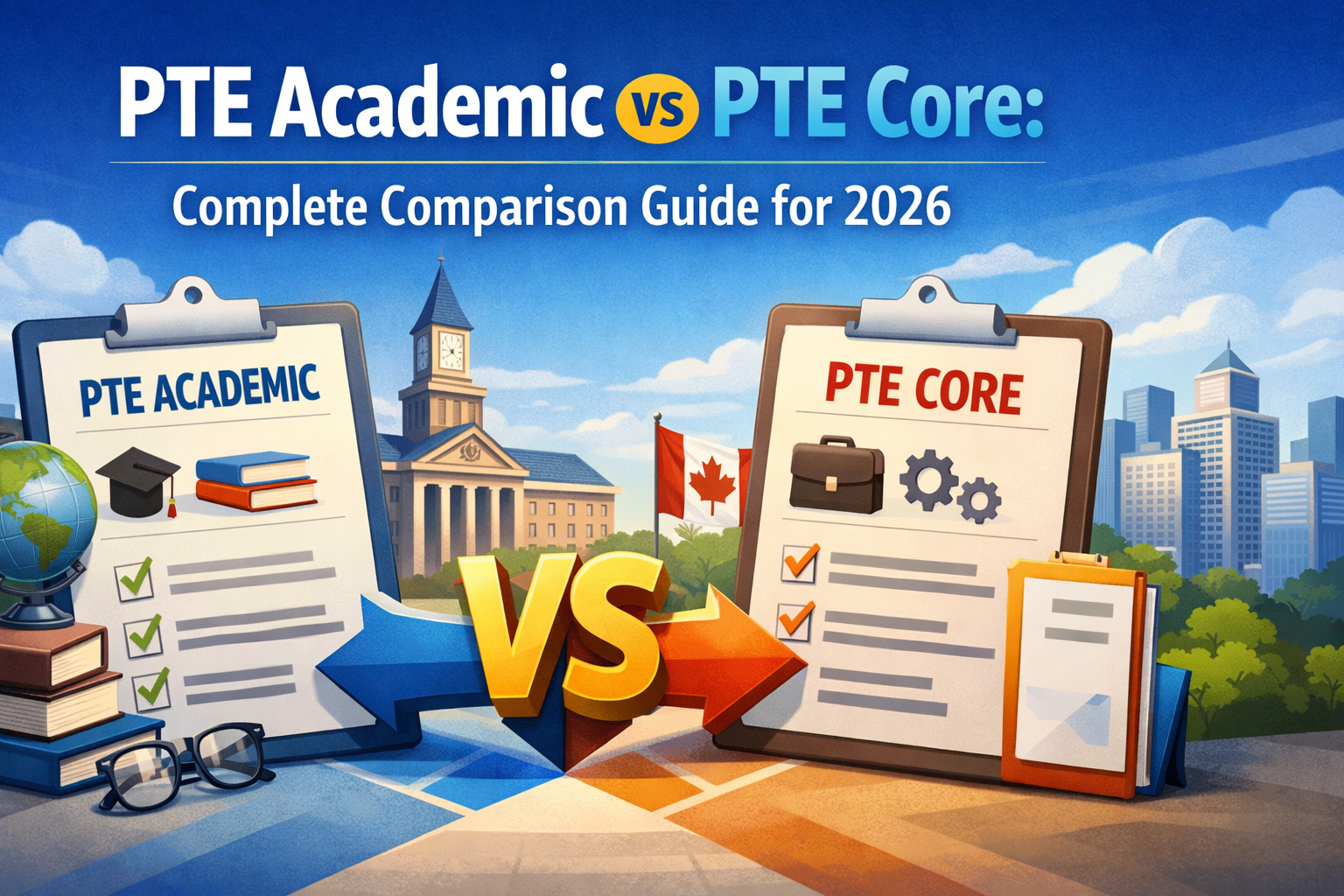
You've decided to take a PTE test — but which one? With Pearson now offering both PTE Academic and PTE Core, thousands of test-takers find themselves stuck at the very first step: choosing the right exam. Pick wrong, and you could waste months preparing for a test that doesn't meet your destination country's requirements.
This guide breaks down every meaningful difference between PTE Academic and PTE Core so you can make a confident decision and start preparing with the right focus.
What Is PTE Academic?
PTE Academic is Pearson's flagship English proficiency test, designed for students and professionals seeking admission to universities, colleges, and professional organizations worldwide. It tests all four communication skills — speaking, writing, reading, and listening — in an integrated, computer-based format. The test is widely accepted across Australia, the UK, New Zealand, Canada, and parts of Europe and Asia.
PTE Academic uses a scoring scale of 10–90, and results are typically available within 48 hours. It is recognized by thousands of institutions globally, making it a versatile choice for study abroad and skilled migration pathways.
What Is PTE Core?
PTE Core is Pearson's newer test, launched specifically for Canadian immigration and citizenship purposes. It maps directly to the Canadian Language Benchmarks (CLB), which are required for programs like Express Entry, Provincial Nominee Programs (PNPs), and Canadian citizenship applications.
PTE Core uses the same technology platform as PTE Academic but tests everyday English communication rather than academic English. The scoring is reported as CLB levels (1–12), making it straightforward for immigration applications.
PTE Academic vs PTE Core: Side-by-Side Comparison
| Feature | PTE Academic | PTE Core |
|---|---|---|
| Purpose | Study abroad, university admissions, skilled migration | Canadian immigration and citizenship |
| Score Scale | 10–90 (Global Scale of English) | CLB 1–12 (Canadian Language Benchmarks) |
| Test Duration | Approximately 2 hours | Approximately 2 hours |
| Skills Tested | Speaking, Writing, Reading, Listening | Speaking, Writing, Reading, Listening |
| English Type | Academic English | Everyday/General English |
| Content Focus | Academic lectures, research topics, university-level texts | Daily conversations, workplace scenarios, community interactions |
| Accepted By | Universities, colleges, governments worldwide (AU, UK, NZ, CA, etc.) | IRCC (Immigration, Refugees and Citizenship Canada) |
| Results Turnaround | Typically within 48 hours | Typically within 48 hours |
| Test Format | Computer-based, AI-scored | Computer-based, AI-scored |
| Score Validity | 2 years | 2 years |
Key Differences That Actually Matter
1. Content Difficulty and Style
The most significant difference is in what you'll encounter during the test. PTE Academic draws from academic sources — think university lectures, scientific articles, and formal discussions. PTE Core uses everyday scenarios — workplace emails, community announcements, and casual conversations. If academic English isn't your strength, PTE Core's content will feel more accessible.
2. Score Reporting
PTE Academic reports scores on Pearson's 10–90 scale, which can then be mapped to CEFR levels or other frameworks. PTE Core reports directly in CLB levels, which is exactly what IRCC requires. This eliminates the need for score conversion and reduces confusion during your immigration application.
3. Acceptance and Use Cases
If you're applying to a university in Australia, the UK, or elsewhere, PTE Academic is your test. If you're pursuing Canadian permanent residency or citizenship through IRCC pathways, PTE Core is purpose-built for that. Some Canadian universities may also accept PTE Academic for admissions, so check your specific institution's requirements.
PTE Academic to CLB Score Mapping
For applicants considering both Canadian immigration and study, understanding how PTE Academic scores translate to CLB levels is useful:
| CLB Level | PTE Academic Score Range | IRCC Use Case |
|---|---|---|
| CLB 10+ | 89–90 | Maximum CRS points |
| CLB 9 | 79–88 | High CRS points, most PNPs |
| CLB 8 | 69–78 | Federal Skilled Worker minimum |
| CLB 7 | 59–68 | Express Entry minimum (most streams) |
| CLB 6 | 50–58 | Canadian citizenship requirement |
| CLB 5 | 42–49 | Some provincial programs |
| CLB 4 | 30–41 | Minimum for some pathways |
Which Test Should You Take?
Choose PTE Academic If:
- You're applying to universities or colleges outside Canada (especially Australia, UK, New Zealand)
- You need a test accepted by multiple countries for maximum flexibility
- You're applying for skilled migration to Australia or New Zealand
- Your institution specifically requires PTE Academic
Choose PTE Core If:
- You're applying for Canadian permanent residency through Express Entry
- You need CLB scores for Provincial Nominee Programs
- You're applying for Canadian citizenship
- You prefer being tested on everyday English rather than academic content
How to Prepare for Either PTE Test Effectively
Regardless of which PTE test you choose, preparation strategy matters more than study hours. The computer-based format means you need to practice with tools that replicate the actual test environment — not just textbooks.
AI-powered practice platforms have changed how students prepare for PTE. With Voice AI technology that provides real-time pronunciation scoring and fluency analysis across 30+ English accents, you can get instant feedback on your speaking performance — something traditional prep methods simply can't offer.
For PTE Academic, focus on building comfort with academic vocabulary and complex sentence structures. For PTE Core, practice everyday communication scenarios and workplace-relevant language.
Key preparation strategies for both tests include practicing with AI-scored mock tests that mirror real test conditions, using AI writing analysis to identify patterns in your writing that lose marks, and following a personalized study plan that adapts to your specific weaknesses.
Final Thoughts
The choice between PTE Academic and PTE Core comes down to your destination and purpose. For Canadian immigration, PTE Core gives you exactly what IRCC needs. For everything else — university admissions, Australian migration, global flexibility — PTE Academic is the established choice.
Whichever test you choose, consistent practice with realistic test simulations is the fastest path to your target score.
Ready to start preparing? Take a free PTE practice test and see where you stand before exam day.


Join the Discussion