

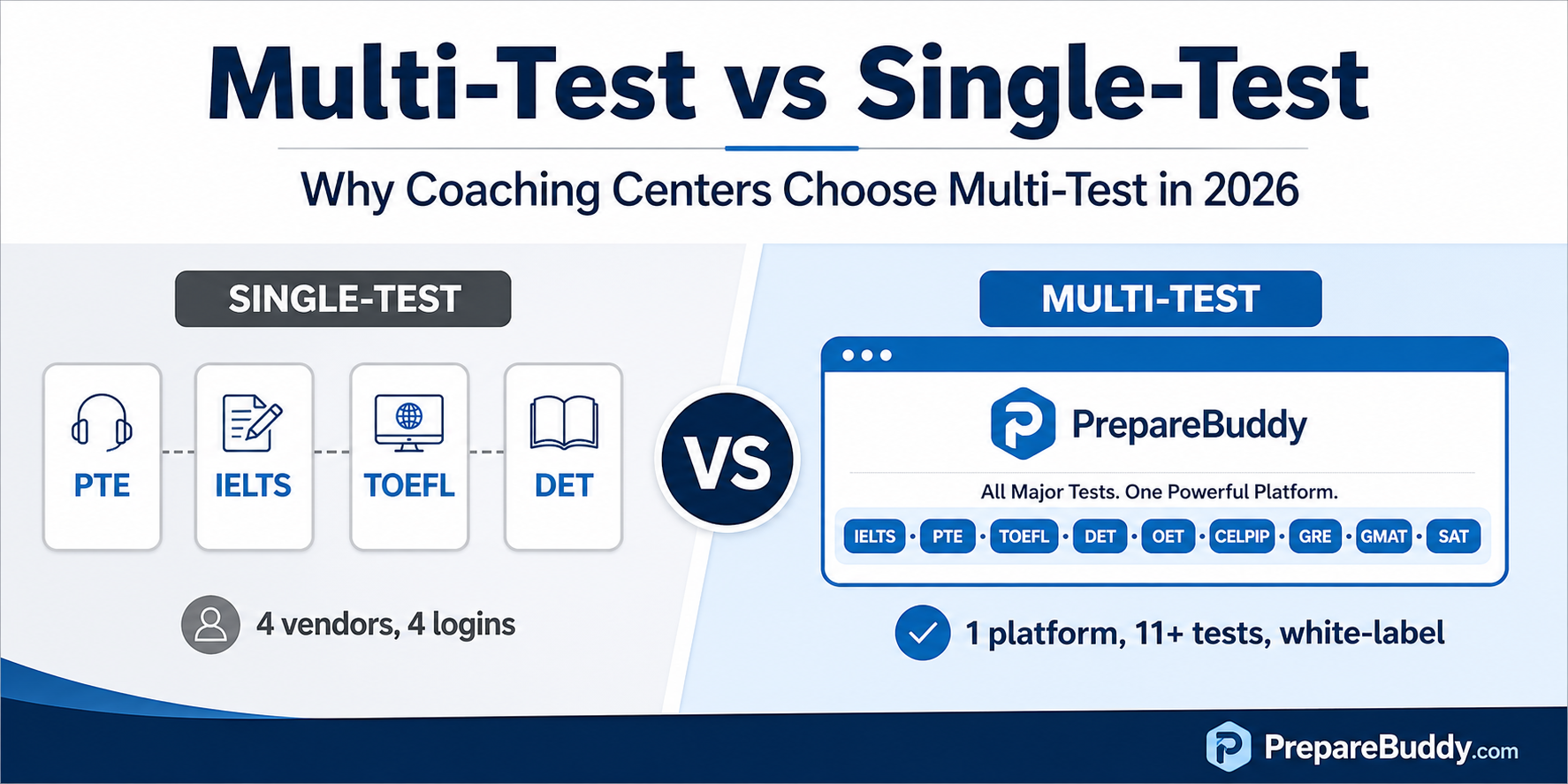
Most coaching centers in 2026 don't have an IELTS problem. They have a stack problem. One vendor for PTE practice, another for IELTS mocks, a separate tutor management spreadsheet, a free Duolingo simulator that breaks every other week, and a marketing page that lists "all major tests" while the back-end can deliver maybe two of them. The decision facing coaching center owners now is no longer "which test should we focus on?" — it's "do we keep stitching single-test specialists together, or move to one multi-test platform?"
This post compares the two models honestly. Single-test specialists like Gurully (PTE/IELTS/DET/CELPIP), APEUni (PTE), and AlfaPTE (PTE) genuinely do some things well. Multi-test platforms like PrepareBuddy bet that breadth, AI depth, and white-label control beat specialist depth for institutions running real businesses. Here's how the two models actually stack up in 2026.
What "Single-Test Specialist" Means in 2026
A single-test specialist platform is built around one exam — usually PTE Academic, sometimes IELTS, occasionally TOEFL or DET. Their content library, scoring engine, UI, and marketing all assume the student is preparing for that one test. APEUni's PTE-only focus, AlfaPTE's PTE mock test specialization, and Mocko.ai's PTE-only AI scoring are all examples. The strength of this model is depth: thousands of exam-specific items, a scoring engine tuned to that test's quirks, and a community of students all working on the same thing.
The honest case for single-test specialists: if your coaching center serves only PTE students, and you don't sell other services, a specialist tool can be cheaper per student and emotionally simpler. Gurully's 30,000+ PTE-style questions and APEUni's massive PTE community are real assets for PTE-only operators.
What "Multi-Test Platform" Means in 2026
A multi-test platform delivers IELTS, PTE Academic, PTE Core, TOEFL iBT, Duolingo English Test, OET, CELPIP, GRE, GMAT, and SAT from a single back-end. Often it adds language proficiency testing (CEFR A1–C2 in 11 languages), psychometric assessments, and a custom test builder for branded internal exams. PrepareBuddy is built this way: 11+ test types, 11 supported languages, AI scoring, and a white-label deployment that takes your brand to students, not the vendor's.
The honest case for multi-test platforms: most coaching centers don't actually serve one test. Australia-bound students need IELTS or PTE. Canada PR aspirants need IELTS, CELPIP, or PTE Core. US grad school applicants need TOEFL, GRE, or GMAT. Healthcare workers need OET. Counsellors regularly switch students between tests based on score history and country. A multi-test platform makes that workflow native instead of pasting four logins together.
Side-by-Side: Multi-Test vs Single-Test in 2026
| Capability | Single-Test Specialist (typical) | Multi-Test Platform (PrepareBuddy) |
|---|---|---|
| Test types covered | 1–4 tests | 11+ standardized tests + 11 languages |
| Add a new test the institute wants | Buy another tool | Already in the platform |
| White-label branding | Co-branded or vendor-branded | Full white-label: your domain, logo, colors, branded emails |
| AI speaking practice | Record-and-submit, exam-specific | Voice AI with real-time conversation, 30+ accents, 48-emotion detection |
| AI scoring accuracy | Varies; often single-model | 95% accuracy with multi-model verification |
| Adaptive testing | Rare outside GRE/GMAT clones | Built-in for adaptive tests + adaptive language |
| Custom branded exams | Not supported | Custom Test Builder (any CEFR level, any topic) |
| Psychometric assessments | Not offered | Big Five, Holland Code, HEXACO, aptitude |
| Student lifecycle management | Manual or third-party | Built-in batches, enrollments, analytics |
| Deployment time | Days to weeks per tool | 24–48 hours for the full platform |
| Vendor count to manage | 3–5 typical | 1 |
This comparison reflects the typical multi-test vs single-test split, not every product in every category. Single-test specialists like Gurully and APEUni are stronger than "average" inside their narrow scope; the table is meant to show category-level tradeoffs.
The Five Coaching Center Problems Multi-Test Solves
1. Counsellors stop losing students at the test-selection stage
When a student walks in unsure whether to take IELTS, PTE, or TOEFL, a single-test center either pushes the only test they offer or refers the student elsewhere. With a multi-test platform, counsellors can run a free diagnostic on PrepareBuddy's diagnostic test, recommend the right exam based on score and country, and keep the student inside the institute's funnel.
2. Marketing claims finally match what the back-end delivers
Coaching center websites routinely advertise IELTS, PTE, TOEFL, OET, and CELPIP. Single-test back-ends mean four of those promises depend on PDFs, manual mocks, or third-party demos. Multi-test platforms close the gap between what's advertised and what's delivered.
3. AI grading at scale eliminates the speaking-feedback bottleneck
Speaking is where coaching centers lose the most time. Tutors can grade 12 IELTS speaking responses an hour at best. PrepareBuddy's AI scoring grades unlimited responses with 95% accuracy and 75% time saved on grading — and the institute saves 18+ hours per tutor per week, time that goes back into teaching, sales, and counselling.
4. White-label keeps the brand equity in the institute
If students log into "Gurully" or "APEUni" or any vendor-branded tool, the relationship eventually drifts to the platform, not the institute. White-label deployment means students see the institute's logo, domain, and colors. The technology is invisible — the brand is visible.
5. One contract, one invoice, one integration
Coaching centers running 4 vendors face 4 onboarding cycles, 4 pricing pages, 4 support queues, 4 GDPR conversations. Multi-test platforms collapse that into one. PrepareBuddy reports 300% ROI within 18 months from 200+ institutions and 50,000+ students prepared, partly because consolidation alone drives operational savings.
When a Single-Test Specialist Is Still the Right Choice
Multi-test isn't always the answer. Be honest with yourself if you fit one of these profiles:
- You serve only PTE and have no plan to ever offer IELTS, TOEFL, or DET. Gurully or APEUni's PTE depth may be enough.
- You're a solo tutor charging hourly without scale ambitions. The cost-to-coverage math may not justify a full platform.
- You operate in one geography with one dominant test (e.g., only Indian PTE migration prep), and your students rarely ask about other exams.
If any of these fit, a specialist tool is a reasonable choice — and you can always migrate to a multi-test platform later when the business diversifies.
How to Evaluate the Switch
Before signing anything, ask the vendor these five questions:
- How many test types do you actually deliver in production today, and which ones rely on third-party content?
- Is your AI scoring accuracy validated against human graders, and what's the alignment percentage?
- Can our institute's name, domain, and branded emails be applied without your logo appearing anywhere students see?
- How long does deployment take from contract signing to students logging in?
- What does the contract look like if we want to add or remove tests next quarter?
The answers will sort serious multi-test platforms from re-skinned single-test products fast.
Get Started
If your coaching center already runs more than one test type — or wants to — the multi-test economics get hard to ignore. PrepareBuddy offers a free first month with no credit card and no lock-in contract, plus 24–48 hour deployment so you can see the platform under your brand before committing. Schedule a demo to see the white-label dashboard, or try a free diagnostic test the way your students would experience it. View pricing when you're ready to compare options.


Join the Discussion