

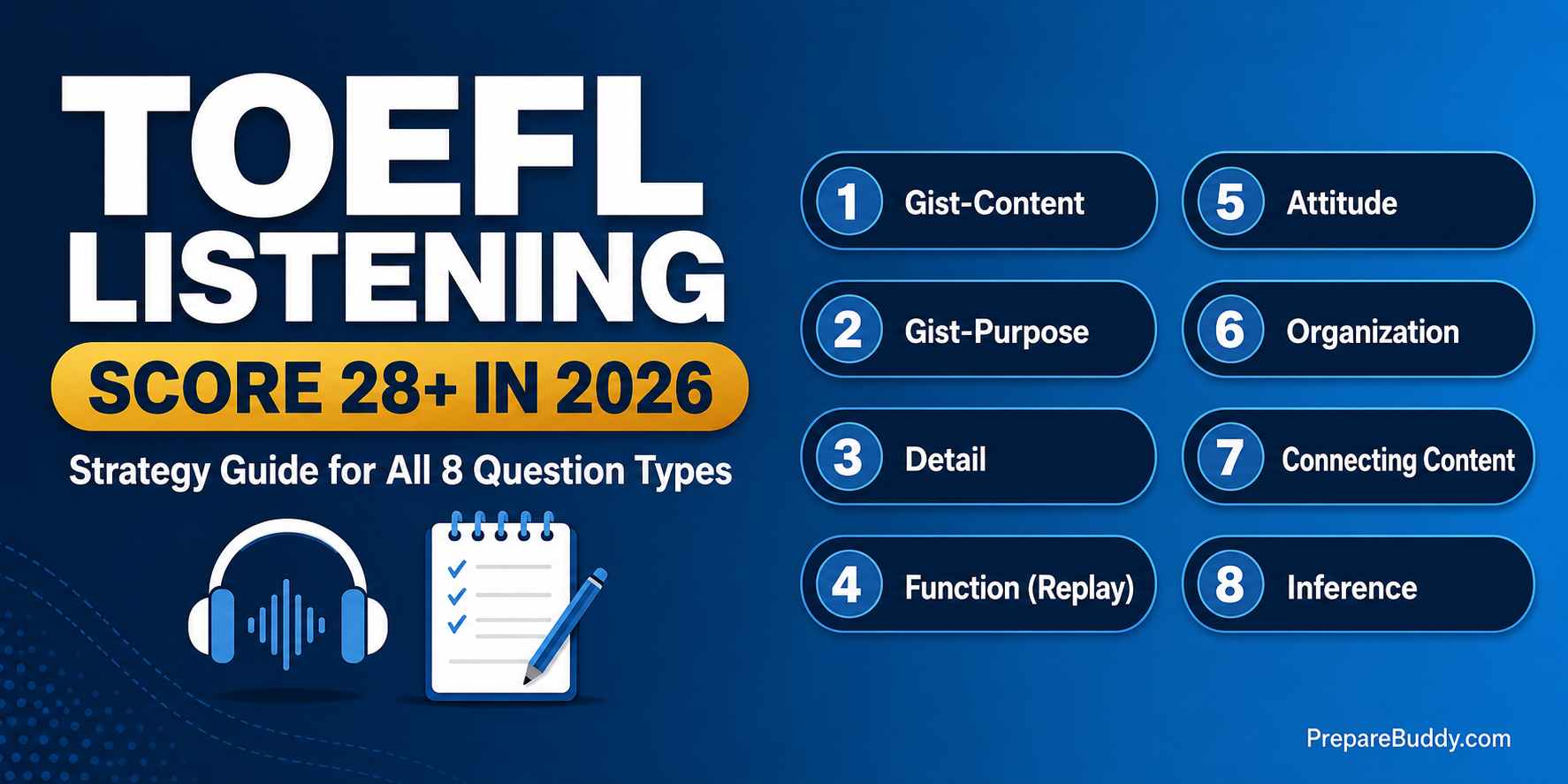
The TOEFL Listening section asks 28 questions across 5 long audio passages, and you cannot replay anything. Three lectures, two conversations, roughly 36 minutes of audio you hear exactly once — and then ETS expects you to answer questions about gist, attitude, inference, and how ideas connect to each other. If you are aiming for a 28+ score (the band most graduate programs treat as "native-equivalent"), guesswork on question-type recognition is not going to get you there.
This is the strategy guide we wish more candidates read before booking their TOEFL iBT. It breaks down all 8 official ETS question types, the note-taking system that high scorers actually use, and how to build the listening stamina the section punishes you for not having. We also show where AI-generated practice fits in — because at 5 passages per test, the official prep pool runs out fast.
How TOEFL iBT Listening Is Scored in 2026
TOEFL Listening is one of four sections on the TOEFL iBT (Reading, Listening, Speaking, Writing). The full test runs 116 minutes; the Listening section delivers 28 raw questions and reports a scaled score between 0 and 30. A 28+ scaled score generally requires you to miss no more than 2–3 questions across the whole section.
| Listening Section At a Glance | Detail |
|---|---|
| Total questions | 28 |
| Audio content | 3 academic lectures (3–5 min, 6 Qs each) + 2 conversations (~3 min, 5 Qs each) |
| Section time | ~36 minutes |
| Replay allowed? | No — you hear each passage once |
| Note-taking allowed? | Yes — and essential |
| Scaled score range | 0–30 (rolled into the 0–120 TOEFL total) |
| 28+ target | Allow at most 2–3 missed across the whole section |
Two implications fall out of that table. First, every question matters — there is no "throwaway" section like in some other tests. Second, your single biggest leverage point is during the audio, not after. By the time the questions appear on screen, the audio is gone.
The 8 TOEFL Listening Question Types (and How to Beat Each One)
ETS officially uses 8 question types in TOEFL Listening, grouped into three families: Basic Comprehension (what was said), Pragmatic Understanding (what was meant), and Connecting Information (how ideas relate). High scorers learn to recognise the family within the first 2 seconds of seeing the stem — because the strategy diverges sharply by family.
| # | Question Type | Family | What It Tests | Strategy in One Sentence |
|---|---|---|---|---|
| 1 | Gist-Content | Basic | The main topic of the lecture/conversation | Listen for the speaker's topic statement in the first 30–60 seconds. |
| 2 | Gist-Purpose | Basic | Why the speakers are talking | In office-hours conversations, the student's opening line almost always gives this away. |
| 3 | Detail | Basic | Specific facts, examples, names, dates | Write down dates, proper nouns, numbers, and any term the lecturer defines. |
| 4 | Function (Replay) | Pragmatic | What the speaker really means in a replayed snippet | Listen for tone shift and sarcasm — the literal answer is almost never right. |
| 5 | Attitude | Pragmatic | The speaker's feeling or opinion | Track hedging language ("I'm not sure…", "Actually…") — that is where attitude leaks. |
| 6 | Organization | Connecting | How the lecturer structured the talk | In your notes, mark structural verbs: "compares", "contrasts", "defines", "gives an example of". |
| 7 | Connecting Content | Connecting | Cause/effect, category, sequence — often a table or drag-drop | If the lecturer says "there are three types", you have just been warned that a table question is coming. |
| 8 | Inference | Connecting | What can be concluded but isn't stated | The correct answer is always defensible from one specific line — find that line in your notes. |
Most candidates lose points on questions 4, 7, and 8 — the "listen between the lines" trio. The fix is not more listening volume; it is targeted Function/Connecting/Inference practice with explanations, which is exactly the kind of practice that runs out quickest in official materials.
The Note-Taking System for 28+
You cannot remember 5 minutes of academic lecture. You also cannot transcribe it. The job of notes is to compress structure, not record content. Here is a two-column system that consistently produces 28+ scores in our coaching-center deployments:
- Left column (60% of the page) — Structure: the lecturer's outline. Use arrows for cause/effect, "vs." for contrasts, numbered bullets for lists, and a question mark next to anything the lecturer poses rhetorically. This is the column that feeds Organization, Connecting Content, and Gist-Content questions.
- Right column (40% of the page) — Specifics: proper nouns, dates, defined terms, examples, and any place the speaker repeats themselves (repetition = important). This is the column that feeds Detail and Inference questions.
- Margin symbols — Pragmatics: a tone arrow (↑ enthusiasm / ↓ doubt / ! surprise) wherever the lecturer's voice does something. This is the column that wins Function and Attitude questions.
One additional rule that costs candidates more points than any other: do not write in your native language. The 0.5 seconds of translation lag means you miss the very next sentence — and TOEFL lectures stack ideas tightly enough that one missed sentence ruins the entire next question.
The 6-Week Plan to Get to 28+
Below is the schedule we recommend at PrepareBuddy's TOEFL prep workspace, calibrated to candidates already sitting around 23–25. If you are below 22, add 2–3 diagnostic weeks at the start to build raw listening stamina.
| Week | Focus | Daily Workload | Output |
|---|---|---|---|
| 1 | Diagnostic + Note-taking system | 1 full Listening section + 60 min review | Establish baseline; lock in two-column notes |
| 2 | Lecture comprehension (academic) | 3 lectures/day across 14 disciplines (history, biology, art, geology, psychology…) | Confident gist + organization on all subject pools |
| 3 | Conversation comprehension | 2 office-hours + 1 campus-services dialogue/day | Lock Gist-Purpose recognition in <5 seconds |
| 4 | Replay questions (Function + Attitude) | 20 isolated replay drills/day with AI-explained answers | Function/Attitude accuracy above 85% |
| 5 | Connecting Content + Inference | 4 table/drag-drop drills + 8 inference drills/day | Connecting/Inference accuracy above 80% |
| 6 | Full-length simulations under timed conditions | 3 full TOEFL sections/week with no replays | Sustainable 28+ across multiple mocks |
Why AI-Generated Practice Closes the Gap
The biggest single bottleneck for serious TOEFL candidates is supply. Most students burn through every official ETS practice listening passage in 2–3 weeks, then either repeat (which memorises answers) or grind through low-quality third-party content (which trains the wrong listening reflexes).
PrepareBuddy's AI content engine runs on a 120-billion-parameter model that scored 96% indistinguishable from official materials in blind quality tests. It generates fresh lectures across 14 academic disciplines (TOEFL's actual academic pool) and renders audio with 23 professional TTS voices across 30+ English accents — so a six-week prep plan never repeats a topic and your ear is trained on the accent variety ETS uses on the real exam.
Three platform features that materially move TOEFL Listening scores:
- Adaptive testing pushes you into the question types you're weakest at — typically Function/Connecting/Inference — instead of giving you another easy Detail run.
- AI Tutor is available 24/7, remembers your last attempt, and can explain why a specific replay snippet's correct answer is "to soften a disagreement" rather than "to ask a question".
- AI study plans rebuild themselves every week based on which question types are still costing you points — so week 5 doesn't look like week 2 just because the calendar moved.
Four Plateau Traps Below 28
- Replaying audio in practice. The real test never lets you replay — practising with replay builds a crutch the exam will break.
- Writing sentences, not structure. If your notes look like a transcript, you are missing the next sentence.
- Skipping conversations. Office-hours and campus-service dialogues carry Gist-Purpose freebies you only collect with practice volume.
- Ignoring the replay-question family. Function and Attitude questions separate 26 from 28; they need isolated drills, not more full sections.
Frequently Asked Questions
How many questions can I miss and still score 28 on TOEFL Listening?
The TOEFL raw-to-scaled conversion table varies slightly per administration, but as a rule of thumb you can miss 2 questions and stay at 28, and 3 questions sometimes still rounds up. Beyond that, you typically drop into the 26–27 band.
How many TOEFL Listening practice tests should I do before the real exam?
For a 28+ target we recommend 12–15 full Listening sections in the 6-week window, plus 200+ isolated question-type drills. Quality and review depth matter far more than raw volume.
Should I take notes on every passage?
Yes — even on conversations. ETS specifically designs Connecting Content and Inference questions on conversation passages, and your notes are the only way to reconstruct who said what at minute three of a five-minute dialogue.
Is AI-generated TOEFL Listening practice as good as official ETS materials?
Official ETS materials are the gold standard for calibration — always do all of them first. After that, high-quality AI practice (built on large, high-parameter models with proper TTS) is what most 28+ scorers actually use, because it's the only way to get unlimited fresh passages across all 14 TOEFL discipline pools without memorising answers.
How does PrepareBuddy's TOEFL Listening practice work?
PrepareBuddy generates full TOEFL iBT Listening sections (3 lectures + 2 conversations, 28 questions, 36-minute timing) on demand. You can try a free section at our free TOEFL practice page with AI scoring and per-question feedback.
Start Your 28+ Plan Today
The biggest predictor of a TOEFL Listening 28+ is not talent — it's how many hours of fresh, well-explained listening practice you put in before test day. Take a free TOEFL Listening section now — no credit card required — at preparebuddy.com/language-tests/free-test/, or sign up for the full 6-week plan with AI-explained drills and an adaptive study schedule.


Join the Discussion