

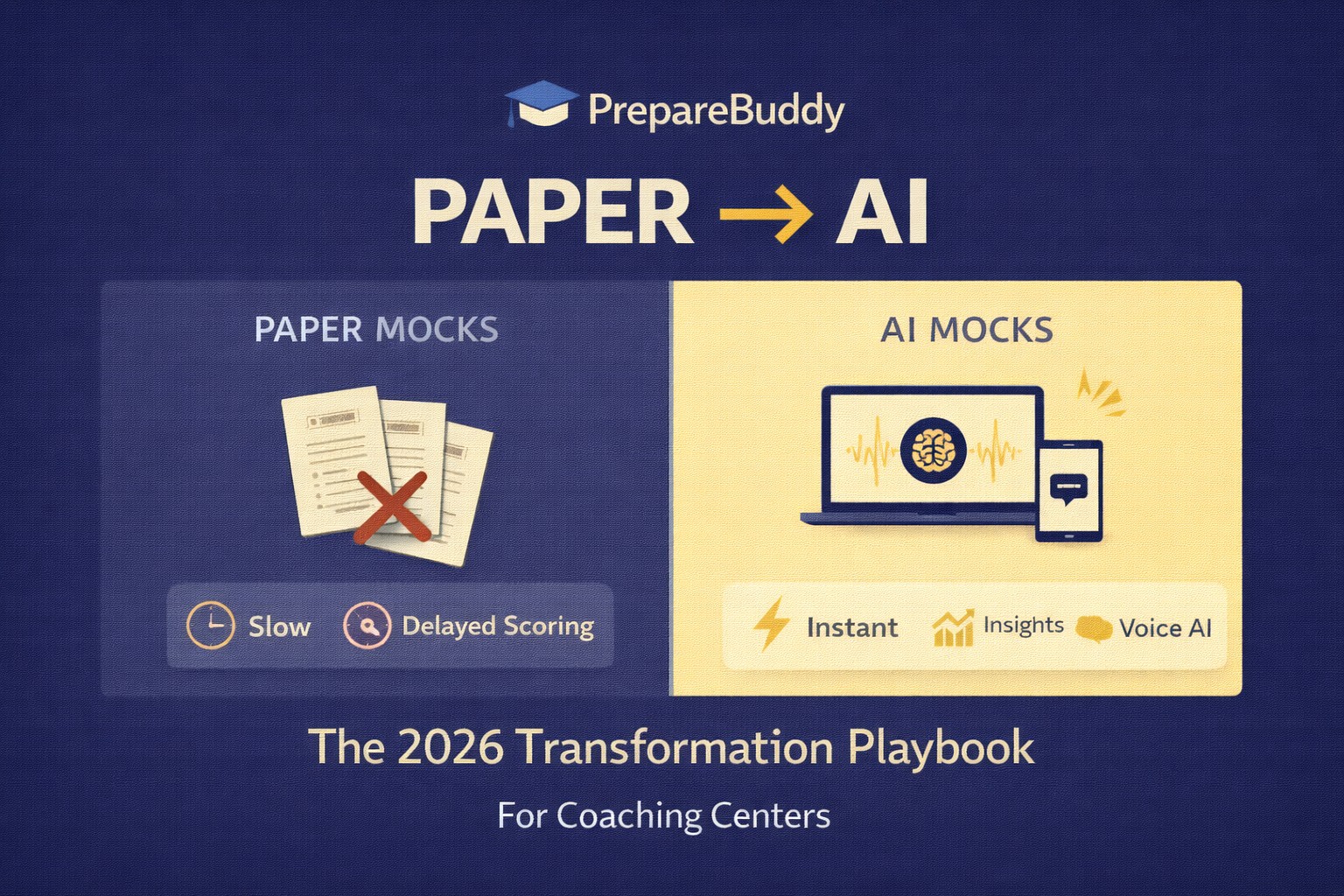
A 200-student coaching center in Hyderabad recently calculated what its weekly paper mock tests actually cost: 37 hours of teacher grading, ₹14,000 in printing, two locked classrooms, and a 5-day delay before students saw their scores. Then they ran the same mock through an AI platform. Total time: 22 minutes. Cost per student: ₹0. Score delivery: instant.
That gap is why coaching centers across India, the Middle East, Southeast Asia, and Australia are moving away from paper-based mocks faster than at any point in the last decade. The shift isn't ideological — it's arithmetic. This is the 2026 playbook for what's changing, why it matters, and how a coaching center can complete the transition in under 48 hours.
The hidden cost of paper-based mock tests
Paper mocks feel cheap because the cost is buried inside teacher salaries and student waiting time. Once you actually price it out, the picture changes dramatically. Here is what a typical 200-student IELTS/PTE coaching center spends to run weekly paper mocks compared to the AI-powered alternative.
| Cost Component | Paper Mocks (weekly) | AI Mock Tests (weekly) |
|---|---|---|
| Printing & paper | ₹12,000–₹16,000 | ₹0 |
| Teacher grading time | 30–40 hours | 0–2 hours (review only) |
| Score delivery to students | 3–7 days | Instant |
| Speaking section coverage | Often skipped (1:1 unaffordable) | Every student, every mock |
| Writing feedback depth | Generic comments | Criterion-by-criterion evidence |
| Classroom space needed | 2–3 rooms blocked for 3 hours | Any device, any time |
| Re-tests / extra practice | Limited by paper supply | Unlimited |
The economics are not subtle. PrepareBuddy data shows institutions save up to 75% of grading time and recover their platform investment within roughly 18 months — sometimes faster for centers that previously hired part-time graders just to keep up with mock volume.
What AI-powered mock tests actually do differently
Calling something an "AI mock test" is easy. Delivering a mock that mirrors the real exam, scores it within human-grader tolerance, and gives students actionable feedback is a different problem. Modern AI assessment platforms like PrepareBuddy approach it through three layers.
1. Exam-faithful generation, not random questions
The AI content engine produces questions across 4 distinct format types with built-in difficulty calibration and educational standard validation. That means a Read Aloud item respects PTE's 30–40 word range, an IELTS Task 2 prompt matches Cambridge phrasing, and a TOEFL Integrated Writing passage uses authentic academic register. Teachers can also import existing question banks and have the platform generate variants.
2. RAG-enhanced scoring grounded in real examples
Generic AI grading sounds generic because it has no reference for what "good" means at your center. PrepareBuddy's assessment engine uses Retrieval-Augmented Generation: before scoring a writing or speaking response, it pulls 5 similar high-quality examples from the institution's reference library and uses them as context. The result is 94% alignment with human graders, compared to roughly 85% for single-pass generic grading. For high-stakes mocks, triple-verification can be enabled.
3. Speaking that's actually evaluated, not just recorded
This is where paper mocks fail completely. Most coaching centers cannot afford 1:1 speaking evaluation for every student every week. Voice AI changes that math. PrepareBuddy's speaking engine offers real-time pronunciation scoring across 30+ English accents, fluency analysis, 48-emotion detection for delivery feedback, and instant criterion-level feedback. A 200-student center can deliver one speaking mock per student per day without adding a single hour of teacher time.
Paper mocks vs AI mocks: feature-by-feature comparison
| Feature | Paper Mocks | AI Mock Tests |
|---|---|---|
| Question variety | Fixed printed sets | Unlimited AI-generated variants |
| Scoring accuracy | Depends on grader | 94% human-grader alignment |
| Score turnaround | 3–7 days | Instant (writing/speaking in minutes) |
| Speaking evaluation | Rare, expensive | Every student, automated |
| Writing feedback | Generic remarks | Criterion-level with evidence quotes |
| Adaptive difficulty | Not possible | Real-time adjustment per student |
| Anti-cheating | Manual proctoring | 8-type cheating detection |
| Analytics for owners | Manual spreadsheets | Live dashboards per batch |
| Branding | Logo on header | Full white-label platform |
| Cost per mock per student | ₹60–₹80 | Near-zero marginal cost |
The four reasons coaching centers are switching now
Three of these reasons are obvious. The fourth is the one that usually closes the deal.
Reason 1 — Student expectations have shifted. Students who grew up on Duolingo, Khan Academy, and ChatGPT expect instant feedback. A 5-day wait for a mock score is a competitive disadvantage when the coaching center next door delivers scores in seconds.
Reason 2 — Teacher burnout is real. Senior IELTS/PTE teachers spend 40% of their week grading instead of teaching. AI grading reclaims roughly 18+ hours weekly per teacher, which gets redirected into actual instruction, doubt-clearing, and 1:1 intervention with weak students.
Reason 3 — Speaking and writing are the moats. Students don't switch coaching centers because of their reading mock — they switch because they're not improving on speaking and writing. Paper mocks are structurally bad at both. AI mocks fix both.
Reason 4 — White-label changes the business model. The biggest unlock isn't replacing paper. It's that a modern platform can be deployed under the coaching center's own brand, on the center's own domain, with the center's own colors and emails — and the end student never sees "PrepareBuddy" anywhere. That turns a tech expense into a tech moat. Centers can now sell premium digital subscriptions to students who never enroll in classroom batches at all, opening a new revenue line.
What a 48-hour migration actually looks like
Transitioning to an AI mock test platform is not a six-month IT project. PrepareBuddy's standard 24–48 hour deployment for coaching centers follows this sequence.
Day 1 morning — Setup. The coaching center provides its logo, brand colors, and a custom subdomain. The platform provisions a fully white-labeled instance. Test types are enabled (IELTS, PTE Academic, PTE Core, TOEFL, OET, CELPIP, Duolingo English Test — pick whichever the center teaches).
Day 1 afternoon — Reference library. The center uploads 30–50 existing high-quality graded mocks (scanned writing samples, recorded speaking with scores). This becomes the RAG reference library that anchors AI scoring to the center's standards.
Day 2 morning — Student onboarding. Bulk-import the student roster. Each student receives an invitation email with a one-click signup link. Per-student AI feature controls let admins decide which batches get the full AI Tutor and which get core features only.
Day 2 afternoon — First live mock. Run the first AI-powered mock with one batch. Teachers compare the AI scores against their own grading on a sample. Tweak the rubric if needed. Roll out to all batches the same day.
That's the entire migration. Most centers run paper mocks and AI mocks in parallel for the first week, then quietly retire the paper mocks once teachers see the speaking and writing reports.
Common objections — and the honest answers
"Will students trust an AI score for IELTS or PTE?" Yes, when scoring is transparent. The platform shows criterion-level scores with quoted evidence from the response, not a single opaque number. Students see exactly why they got a 6.5 instead of a 7.
"What if the AI is wrong on a high-stakes mock?" Triple-verification can be turned on for any mock. Discrepancies above one grade level are flagged for human teacher review automatically.
"We have older teachers who don't trust technology." The dashboard is built for non-technical users. Teachers spend their time reviewing flagged responses and giving 1:1 feedback — the highest-leverage parts of their job — instead of marking 200 essays.
"Will students cheat on online mocks?" Built-in 8-type cheating detection covers tab switching, copy-paste, multiple faces in webcam, audio anomalies, and more. Centers can choose strict mode for high-stakes tests and relaxed mode for practice.
What this means for coaching center owners in 2026
The coaching centers winning right now are not the ones with the biggest classrooms. They are the ones running the most mocks, delivering the fastest feedback, and showing parents a digital experience that justifies premium fees. Paper mocks made sense when there was no alternative. In 2026 there is an alternative, it deploys in 48 hours, and it pays for itself within the first year for any center running more than 100 students.
The question isn't whether to switch. It's whether to switch before the coaching center next door does.
Get started
If you run a coaching center and want to see how an AI mock test platform would look under your own brand, the fastest path is a 30-minute walkthrough. Schedule a demo and we'll show you a live white-label instance with your logo. Or try a free AI-scored mock yourself first to see the scoring quality before involving your team. Pricing details are on the pricing page — first month is free, no credit card, no lock-in.


Join the Discussion