

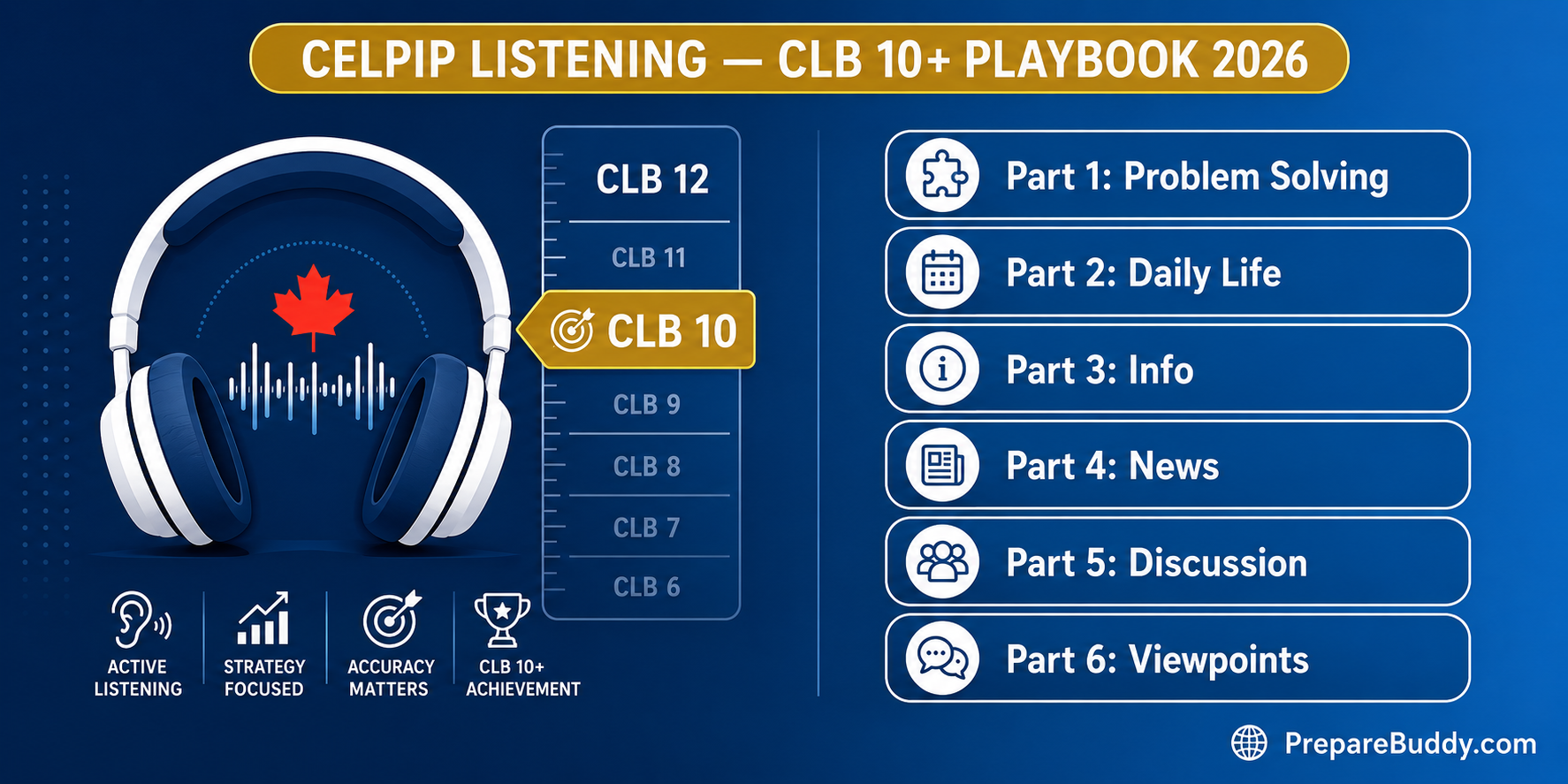
Most CELPIP candidates lose Listening points not because their English is weak, but because they don't know the rhythm of the test. CELPIP Listening is a listen-once exam. You hear each audio clip exactly one time, you have a few seconds to read the next set of questions, and the test moves on whether you're ready or not. CLB 10+ is the level Canadian employers, regulators, and citizenship pathways increasingly ask for in 2026 — and it is achievable with a clear strategy for all 6 parts of the Listening section.
This guide breaks down the CELPIP Listening test part by part, explains the CLB band cut-offs, and shows you the exact practice routine to lift your score from CLB 8 to CLB 10+ in four to six weeks.
CELPIP Listening at a Glance
The CELPIP Listening section sits at the start of the full CELPIP General test (a 180-minute computer-based exam graded on the 1–12 CLB scale). It runs about 47–55 minutes and is structured into six parts. Each part has its own audio context, its own question style, and its own scoring weight — which is why a part-by-part strategy matters more than generic listening tips.
| Part | Context | Format | Typical Qs | Difficulty Weight |
|---|---|---|---|---|
| Part 1 | Problem Solving | 3 short conversations + MCQs | 8 | Low–Medium |
| Part 2 | Daily Life Conversation | Single conversation + MCQs | 5 | Low |
| Part 3 | For Information | Phone-style interview + MCQs | 6 | Medium |
| Part 4 | News Item | News broadcast + MCQs | 5 | Medium–High |
| Part 5 | Discussion (Video) | Workplace video + MCQs | 8 | High |
| Part 6 | Viewpoints | Monologue with opposing views + MCQs | 6 | High |
The exam also includes a short unscored practice task at the very beginning — use it to set your headphone volume; don't burn focus on the content.
What Does CLB 10+ Actually Mean in Listening?
CELPIP reports scores from CLB 1 to CLB 12 in each of the four skills. CLB 10 is the threshold most often associated with federal Skilled Worker maximum CRS points, professional regulatory bodies (engineering, accounting, healthcare admin), and high-tier citizenship eligibility. CLB 11 and 12 sit just above and signal near-native, error-free comprehension under load.
| CLB Level | What You Can Do | Typical Accuracy Needed |
|---|---|---|
| CLB 7 | Follow clear, everyday conversations | ~60–66% |
| CLB 8 | Catch implied meaning in routine workplace audio | ~66–74% |
| CLB 9 | Handle abstract topics and longer monologues | ~74–82% |
| CLB 10 | Decode nuance, tone, and opposing viewpoints in real time | ~82–88% |
| CLB 11–12 | Near-native, including idioms and complex inference | ~88–96%+ |
For CLB 10+, you need to be confidently right on the lower-weighted Parts 1–4 (target near-perfect accuracy) and lose no more than 2–3 marks across the harder Parts 5 and 6. That is what separates CLB 9 candidates from CLB 10 candidates: not perfect English, but a disciplined hit rate on the easy parts and a calm head on the hard ones.
Part 1: Problem Solving (8 Qs)
You hear three short conversations. After each conversation, a few MCQs appear. The conversations are friendly and the language is everyday, but the trap is identifying the speaker's actual problem and the solution they finally settle on — not the first option that gets mentioned.
CLB 10+ strategy: while listening, mentally tag two anchors — "What is the issue?" and "What is the chosen action?" Don't try to remember every detail. The MCQ stems will tell you which details mattered.
Watch for distractors: the test loves to mention 2–3 possible solutions and then have the speakers reject all but one. If you remember the first solution, you'll pick the wrong answer. Always wait for the final decision.
Part 2: Daily Life Conversation (5 Qs)
One conversation, usually between two friends or family members, in a low-stakes setting (a barbecue, planning a trip, choosing a gift). The MCQs test factual recall and basic inference.
CLB 10+ strategy: this is your free 5 marks. The trick is staying engaged — Part 2 audio is light, the topic is dull, and many candidates start mentally rehearsing Part 3 instead of listening. Treat Part 2 like a focus test: full attention, zero drift.
Part 3: Listening for Information (6 Qs)
A phone-call style conversation, often someone calling a service provider, advisor, or expert for information. Expect dates, fees, requirements, comparisons, and short numerical details.
CLB 10+ strategy: jot down keywords on the scratch sheet — names, numbers, and verbs. The MCQs almost always test a specific piece of information that was mentioned once, not the gist. If you only retained the overall meaning, you'll lose marks.
Trap to avoid: answer paraphrases. The correct answer rarely uses the exact words from the audio — it uses synonyms. Train your ear to spot "cancel = withdraw", "refund = reimbursement", "strict = inflexible".
Part 4: Listening to a News Item (5 Qs)
A short news broadcast (~90 seconds) on a single Canadian topic. The MCQs test main idea, supporting detail, and tone or implication.
CLB 10+ strategy: news segments follow a predictable structure — headline, who, what, where, why, quoted reaction, conclusion. As you listen, map the audio onto that template. If you miss the "why", you'll lose the inference question that always appears.
Practice tip: spend 10 minutes a day listening to CBC News short-form clips. Don't read the transcript while listening — listen first, then check.
Part 5: Listening to a Discussion (8 Qs)
This is the heaviest-weighted part of the section. You watch a short video — a workplace discussion involving 2–3 people — and answer 8 MCQs that include questions about implied meaning, attitude, and speaker disagreement.
CLB 10+ strategy: the visual helps you track who is speaking. Use it to map opinions: "Speaker A supports X", "Speaker B is worried about Y", "Speaker C suggests Z". Several MCQs will ask which speaker felt what — without that mental map, you'll guess.
What separates CLB 10 from CLB 9 here: catching disagreement signalled by softeners like "well, I'm not sure that's the whole picture" or "I see your point, but…". Polite disagreement is a CLB 10 comprehension marker.
Part 6: Listening to Viewpoints (6 Qs)
A single speaker discusses a contentious topic and presents multiple sides of an argument. The MCQs test which view was attributed to which group, and what the speaker's own position is (if any).
CLB 10+ strategy: the speaker uses signposting language — "supporters argue…", "critics counter that…", "on the other hand…". Train your ear to hear these signposts as buckets. When the test asks "What do critics believe?", you're recalling the contents of the "critics" bucket, not the entire monologue.
Common mistake: attributing the speaker's quoted opposing view to the speaker themselves. The speaker may be neutral or only mildly tilted. Don't infer beyond what's said.
The 4–6 Week CLB 10+ Study Plan
Most candidates who jump from CLB 8 to CLB 10 do so by changing how they practise, not by listening more. Here is a structured plan that works for a 4–6 week window before test day.
| Week | Focus | Daily Time | Output |
|---|---|---|---|
| 1 | Diagnose — full mock under timed conditions | 60 min | Per-part accuracy breakdown |
| 2 | Parts 1–2 perfection drills + paraphrase ear training | 45 min | 95%+ accuracy on light parts |
| 3 | Parts 3–4 — note-taking and news structure | 45 min | Reliable detail recall |
| 4 | Part 5 — workplace discussion speaker mapping | 60 min | ≤2 errors per Part 5 set |
| 5 | Part 6 — viewpoint bucketing + signpost vocabulary | 45 min | ≤1 error per Part 6 set |
| 6 | Full mocks every other day + targeted weakness review | 90 min mock days | Stable CLB 10 score |
How AI-Scored CELPIP Listening Practice Accelerates Your Score
The hardest part of self-study is honest feedback. You can listen to 100 clips and not know whether you're improving — unless someone (or something) is grading you, ranking your weaknesses, and feeding you the next clip at the right difficulty.
PrepareBuddy's adaptive language testing engine and AI assessment are built exactly for this. The platform delivers CELPIP-format Listening practice in the real exam structure (all 6 parts, listen-once, narrated section intros that mirror the real test feel), scores responses with 95% AI scoring accuracy, and uses your error pattern to choose the next practice block — more Part 5 if you keep missing workplace inference, more Part 6 if signpost tracking is your gap.
Personalised AI study plans adapt week by week as your accuracy shifts, and the AI tutor is available 24/7 to explain why an answer was wrong and what to listen for next time.
For coaching centers and immigration consultants preparing CELPIP candidates at scale, the same engine powers branded CLB 10+ preparation tracks with student-level analytics — so instructors can see in real time which students are stuck on Part 5 inference vs Part 6 viewpoint attribution and intervene early.
Day-Before-Test Checklist
Keep this short list visible the day before your CELPIP test:
- Light revision only — do one Part 1 + one Part 6 set, no full mocks.
- Confirm headphones, ID, test centre route, and arrival time.
- Sleep 7+ hours. Tired ears miss paraphrases.
- Eat a slow-release breakfast — CELPIP runs ~3 hours straight.
- On test day, use the unscored practice task at the start of Listening to set headphone volume and calm your breathing.
Start Practising Today
CLB 10+ is a planning problem, not a luck problem. Diagnose your part-by-part baseline, drill the easy parts to near-perfect, build calm focus for the heavy parts, and let adaptive AI scoring keep your practice honest.
Try a free CELPIP-format practice test on PrepareBuddy and get an instant per-part accuracy report. If you're a coaching center or immigration consultant running CELPIP prep, schedule a quick demo to see how the white-label platform deploys in 24–48 hours with zero PrepareBuddy branding for your students.


Join the Discussion