

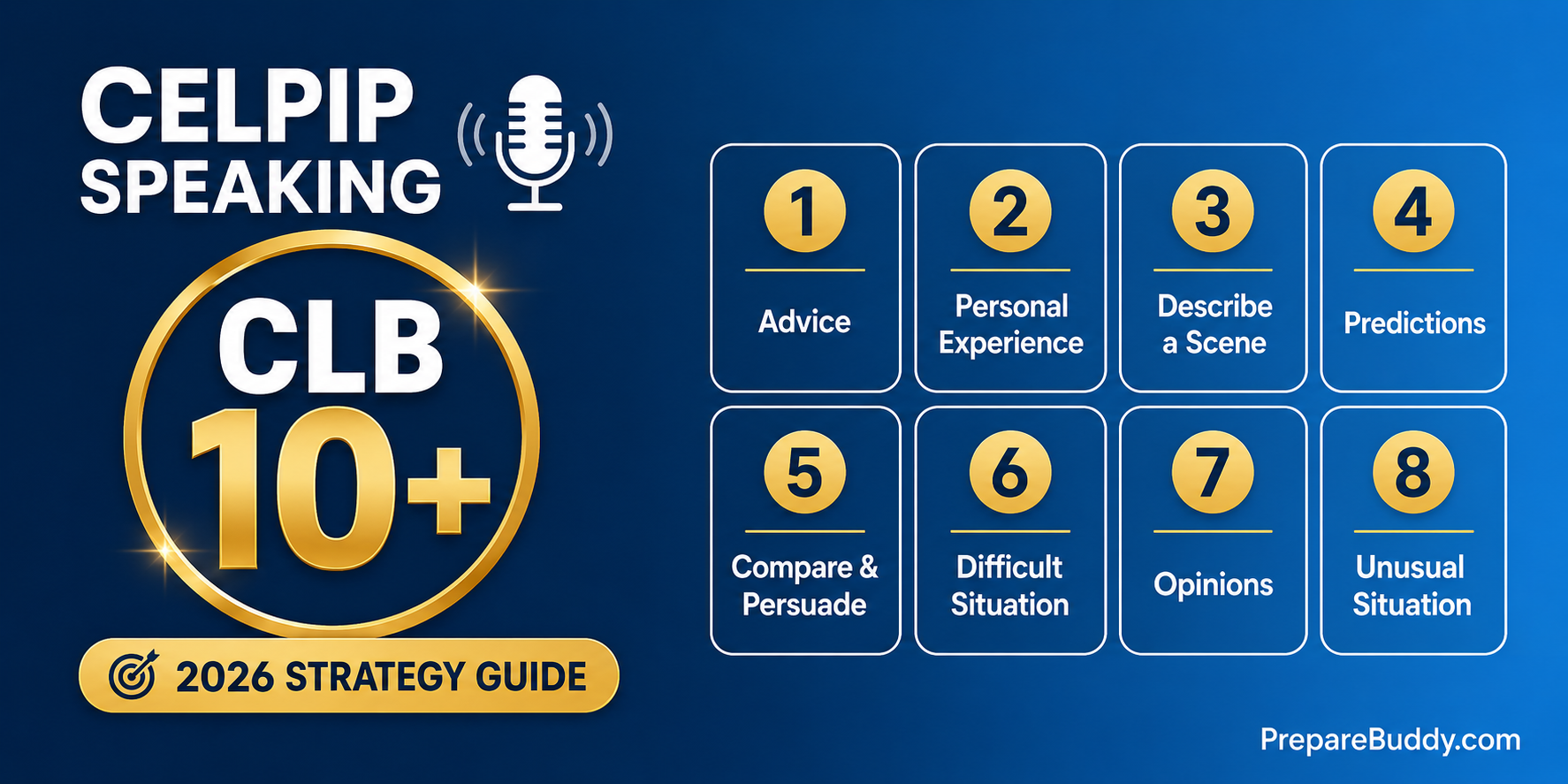
The cut-off for Canada's highest Express Entry CRS bracket for English is CLB 10 — and on CELPIP, that's the score that separates "good enough to pass" from "good enough to win the draw." A CLB 10 in Speaking is worth 32 CRS points per skill compared to 23 at CLB 9. For a single applicant, that's the difference between an Invitation to Apply this round and waiting another year.
And yet most CELPIP Speaking candidates walk in with a strategy that's been recycled from IELTS: speak slowly, use complex vocabulary, give long answers. CELPIP rewards the opposite — a fast, clear, "Canadian neighbour over coffee" register across 8 tightly timed tasks in 15–20 minutes. This guide breaks down the CELPIP Speaking section task by task, with the rubric, the timing, the scripts that hit CLB 10+, and the 4-week practice plan that gets you there.
What CLB 10+ Actually Means on CELPIP Speaking
CELPIP scores each task on the CLB 1–12 scale, then averages across all eight tasks to give an overall Speaking score. A CLB 10 means an examiner judged your spoken English as advanced — fluent, well-organised, and natural enough to handle academic or professional Canadian contexts without strain.
| CELPIP Speaking Level | CLB Equivalent | Express Entry CRS Points (per skill, single applicant) | What It Signals |
|---|---|---|---|
| 11–12 | CLB 11–12 | 34 (CLB 10+) | Expert — near-native fluency, near-zero errors |
| 10 | CLB 10 | 32 | Advanced — confident in any Canadian context |
| 9 | CLB 9 | 23 | Strong — functional in most contexts, occasional gaps |
| 8 | CLB 8 | 17 | Intermediate-high — adequate for general purposes |
| 7 | CLB 7 | 16 | Intermediate — meets minimum for most PR programs |
For Express Entry, CLB 10 in Speaking is also a hard requirement for most occupation-specific draws and many provincial nominee streams. For Canadian professional licensing — nursing, pharmacy, engineering — CLB 10 Speaking is increasingly the floor, not the ceiling.
The 4 Things CELPIP Examiners Score on Every Task
CELPIP Speaking uses task-specific criteria for each of the 8 tasks, but every task is graded on the same four dimensions. If you don't know what's being measured, you'll waste effort optimising the wrong things.
- Content / Coherence — Did you answer the actual prompt? Did your ideas connect logically? CLB 10 means you addressed every part of the question with relevant, specific examples.
- Vocabulary — Did you use a precise, varied range of words appropriate to the task? CLB 10 doesn't mean "fancy" — it means "right word, right register." A neighbour talking about a leaky tap doesn't say "the precipitation infiltrated the domicile."
- Listenability — Could a Canadian listener follow you without effort? This combines pronunciation, intonation, pacing, and stress patterns. Heavy accent isn't penalised; unclear accent is.
- Task Fulfilment — Did you complete the specific instruction (advise, predict, compare, persuade, etc.) within the time limit? Going off-task hurts more than being brief.
The 8 CELPIP Speaking Tasks — Timing, Prompt, and CLB 10 Strategy
Task 1: Giving Advice (30 sec prep / 90 sec speak)
You'll see a scenario where a friend or family member needs help making a decision. Your job: give clear, practical advice.
- CLB 10 structure (90 sec): 1 sentence acknowledging the situation → 2–3 specific pieces of advice with a reason for each → 1 sentence of warm reassurance.
- Phrase bank: "If I were you, I'd..." / "The first thing I'd try is..." / "One option worth considering is..."
- Trap to avoid: Don't list 6 generic tips. Two specific, reasoned recommendations beat six vague ones.
Task 2: Talking About a Personal Experience (30 sec prep / 60 sec speak)
You describe something that happened to you — a memorable trip, a difficult decision, a learning moment.
- CLB 10 structure (60 sec): Set the scene in 1 sentence (when/where) → narrate 2 specific moments → close with what you learned or how you felt.
- Phrase bank: "A few years back..." / "What really stood out was..." / "Looking back, I realised..."
- Trap to avoid: Making up a story you don't actually remember. Specificity sounds true; vagueness sounds rehearsed.
Task 3: Describing a Scene (30 sec prep / 60 sec speak)
You're shown an image and have to describe it to someone who can't see it — usually a photograph of a setting with several people doing different things.
- CLB 10 structure (60 sec): General overview (where, when, who) → describe the foreground in detail → describe the background → finish with a mood or atmosphere statement.
- Phrase bank: "In the foreground, there's..." / "Just behind them..." / "The overall feeling is..."
- Trap to avoid: Listing objects without spatial relationships. CLB 10 needs prepositional precision: on the left, just beside, in front of the window.
Task 4: Making Predictions (30 sec prep / 60 sec speak)
You see the same image (or a related one) and predict what will happen next.
- CLB 10 structure (60 sec): One main prediction with a reason → a secondary prediction that branches off the first → acknowledge an alternative outcome.
- Phrase bank: "It looks like... is about to..." / "I'd expect..." / "On the other hand, there's a chance that..."
- Trap to avoid: Switching tenses. Stay future-oriented: will, is going to, likely to.
Task 5: Comparing and Persuading (60 sec prep / 60 sec speak)
You're given two options (say, two apartments, two job offers, two cars). You pick one and persuade a third party that yours is the better choice.
- CLB 10 structure (60 sec): State your pick in 1 sentence → 3 specific comparison points (price, location, feature) → close with a confident recommendation.
- Phrase bank: "I'd definitely go with..." / "Compared to the other one, it offers..." / "It just makes more sense because..."
- Trap to avoid: Sitting on the fence. CELPIP rewards a clear, defended choice — not a balanced essay.
Task 6: Dealing with a Difficult Situation (60 sec prep / 60 sec speak)
You're placed in an interpersonal scenario — a conflict with a roommate, a problem with a co-worker, a complaint to address. You speak to one party in the conflict and propose a resolution.
- CLB 10 structure (60 sec): Acknowledge the other person's perspective → state your concern calmly → propose a concrete compromise → close with goodwill.
- Phrase bank: "I totally understand where you're coming from..." / "From my side, the issue is..." / "Would it work if we..."
- Trap to avoid: Sounding aggressive or robotic. CELPIP Task 6 is the single biggest "listenability" task — tone matters as much as words.
Task 7: Expressing Opinions (30 sec prep / 90 sec speak)
You take a position on a debatable topic — should kids have smartphones, should universities be free, etc.
- CLB 10 structure (90 sec): State your position in 1 sentence → 2 reasons with examples → acknowledge the counter-argument → restate position more firmly.
- Phrase bank: "In my view..." / "A good example of this is..." / "I can see why some people argue... but..."
- Trap to avoid: Memorised political opinions. Examiners hear the same "social media is bad for teenagers" script daily. Pick the angle you actually believe.
Task 8: Describing an Unusual Situation (30 sec prep / 60 sec speak)
You see a strange or out-of-context image and explain it to a friend on the phone — what's happening, where, why it's unusual.
- CLB 10 structure (60 sec): 1 sentence setting context (where you are, what you're seeing) → describe the unusual element with specific detail → speculate on a reason → close with your reaction.
- Phrase bank: "You won't believe what I just saw..." / "What's strange is..." / "I have no idea why, but..."
- Trap to avoid: Treating it like Task 3 (scene description). Task 8 is conversational storytelling, not a neutral inventory.
Total Speaking Time Map — Every Second Counts
| Task | Prep | Speak | Cumulative Speaking Time |
|---|---|---|---|
| 1. Giving Advice | 30 sec | 90 sec | 1:30 |
| 2. Personal Experience | 30 sec | 60 sec | 2:30 |
| 3. Describing a Scene | 30 sec | 60 sec | 3:30 |
| 4. Making Predictions | 30 sec | 60 sec | 4:30 |
| 5. Comparing & Persuading | 60 sec | 60 sec | 5:30 |
| 6. Difficult Situation | 60 sec | 60 sec | 6:30 |
| 7. Expressing Opinions | 30 sec | 90 sec | 8:00 |
| 8. Unusual Situation | 30 sec | 60 sec | 9:00 |
Total spoken output: about 9 minutes of speech across the section. The biggest cause of dropping from CLB 10 to CLB 8 isn't language — it's silence. Trailing off at 45 seconds on a 60-second task signals weakness to the examiner regardless of how good your sentences are.
What Makes CELPIP Speaking Different From IELTS Speaking
- No examiner in the room. CELPIP is fully computer-delivered. You speak to a microphone. The advantage: no nerves about an interviewer's expression. The challenge: no human cues telling you to slow down or expand.
- Strict timer. When the countdown hits zero, the mic cuts off mid-word. You cannot push past the buzzer the way you can with an IELTS examiner.
- Canadian register. CELPIP rewards what sounds like everyday Canadian English — contractions ("I'd", "wouldn't"), natural fillers used sparingly ("you know", "I mean"), and conversational connectors. Over-formal language can hurt your Listenability score.
- Eight tasks, not three. Stamina is a real factor. Most candidates' Listenability drops in tasks 6–8 simply because they're tired.
The 4-Week Practice Plan for CLB 10+
This plan assumes you can put in about 45 minutes of focused practice per day. Less than that, and you'll need to extend the plan to 6 weeks.
Week 1 — Diagnose and Fix Listenability
- Record yourself doing one task per day. Listen back at 1.25x speed. If you can't follow your own English at 1.25x, a Canadian listener won't either at 1x.
- Drill the 25 most-mispronounced words for South-Asian, Filipino, and Francophone speakers (Google a CELPIP-specific list and target your phonemic weak spots).
- Train your sentence stress: emphasise content words (nouns, verbs), not function words (the, of, to).
Week 2 — Master the 8 Task Structures
- Two tasks per day with strict timing. Use a kitchen timer. When it beeps, you stop — no exceptions.
- Build a personal phrase bank: 5 reusable opening phrases, 5 transition phrases, 5 closing phrases. Memorise so they come out under pressure.
- Get AI feedback on every recording. Tools like PrepareBuddy's Voice AI score your pronunciation, fluency, and pacing in real time with 48-emotion detection, so you can see exactly where your listenability drops.
Week 3 — Build Stamina and Range
- Do all 8 tasks in one sitting, 3 times this week. This is the only way to build the endurance you need for the real test.
- Push your vocabulary range — collect 30 precise Canadian-English collocations you've never used (e.g., "weighing my options", "running by you", "split the difference", "a fair shake").
- Practice with PrepareBuddy's CELPIP module — full 15-minute mocks that simulate the exact interface and timing of the real test, then AI-scored against task-specific CLB criteria.
Week 4 — Test-Day Conditioning
- Two full mock Speaking sections per week under exact conditions: morning timing, same desk, same headset.
- Refine your Multi-Perspective Feedback review: focus on the Examiner persona's notes (which CLB descriptor you missed) and the Coach's "one before/after rewrite" suggestion for each weak task.
- Sleep, hydration, and warm-up matter. Do a 2-minute vocal warm-up before the real test — humming, lip trills, reading a paragraph aloud.
How AI Speaking Practice Closes the CLB 9-to-10 Gap
The single most common plateau on CELPIP Speaking is the CLB 9 wall. Candidates speak fluently, hit the time, and answer the prompt — but score CLB 9, not 10. The reason is almost always feedback granularity: a human tutor catches a handful of issues per session. AI catches every issue.
PrepareBuddy's Voice AI uses real-time pronunciation scoring across 30+ English accents, with 48-emotion detection that flags when your delivery sounds tentative, monotone, or rushed. After each task, the system runs a Multi-Perspective Feedback panel: an Examiner persona points to the exact CLB descriptor missed, a Study Coach gives one before/after rewrite of your actual words, and a Fellow Student shows how fixing one area moves your overall band. That's three layers of feedback per response — the kind of granularity that converts CLB 9 into CLB 10.
You can also practise CELPIP Speaking under demo conditions free on the free practice test page to benchmark where you stand before committing to a full prep cycle.
Frequently Asked Questions
How long is the CELPIP Speaking section?
About 15–20 minutes total. You'll complete 8 tasks with preparation time built in. Total spoken output is roughly 9 minutes; the rest is prep, instructions, and transitions.
What's the minimum CELPIP Speaking score for Canadian PR?
For most Express Entry programs, CLB 7 (CELPIP 7) is the minimum. For CLB 10 CRS points (32 per skill, single applicant), you need a 10 in each of Speaking, Listening, Reading, and Writing.
Is CELPIP Speaking easier than IELTS Speaking?
Different, not easier. CELPIP is computer-delivered and rewards a natural Canadian register; IELTS is face-to-face and rewards range and complexity. Most candidates find CELPIP fairer for everyday English but harder for stamina (8 tasks vs. 3 parts).
Can I retake just the Speaking section?
No. CELPIP requires you to retake the entire test if you want to improve any single skill score.
Does my accent matter on CELPIP?
No, as long as you're clear. CELPIP is graded on listenability — can a Canadian listener follow you easily? — not on whether you sound North American. PrepareBuddy's Voice AI is calibrated on 30+ English accents for exactly this reason.
Ready to Practise CELPIP Speaking?
The fastest path to CLB 10 on CELPIP Speaking is volume + granular feedback + real test conditions. Start a free PrepareBuddy account and access the full CELPIP Speaking practice suite — all 8 task types, AI-scored to task-specific CLB criteria, with Voice AI feedback on pronunciation, fluency, and listenability after every attempt. Or try a free CELPIP practice test first to benchmark where you stand today.
Join the Discussion