

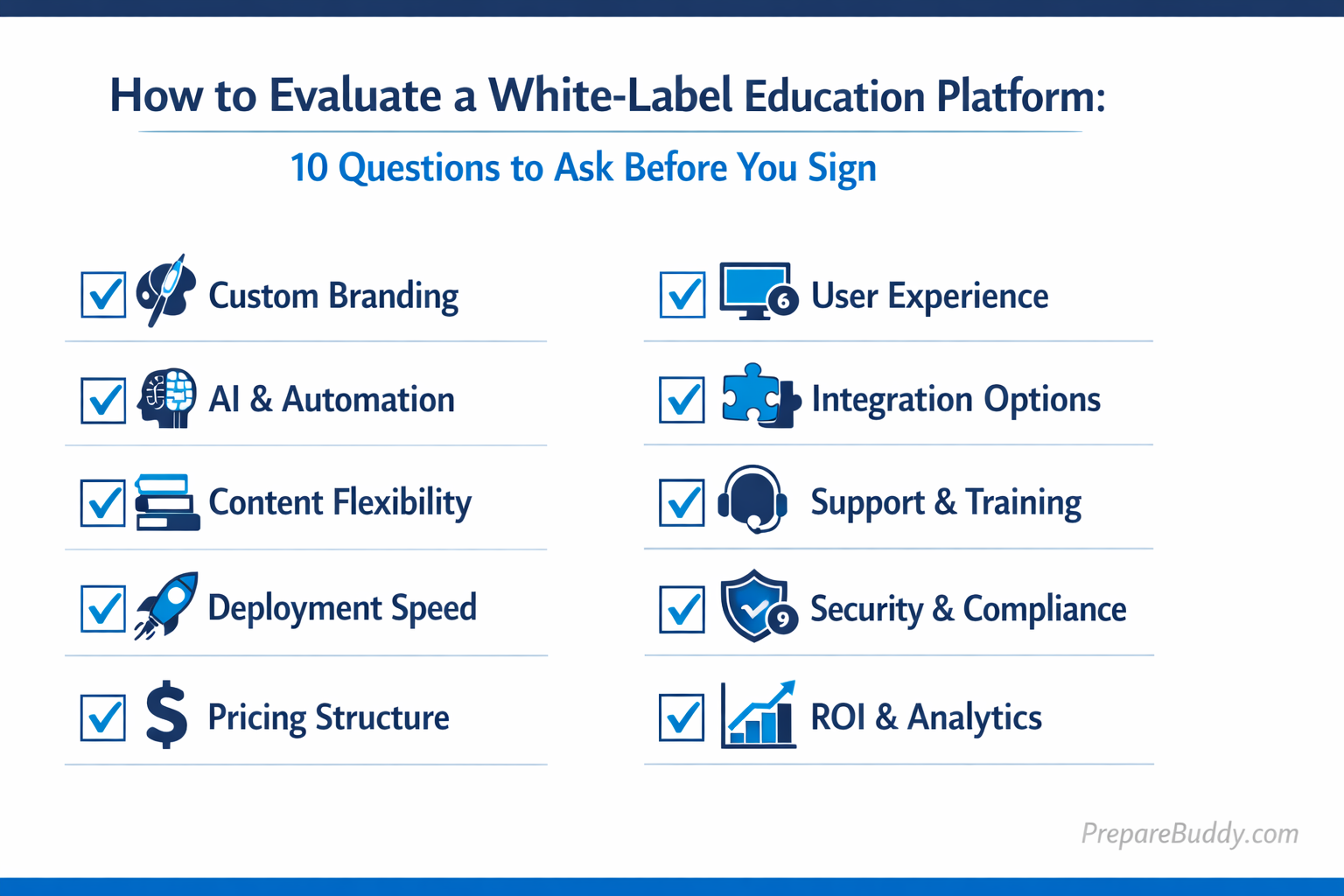
You've decided your coaching center, consultancy, or language institute needs a technology platform. You're not going to build one from scratch — that's a 12-month, six-figure commitment most education businesses can't justify. So you're evaluating white-label platforms.
Here's the problem: most evaluation processes focus on surface-level features. They miss the questions that actually determine whether a platform will scale with your business or become an expensive headache within six months.
After working with 200+ institutions across Australia, Southeast Asia, the Middle East, and Europe, we've identified the 10 questions that separate a smart platform choice from a costly mistake.
1. How Complete Is the White-Label Branding?
Not all "white-label" platforms are created equal. Some let you add a logo. Others give you complete control over the student experience.
Ask specifically: Can I use my own domain? Can I customize the logo, color scheme, and email templates? Will my students ever see the platform provider's branding?
What to look for: A platform that offers 100% custom branding — your domain, your logo, your colors, and branded emails. Your students should never know there's a technology partner behind the scenes. This is especially critical for consultants and coaching centers building a premium brand.
2. What Test Types and Content Are Included?
Your students don't all take the same test. A platform locked into one or two test types limits your market.
| Category | Tests to Look For | Why It Matters |
|---|---|---|
| English Proficiency | IELTS, TOEFL, PTE Academic, PTE Core, Duolingo, CELPIP, OET | Covers students headed to UK, US, Canada, Australia |
| Graduate Admissions | GRE, GMAT, SAT | Expands your addressable market beyond language tests |
| Language Proficiency | CEFR A1-C2 levels across Reading, Writing, Listening, Speaking | Essential for institutional and corporate clients |
| Psychometric | Big Five, Holland Code, HEXACO, Aptitude | Differentiates your offering from competitors |
The best platforms support 11+ test types and include psychometric assessments as a value-add, not a separate product you have to purchase.
3. How Sophisticated Is the AI Scoring?
AI scoring is the feature that makes or breaks a test prep platform. Generic auto-scoring that just checks keywords won't cut it — students need feedback that mirrors real exam conditions.
Ask for specifics: What's the scoring accuracy compared to human raters? Does the AI handle essay writing analysis, not just multiple choice? Can it score speaking responses with pronunciation and fluency feedback?
Benchmark: Look for 95% AI scoring accuracy with multi-model verification. The platform should support AI writing analysis that evaluates coherence, grammar, vocabulary, and task achievement — not just surface-level grammar checks.
4. Does It Include Voice AI for Speaking Practice?
Speaking sections are where students struggle most, and where most platforms fall short. If students have to record audio and wait days for feedback, they won't practice enough.
Key capabilities to evaluate: real-time pronunciation scoring, fluency analysis, support for multiple English accents (look for 30+ accents), and emotion detection that can identify student confidence and anxiety patterns.
A platform with 48-emotion detection in its Voice AI gives students genuinely useful feedback — not just "try again."
5. Can It Generate Content, or Are You Stuck with a Fixed Question Bank?
Static question banks run dry. Students cycle through the same questions, and the practice effect diminishes. Your platform needs an AI content engine that can generate fresh, calibrated questions on demand.
Ask: Can the platform generate questions across multiple format types? Does it calibrate difficulty levels? Can it validate content against educational standards?
Look for a platform with an AI content engine supporting 4 question format types with difficulty calibration and educational standard validation. This means your question bank never runs out.
6. What Does the Student Experience Look Like Beyond Practice Tests?
A test prep platform that only offers practice tests is missing the bigger picture. Students need a guided preparation journey.
Evaluate whether the platform includes:
| Feature | Student Impact | Business Impact |
|---|---|---|
| AI Study Plans | Personalized roadmap that adapts to performance | Higher completion rates, better outcomes |
| AI Tutor (24/7) | Instant help when stuck, remembers student progress | Reduces support burden on your team |
| Adaptive Testing | Questions adjust difficulty in real-time | More accurate score predictions |
| University Recommendations | AI-powered Reach/Target/Safety school matching | Adds consultancy value to your offering |
| Analytics Dashboard | Clear progress tracking and weak area identification | Data for parent/student progress meetings |
7. How Fast Can You Deploy?
Every week without a platform is a week of lost revenue. Some white-label providers take 3-6 months to set up. Others can get you live in days.
Ask: What's the typical deployment timeline? Do I need technical staff to set up? What's included in the onboarding process?
Benchmark: A well-built platform should deploy within 24-48 hours. If a provider tells you it takes months, that's a sign of heavy customization requirements — which usually means higher costs and more complexity down the road.
8. What's the Pricing Model, and What Are the Hidden Costs?
Education technology pricing is notorious for hidden fees. Setup costs, per-student fees, feature tiers, annual commitments — they add up fast.
Questions to ask: Is there a setup fee? Are there per-student charges? What features are included in the base price versus add-ons? Am I locked into an annual contract?
What to look for: Transparent pricing with no lock-in contracts. A free first month lets you validate the platform with real students before committing any budget. No credit card required to start means the provider is confident in their product.
9. Can the Platform Support Your B2B Operations?
If you're running a coaching center or consultancy, you need more than student-facing features. Your operational workflow matters too.
Evaluate: Can you manage student batches? Can you assign and track assignments? Is there enrollment management? Can you run batch assessments for institutional clients?
For education consultants, look for a student journey management feature that covers the complete study abroad pipeline — from career discovery through post-arrival. This turns your platform from a test prep tool into a full-service consultancy system with counselor dashboards, stage stall detection, and automated email reminders.
10. What's the Measurable ROI?
The final question is the most important: will this platform pay for itself?
Ask the provider for concrete ROI metrics from existing clients. How much time does it save on grading? What's the impact on student satisfaction? What revenue increase have similar businesses seen?
| Metric | What to Expect |
|---|---|
| Time Saved on Grading | 75% reduction (18+ hours saved weekly) |
| Student Satisfaction | 95% satisfaction rate |
| ROI Timeline | 300% ROI within 18 months |
| Deployment Speed | Live within 24-48 hours |
The Evaluation Checklist
Before signing with any white-label education platform, score each provider against these 10 criteria. Weight them based on your specific business model — a coaching center in Australia evaluating IELTS/PTE prep has different priorities than a consultant managing the full study abroad journey.
The platforms that score highest across all 10 areas are the ones built specifically for education businesses, not adapted from generic LMS tools. Look for providers with a proven track record across 200+ institutions, supporting 50,000+ students, and offering the full stack — from AI-scored practice tests to student lifecycle management.
Ready to Evaluate?
If you're currently comparing white-label education platforms, see how platforms stack up side-by-side. You can also explore what a white-label platform looks like for consultants or check transparent pricing with no hidden fees.
Want to see a platform that checks all 10 boxes? Schedule a free demo — no commitment, no credit card required.


Join the Discussion