

Most people studying for the GRE pour weeks into Quant drills and vocabulary lists, then spend roughly twenty minutes thinking about the essay. Then the scores arrive: a respectable 162 Quant, a solid 159 Verbal—and a 3.5 in Analytical Writing that makes an admissions reader pause. GRE Analytical Writing is the section applicants most often underestimate, and at competitive programs a weak essay score can quietly undercut an otherwise strong file. The good news: the Issue task is one of the most coachable parts of the entire test. This guide breaks down exactly how to reach a 5.0 or higher in 2026.
What GRE Analytical Writing actually tests in 2026
Since the GRE was shortened, the Analytical Writing measure is a single 30-minute task: Analyze an Issue. (The older "Analyze an Argument" essay was retired.) You are given a short statement on a topic of general interest plus a specific instruction, and you have half an hour to build a reasoned, well-supported response.
You are not scored on whether you are "right." The rating reflects how clearly you take a position, how logically you develop it, how relevant your reasons and examples are, and how well you control standard written English. Each essay is scored on a 0–6 scale in half-point increments by one trained human rater and an automated scoring engine (ETS's e-rater); if those two scores diverge, a second human rater steps in, and the reported score is their average rounded to the nearest half point.
The GRE Analytical Writing score scale — and what each band signals
Understanding the scale tells you what "good" really means. Here is how scores map to ETS performance levels, approximate percentiles, and how admissions readers tend to interpret them.
| Score | ETS performance level | Approx. percentile | How admissions tends to read it |
|---|---|---|---|
| 6.0 | Outstanding | ~99th | Exceptional and rare |
| 5.5 | Strong to outstanding | ~98th | Elite writing ability |
| 5.0 | Strong | ~91st | Top tier; clears virtually every program's bar |
| 4.5 | Adequate to strong | ~80th | Comfortably above average |
| 4.0 | Adequate | ~54th | The common informal "minimum" |
| 3.5 | Limited to adequate | ~38th | Below the bar at competitive programs |
| 3.0 | Limited | ~14th | Likely to be flagged |
Two takeaways. First, the jump from a 4.0 to a 5.0 is not twice the work—it usually comes down to a handful of specific habits covered below. Second, because the mean essay score sits around 3.5, a 5.0 puts you in roughly the top 10% of test-takers, which is exactly the kind of signal selective programs notice.
Why 5.0 is the number to aim for
Plenty of programs publish no AWA cutoff, but many reviewers use 4.0 as an informal floor and treat 4.5–5.0 as the comfort zone—particularly for applicants whose first language is not English, where the essay doubles as a writing-ability check. Hitting 5.0 removes Analytical Writing as a question mark and lets the rest of your application speak. Aiming for 5.0 rather than scraping 4.0 also gives you a buffer: even if one essay underperforms on test day, you still land safely above the line.
A 5-step framework to score 5.0+ on the Issue task
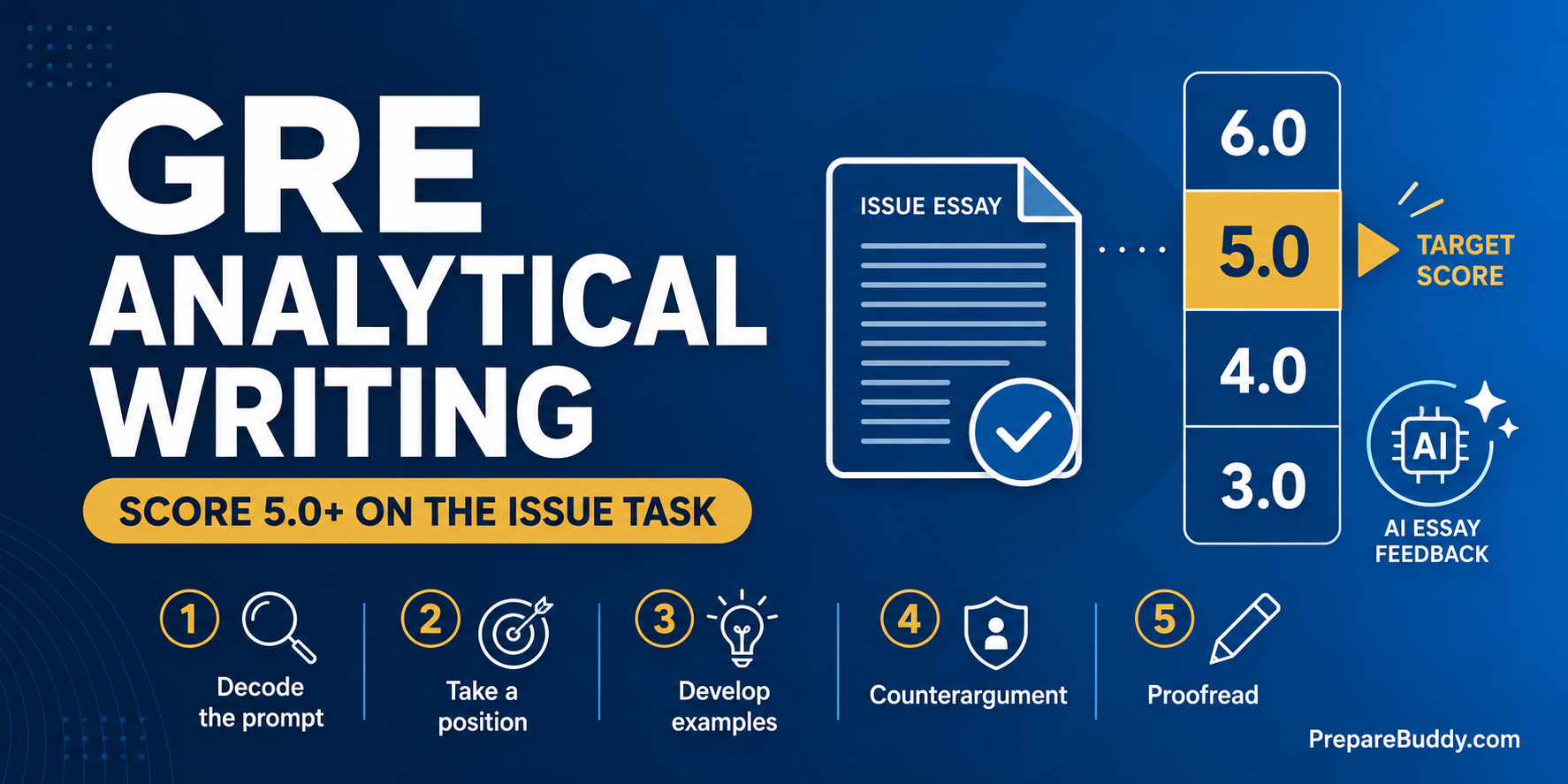
- Decode the instruction, not just the topic. Every Issue prompt comes with a specific instruction line—"discuss the extent to which you agree or disagree," "address the most compelling reasons or examples that could challenge your position," and so on. The instruction tells you what structure the raters expect. Ignoring it is the single most common reason strong writers cap at 4.0.
- Commit to a clear, qualified position. Fence-sitting reads as weak reasoning. Take a side—but a nuanced one ("this holds in most cases, except when..."). State it explicitly in your introduction along with a one-line roadmap of your reasons.
- Develop two to three reasons with concrete examples. Each body paragraph should make one claim, back it with specific evidence (history, current events, science, or a detailed hypothetical), and explain why that evidence proves your point. Depth beats breadth: two fully developed paragraphs outscore four shallow ones.
- Engage the other side. The clearest separator between a 4.5 and a 5.5 is a paragraph that acknowledges a strong counterargument and then answers it. It demonstrates exactly the critical thinking the rubric rewards.
- Protect time for structure and proofreading. A 30-minute essay needs a plan and a clean finish. Use the timing plan below, and save the last three minutes to fix grammar, transitions, and typos—mechanical errors drag scores down fast.
A 30-minute timing plan
| Minutes | Phase | What you are doing |
|---|---|---|
| 0–4 | Plan | Decode the instruction, choose your position, jot 2–3 reasons and examples |
| 4–7 | Introduction | State your qualified position and preview your reasons |
| 7–23 | Body | 2–3 developed paragraphs plus your counterargument (~5 minutes each) |
| 23–27 | Conclusion | Synthesize the implications of your position |
| 27–30 | Proofread | Fix grammar, transitions, and typos |
A repeatable Issue-essay structure
You do not need a memorized template—raters penalize formulaic, content-free scaffolding—but you do need a reliable shape so you are not inventing structure under time pressure:
- Introduction: restate the issue in your own words, state your qualified position, preview your reasons.
- Body 1 and 2: one reason each—claim, then a specific example, then an explanation of why it matters.
- Counterpoint: the strongest objection to your view, followed by your rebuttal.
- Conclusion: synthesize what follows if your position is correct, rather than just repeating the introduction.
Common mistakes that cap you at 4.0
- Answering the topic but ignoring the specific instruction line.
- Listing many examples without developing any of them.
- A vague or missing thesis, so the reader cannot tell where you stand.
- Memorized templates and filler sentences that add no content.
- Skipping the counterargument entirely.
- Leaving no time to proofread, so sentence-level errors run throughout.
How to practice GRE Analytical Writing with AI feedback
Writing improves through timed reps with honest feedback—and the bottleneck has always been that no one is around to grade your tenth practice essay at midnight. That is the gap PrepareBuddy's AI Writing Analysis closes. It evaluates an essay against the criteria that matter—position and focus, development and support, organization, and command of language—and returns criterion-level feedback with specific evidence quoted from your own text, so you see exactly which paragraph cost you points. Because scoring uses multi-model verification, it reaches 95% AI scoring accuracy, and feedback is instant, so you can run many timed Issue essays in the time it used to take to get a single one back.
From there, the platform's AI Tutor is available 24/7 to explain why a paragraph was weak and how to rewrite it, AI Study Plans turn your weak spots into a daily practice schedule, and analytics track your score trend across attempts. GRE prep sits alongside full GRE practice and 11+ other test types on one platform, so you can work on Analytical Writing, Verbal, and Quant in the same place.
Frequently asked questions
Is there only one essay on the GRE now?
Yes. The current GRE Analytical Writing measure is a single 30-minute "Analyze an Issue" task. The separate Argument essay was removed when the test was shortened.
How is GRE Analytical Writing scored?
On a 0–6 scale in half-point steps. One trained human rater and an automated e-rater score each essay; if they disagree meaningfully, a second human adjudicates, and the final score is the average rounded to the nearest half point.
What is a good GRE Analytical Writing score?
A 4.5 is comfortably above average, and a 5.0 sits near the top 10% of test-takers. Many programs treat 4.0 as an informal minimum, so aiming for 5.0 gives you a safe buffer.
How long should a GRE Issue essay be?
There is no required length, but high-scoring essays are well developed—usually four to six paragraphs with fully explained reasons and examples. Depth of development matters more than raw word count.
Can AI score my GRE practice essays?
Yes. PrepareBuddy's AI Writing Analysis grades practice essays against writing criteria and returns instant, evidence-based feedback, so you can practice under timed conditions and see precisely where to improve.
Ready to turn essay practice into points? Write your first timed Issue essay and get instant AI feedback with a free practice test, or create your free account—first month free, no credit card required—and start tracking your Analytical Writing score toward 5.0+.


Join the Discussion