

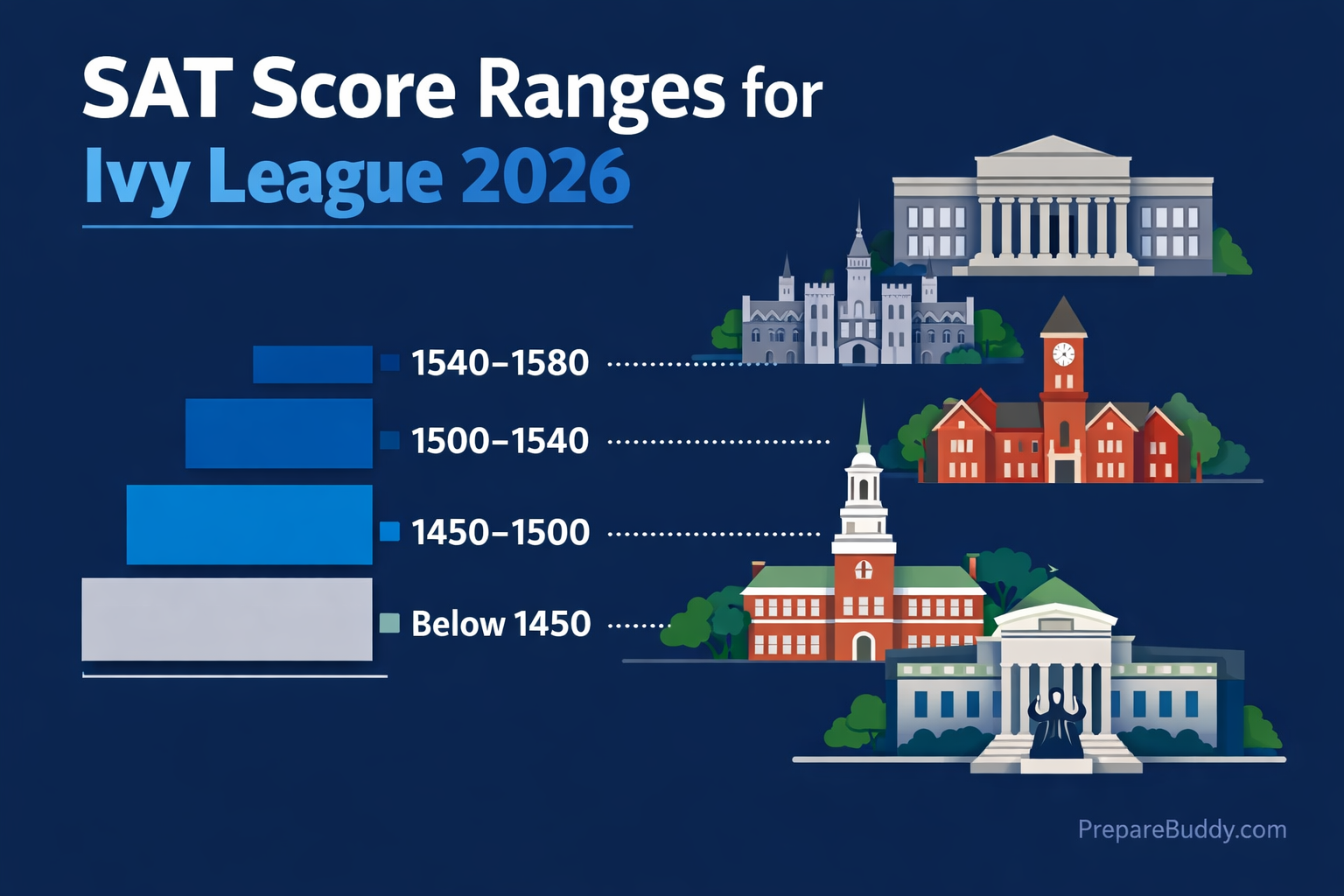
A 1500 on the SAT sounds impressive until you realize the median admitted student at Harvard scored 1520–1580. For Princeton, it’s 1510–1570. And at Columbia, rejected applicants regularly hold 1550+ scores.
The uncomfortable truth about Ivy League admissions is that SAT scores alone don’t get you in—but the wrong score can keep you out. Understanding exactly where you stand relative to each school’s admitted student profile is the first step toward a realistic application strategy.
Here’s a data-driven look at what SAT scores Ivy League schools actually expect in 2026, how to assess your competitiveness, and what to do if your score falls short.
SAT Score Ranges for All 8 Ivy League Schools
The SAT is scored on a 400–1600 scale across two sections: Evidence-Based Reading and Writing (200–800) and Math (200–800). Ivy League schools report the middle 50% range of admitted students, meaning 25% scored below and 25% scored above this range.
| University | 25th Percentile | 75th Percentile | Acceptance Rate | Competitiveness |
|---|---|---|---|---|
| Harvard University | 1500 | 1580 | ~3.4% | Extremely High |
| Princeton University | 1500 | 1570 | ~3.7% | Extremely High |
| Columbia University | 1490 | 1570 | ~3.9% | Extremely High |
| Yale University | 1480 | 1570 | ~4.4% | Extremely High |
| University of Pennsylvania | 1480 | 1570 | ~5.4% | Very High |
| Brown University | 1470 | 1560 | ~5.0% | Very High |
| Dartmouth College | 1470 | 1560 | ~6.2% | Very High |
| Cornell University | 1450 | 1550 | ~7.3% | Very High |
Key takeaway: No Ivy League school has a 25th percentile below 1450. If your SAT score is below 1450, you’re applying from a statistically disadvantaged position at every Ivy.
What These Ranges Actually Mean for Your Application
The middle 50% range tells you where the bulk of admitted students fall, but it doesn’t tell the whole story. Here’s how to interpret your score relative to these ranges:
| Your Score Position | What It Means | Strategy |
|---|---|---|
| Above 75th percentile | Your SAT is a strength. Admissions focus shifts to essays, extracurriculars, and recommendations. | Focus preparation time on application essays and activities |
| Within middle 50% | You’re competitive. Your score won’t hold you back, but it won’t carry you either. | Consider retaking if you can realistically gain 30+ points |
| Below 25th percentile | Your score is a weakness. You need exceptional strengths elsewhere to compensate. | Retake the SAT, or broaden your school list with target and safety options |
| Below 1400 | Statistically unlikely at most Ivies unless you have a significant hook (recruited athlete, legacy, underrepresented background). | Focus on schools where your score is within the middle 50% |
SAT Section Scores: Where Ivy League Applicants Excel
Total scores only tell part of the story. Ivy League applicants typically need strong performance in both sections. Here’s what competitive section scores look like:
| Section | Competitive Range | Target for Ivy League | Tips |
|---|---|---|---|
| Evidence-Based Reading & Writing | 720–780 | 750+ | Focus on passage analysis and grammar rules |
| Math | 750–800 | 770+ | Master algebra, advanced math, and data analysis |
STEM-focused programs (engineering at Cornell, Wharton at Penn) often expect math scores at 780+, while humanities programs may weigh the reading/writing section more heavily.
Beyond the Score: What Else Ivy League Schools Consider
SAT scores are one data point in a holistic review process. Here’s how the major factors typically weight in Ivy League admissions:
| Factor | Importance Level | What Schools Look For |
|---|---|---|
| GPA & Course Rigor | Very Important | High GPA in AP/IB/Honors courses, upward trend |
| SAT/ACT Scores | Important | Scores within or above the middle 50% range |
| Extracurricular Activities | Very Important | Leadership, depth over breadth, meaningful impact |
| Essays | Very Important | Authentic voice, self-reflection, clear narrative |
| Recommendations | Important | Specific examples of character, intellectual curiosity |
| Demonstrated Interest | Varies by School | Campus visits, interviews, school-specific essays |
How Many Times Should You Take the SAT?
Most Ivy League schools practice “superscoring”—they take the highest section scores across multiple test dates. This means retaking strategically can improve your composite score without risk.
Here’s a practical retake framework:
| Current Score | Recommendation | Expected Improvement |
|---|---|---|
| 1200–1350 | Retake after focused preparation (8–12 weeks) | 50–150 points with structured study |
| 1350–1450 | Retake with targeted section focus | 30–80 points with section-specific practice |
| 1450–1520 | Consider one more attempt if time allows | 20–50 points with intensive practice |
| 1520+ | Diminishing returns—invest time in essays and activities | 10–30 points maximum |
The key to score improvement is targeted practice. Generic studying rarely moves the needle above 1450. You need to identify your specific weak areas—whether that’s algebra, data interpretation, grammar rules, or reading comprehension—and drill them systematically.
Building a Smart SAT Preparation Strategy
Effective SAT preparation for Ivy League targets follows a specific progression:
Phase 1: Diagnostic Assessment (Week 1)
Take a full-length practice test under timed conditions. Identify which question types you miss most frequently and which sections have the largest gap from your target score. A free diagnostic test can establish your baseline and pinpoint exactly where to focus.
Phase 2: Targeted Skill Building (Weeks 2–6)
Focus on your weakest areas first. For math, this often means mastering advanced algebra and data analysis. For reading/writing, it typically means improving passage analysis speed and grammar accuracy. Use AI-powered tutoring to get immediate feedback on every practice question rather than waiting for weekly review sessions.
Phase 3: Full-Length Practice (Weeks 7–10)
Take 2–3 full practice tests per week under realistic conditions. Review every wrong answer. Track your score trajectory. If you’re not seeing improvement, adjust your study focus.
Phase 4: Test-Day Preparation (Weeks 11–12)
Reduce to 1 practice test per week. Focus on timing strategy, stress management, and reviewing your most common error patterns.
Using AI Tools to Maximize Your SAT Score
Traditional SAT prep relies on static question banks and generic study plans. Modern AI-powered platforms change this by adapting to your specific performance patterns.
Here’s what AI-driven SAT preparation looks like in practice:
Adaptive question difficulty: Instead of working through questions at a fixed difficulty level, adaptive testing adjusts each question based on your previous answers. Score 780 on math? You get harder problems. Struggling with grammar? You get more practice at your current level before advancing.
Personalized study plans: AI analyzes your practice test results and builds a customized study schedule that prioritizes your weakest areas. No more guessing what to study next.
Instant scoring and feedback: Every practice essay and response gets AI-powered scoring with detailed feedback—what you did well, what needs improvement, and specific suggestions for next time. With 95% scoring accuracy verified through multi-model validation, the feedback you receive closely mirrors what a human scorer would provide.
What If Your Score Falls Short?
Not every student will reach 1500+, and that’s okay. A strong application strategy includes schools at every competitiveness level:
| Your SAT Range | Ivy League Chances | Smart Strategy |
|---|---|---|
| 1500+ | Competitive at all Ivies | Apply broadly, differentiate through essays |
| 1450–1500 | Competitive at Cornell, Dartmouth, Brown | Focus applications on schools where your score is within range |
| 1400–1450 | Below average at most Ivies | Include strong target schools (Top 20–50) alongside 1–2 Ivy reaches |
| Below 1400 | Statistical long shot | Focus on excellent schools where your score is competitive |
Tools like AI-powered university matching can help you build a balanced school list based on your actual profile—categorizing schools into Safe, Target, and Ambitious tiers using a deterministic 100-point scoring system rather than guesswork.
Start Preparing with the Right Tools
The difference between a 1400 and a 1500+ often comes down to preparation strategy, not raw ability. Students who use adaptive, AI-powered practice tools typically see larger score improvements than those using static prep materials, because the technology identifies and addresses weak spots that generic study plans miss.
Ready to see where you stand? Take a free SAT practice test to get your baseline score and a personalized improvement plan. Or explore PrepareBuddy’s full SAT preparation suite with adaptive testing, AI scoring, and personalized study plans designed to help you reach your target score.


Join the Discussion