

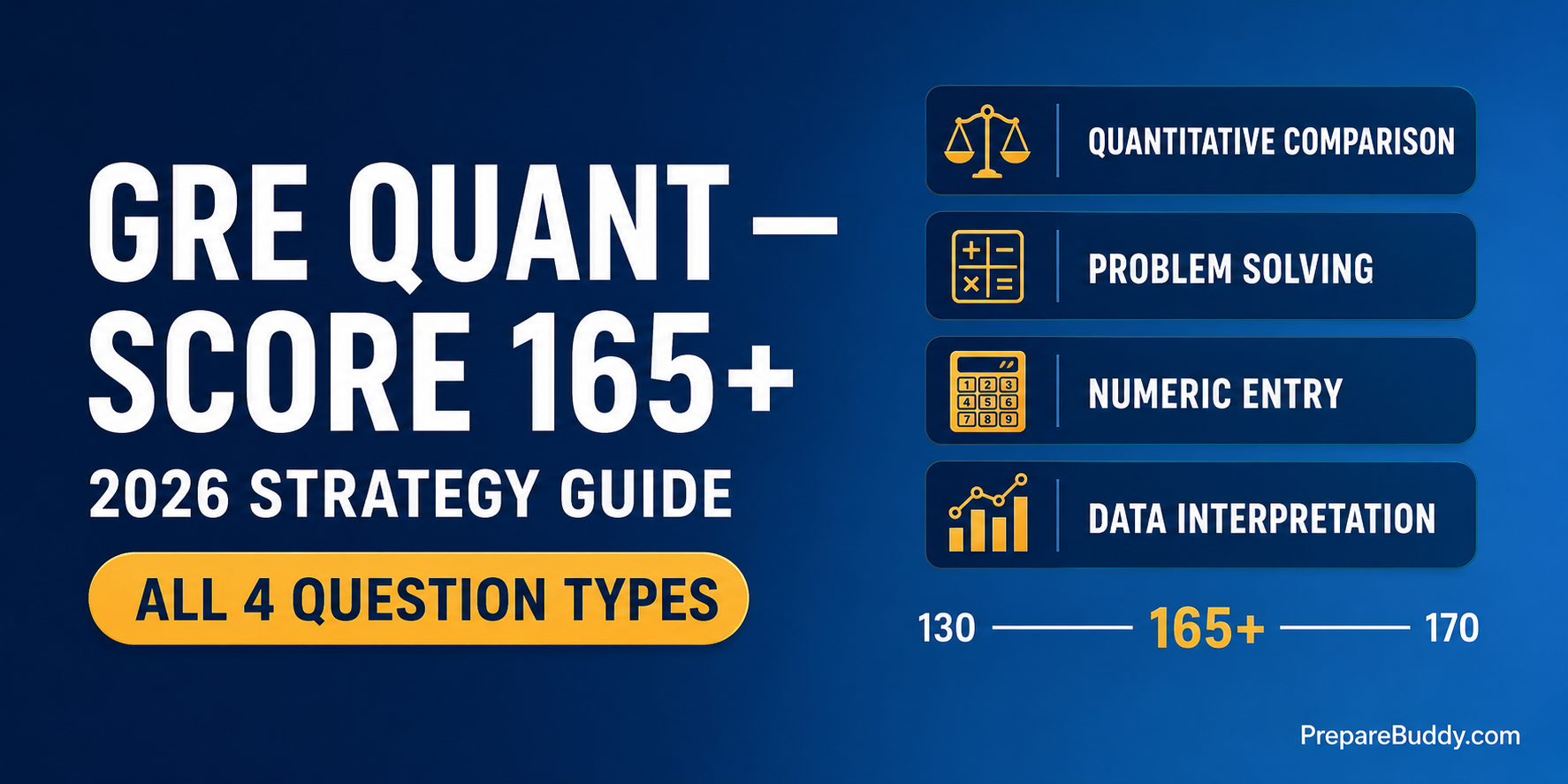
A 165 on GRE Quantitative Reasoning sits at roughly the 87th percentile — and it’s the difference between “applicant we’ll consider” and “applicant we’ll fund” for most STEM and quantitative business graduate programs. The math itself is not hard. Algebra I, geometry, statistics, and word problems — nothing past high-school content. What makes GRE Quant brutal is the format: a section-level adaptive test where your Section 1 performance decides whether Section 2 hands you medium questions you can ace or hard questions that punish a single careless arithmetic slip.
This guide breaks down how the 2026 GRE Quant section actually works, what a 165+ scorer does differently in each of the four question types, and a 6-week practice plan you can actually follow. If you’re prepping for a master’s, PhD, or quant-heavy MBA, this is the playbook.
GRE Quantitative Reasoning Format in 2026: What You’re Actually Up Against
The GRE General Test is 190 minutes, scored 260–340 (130–170 per measure). Quantitative Reasoning is two 27-question sections, ~47 minutes each. Crucially, GRE Quant is section-level adaptive — your performance on Section 1 routes you into an easy, medium, or hard Section 2 pool. The harder the second section, the higher your scoring ceiling.
| GRE Quant Detail | 2026 Format |
|---|---|
| Sections | 2 × 27 questions, ~47 min each |
| Score range | 130–170 per measure (1-point increments) |
| Adaptive logic | Section-level (Section 2 difficulty depends on Section 1) |
| On-screen calculator | Basic 4-function with square-root (no exponents, no memory of intermediate work) |
| Question types | 4 — Quantitative Comparison, Problem Solving, Numeric Entry, Data Interpretation |
| Content areas | Arithmetic, Algebra, Geometry, Data Analysis & Probability |
| Skip & return | Yes — within the same section only |
What a 165+ GRE Quantitative Reasoning Score Actually Requires
To reliably hit 165 or higher, you need to land in the hard pool for Section 2 — which means missing no more than 3–4 questions across Section 1. Below 165, the gap between scores compresses; above 165, every additional question right is worth more, but every careless mistake costs you a point. Here is what each score band typically corresponds to:
| Quant Score | Percentile (approx.) | Typical Program Tier | Section 2 Pool Required |
|---|---|---|---|
| 170 | 96th | Top-10 CS, Stats, Quant Finance, Math PhD | Hard (and near-perfect) |
| 167–169 | 89–94th | Top-20 STEM, MS Data Science, Econ PhD | Hard |
| 165–166 | 84–87th | Strong STEM master’s, MBA quant-heavy | Hard |
| 160–164 | 69–82nd | Most STEM master’s programs | Medium or low-hard |
| 155–159 | 49–65th | Non-quant master’s, humanities PhDs | Medium |
The 4 GRE Quant Question Types — And How 165+ Scorers Attack Each One
1. Quantitative Comparison (~7–9 per section)
You’re shown Quantity A and Quantity B and have to choose: A is greater, B is greater, they’re equal, or relationship cannot be determined. This is GRE Quant’s highest-leverage type — 165+ scorers never solve QC problems by computing both sides. They compare.
The high-scorer rule: if a variable is involved, plug in 3 numbers in this order — a positive integer, zero, and a negative fraction. If the answer flips, choose D. If the comparison holds for all three, you can usually trust the relationship. This single discipline eliminates the most common 165+ killer: forgetting that “number” on the GRE means real numbers, not positive integers.
2. Problem Solving — Multiple Choice (~12–14 per section)
Standard 5-option MCQs. The 2026 GRE keeps this as the dominant type. The high-scorer move here is backsolving — when answer choices are clean numbers, plug them into the problem instead of doing algebra. ETS deliberately writes answer choices in ascending order, so starting with choice (C) means you eliminate at least two options on every guess.
Watch for one specific trap: questions that ask “which of the following could be true” vs “which must be true.” A “could” question accepts any single valid scenario; a “must” question requires proof across all scenarios. Mistaking one for the other costs ~1 point per Quant section on average for 162–164 scorers trying to break 165.
3. Numeric Entry (~3–4 per section)
No answer choices — you type the number into a box (or two boxes for fractions). This is where the on-screen calculator helps least and hurts most. The basic 4-function GRE calculator has no order-of-operations memory and no parentheses-priority enforcement, so a calculation like 3 + 4 × 2 typed left-to-right produces 14, not 11. Always compute multiplication/division first by hand and feed the calculator the simplified arithmetic.
For Numeric Entry, unit conversion is the #1 source of 165+ scorer losses. If the question gives speed in km/h and asks for distance over 45 minutes, the “45” you type into your scratch work has to become 0.75 before it ever touches the calculator.
4. Data Interpretation Sets (~3–5 per section, in 1–2 sets)
A graph, table, or chart followed by 2–4 linked questions. DI is the most teachable type — and the easiest place to bank a 165+ baseline because the math is rarely above arithmetic and percentages. The trick is to spend the first 30–45 seconds reading the axes and footnotes before looking at any question. Footnotes routinely disqualify answer choices: “excludes 2019,” “in thousands,” “adjusted for inflation” — every one of those is a trap if you miss it.
The 6-Week Path to a 165+ GRE Quant Score
165+ doesn’t come from grinding 5,000 questions. It comes from error-log discipline. Here’s the structure that produces score jumps from the 158–162 plateau into the 165+ band:
| Week | Focus | Practice Volume | Success Metric |
|---|---|---|---|
| 1 | Diagnostic + content gap mapping | 1 full Quant section + 50 review Qs | Baseline score, 3-topic gap list |
| 2 | Quantitative Comparison drills only | ~60 QC questions, mixed difficulty | 85%+ on medium QC |
| 3 | Problem Solving + backsolving discipline | ~80 PS questions, timed in 5-question blocks | 1:45 per question average |
| 4 | Numeric Entry + unit-conversion drills | ~30 NE + 20 unit/percentage problems | Zero unit errors on review |
| 5 | Data Interpretation + footnote drills | ~6 DI sets (24 questions) | 5:00 average per 4-question set |
| 6 | Full-length tests, hard-pool focus | 3 full-length adaptive mocks | 165+ on at least 1 mock |
Why AI-Scored GRE Practice Beats Static Question Banks
The reason most students plateau at 160–162 isn’t content — it’s feedback. A static practice book tells you the right answer. An adaptive testing platform tells you which question types you’re missing under time pressure, which content areas show repeat errors, and what difficulty pool you’d land in on the real exam. PrepareBuddy’s GRE engine runs section-level adaptive logic that matches the official 2023+ ETS format, with the same Section 1 → Section 2 routing as the real test, and questions verified by a multi-model answer-key consensus pipeline (Qwen 3 32B for math, two cross-model verifiers for verbal) so your answer key is the same one a human reviewer would mark.
For students prepping with an AI tutor, the value is the personalized error pattern — “you missed 3 of the last 5 quantitative comparisons that involved negative fractions” is the kind of feedback that closes the 162-to-165 gap. AI study plans then adjust your weekly question mix based on those patterns, so you’re not wasting practice volume on topics you’ve already mastered.
The 5 Mistakes That Stop 162-Scorers from Hitting 165+
- Treating QC like Problem Solving. If you’re computing both quantities, you’re too slow. Compare, don’t solve.
- Using the calculator for simple arithmetic. Anything you can do mentally in under 5 seconds is faster than typing. The calculator is for messy decimals only.
- Skipping the “mark and return” feature. You have a flag button. Use it on anything that takes more than 90 seconds and come back. The 165+ scorer answers all 27 questions; the 158 scorer answers 23.
- Reviewing only wrong answers. Review every question you got right but felt unsure on. Lucky guesses are score ceilings in disguise.
- Not taking full-length tests under section-adaptive conditions. Drilling individual question types builds floor; adaptive mocks build ceiling. You need both.
Start Your GRE Quant Prep With a Real Adaptive Diagnostic
You can’t plan a 165 strategy without knowing where you are right now. Take a free GRE diagnostic on PrepareBuddy — section-level adaptive, official 2023+ format, AI-scored on all 4 question types — and get back a Section 1 + Section 2 breakdown, a per-content-area score (algebra, geometry, arithmetic, data analysis), and a customized 6-week study plan that targets your weakest 3 areas first.
Ready to start? Take your free GRE diagnostic or sign up for unlimited adaptive practice across all 4 GRE Quant question types. No credit card required, first month free.


Join the Discussion