

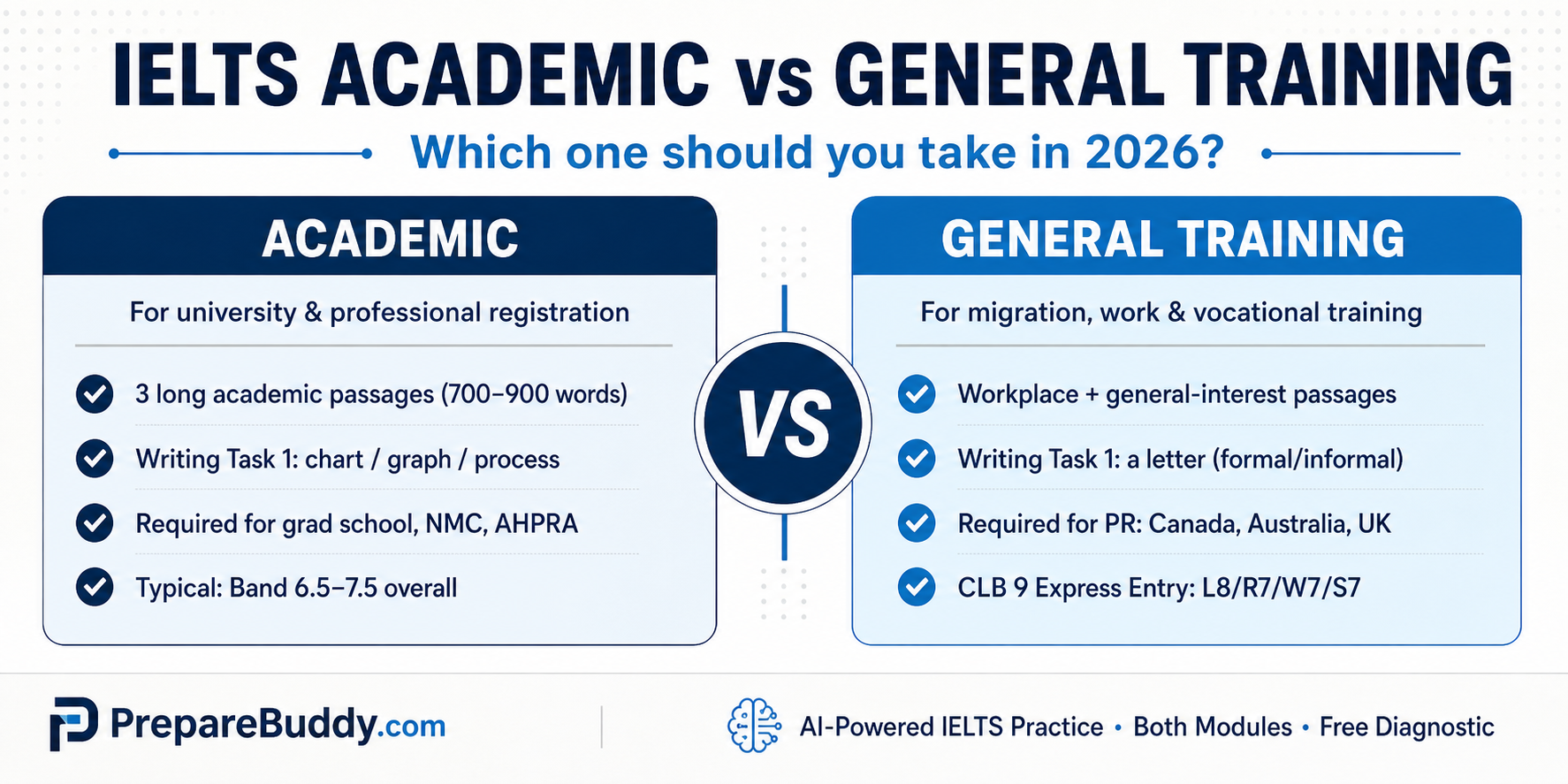
Roughly four out of five IELTS test takers in 2026 sit for IELTS Academic — but a sizeable minority pick the wrong one and end up rebooking. The Academic and General Training modules share an identical Listening section, an identical Speaking format, and the same nine-band scale. Yet the Reading and Writing sections are different enough that a Band 8 in one does not predict a Band 8 in the other. If you are heading to graduate school, applying for a Canadian PR, registering for nursing in Australia, or sponsoring a UK skilled-worker visa, the choice between IELTS Academic and IELTS General Training is the single most expensive decision you will make before booking a slot.
This guide breaks down every meaningful difference, who each module is for, how scoring maps to immigration and university requirements, and how to practice both modules with AI before the real exam day.
IELTS Academic vs General Training: The Quick Decision Matrix
Both modules run for 165 minutes and use the 0–9 band scale. The Listening (40 questions) and Speaking (3 parts) sections are identical. The differences live entirely in Reading and Writing.
| Factor | IELTS Academic | IELTS General Training |
|---|---|---|
| Primary purpose | University admission, professional registration | Migration, work visas, secondary education, training programs |
| Reading texts | 3 long academic passages (700–900 words each), 40 questions | 2 short workplace/everyday passages + 1 longer general-interest passage, 40 questions |
| Writing Task 1 | Describe a chart, graph, table, diagram, or process (150 words) | Write a letter — formal, semi-formal, or informal (150 words) |
| Writing Task 2 | Argumentative essay on academic topic (250 words) | Argumentative essay on everyday topic (250 words) |
| Listening | Identical (40 questions, 30 min) | Identical (40 questions, 30 min) |
| Speaking | Identical (Parts 1, 2, 3 — 11–14 min) | Identical (Parts 1, 2, 3 — 11–14 min) |
| Difficulty (Reading) | Higher — academic register, abstract topics | Lower — practical, workplace English |
| Band scale | 0–9 | 0–9 (same) |
| Same-band score equivalence | Not interchangeable across modules | Not interchangeable across modules |
Who Should Take IELTS Academic
Pick Academic if any of the following apply:
- You are applying to an undergraduate, graduate, or postgraduate program at a university or college that asks for IELTS.
- You are seeking professional registration in fields like medicine, nursing, pharmacy, dentistry, engineering, or law in an English-speaking country.
- You are applying for a research visa or PhD position.
- The institution or council you are applying to specifies "IELTS Academic" — most do, even when they accept General Training for some routes.
Academic Reading uses three long passages (700–900 words) drawn from journals, books, and broadsheet magazines. Topics swing from glaciology to behavioural economics to architecture history. The questions test inference, paraphrase recognition, and the ability to scan dense academic prose under time pressure. Academic Writing Task 1 hands you a chart, graph, table, or process diagram and asks for a 150-word objective summary — no opinion, no flourish.
Who Should Take IELTS General Training
Pick General Training if you are heading toward one of these outcomes:
- Permanent residency in Canada (Express Entry — though many candidates now also consider CELPIP or PTE Core), Australia (skilled migration), New Zealand, or the UK (skilled worker, family).
- Work visas where the host country requires English proof but not academic study.
- Secondary school admission below degree level.
- Vocational or non-degree training programs.
General Training Reading rewards the ability to extract specific information from notices, advertisements, workplace handbooks, and longer general-interest articles. Writing Task 1 is a letter — you might write to a landlord about a faulty heater, to a manager requesting leave, or to an old colleague catching up. The essay in Task 2 is on everyday topics like family, technology in daily life, or community.
Score Requirements: What You Actually Need
Band scores look identical across modules but the underlying requirements differ by destination. Use this table as a starting point — always verify with the destination authority because thresholds change.
| Goal | Module | Typical Overall Band Required | Per-section Minimum |
|---|---|---|---|
| UK/Canada/Australia top-50 university (undergrad) | Academic | 6.5 | 6.0 each section |
| UK/Canada/Australia top-50 university (postgrad) | Academic | 7.0 | 6.5 each section |
| US Ivy League / top-10 graduate program | Academic | 7.0–7.5 | 7.0 each section |
| NMC nursing registration (UK) | Academic | 7.0 | 7.0 each section |
| Canada Express Entry (CLB 9) | General Training | L 8.0 / R 7.0 / W 7.0 / S 7.0 | Strictly per-section |
| Canada Express Entry (CLB 7) | General Training | L 6.0 / R 6.0 / W 6.0 / S 6.0 | Strictly per-section |
| Australia skilled migration (20 points) | General Training | 8.0 in each section | Per-section enforced |
| UK Skilled Worker visa (B1) | General Training | 4.0 overall | 4.0 each section |
Difficulty Differences You Should Plan For
Test takers often assume General Training is "easier." It is — for Reading and Writing only — and the pricing of that easier surface is real: Academic candidates have to handle far heavier vocabulary in Reading and a more abstract Writing Task 1. But the same band score on either module signals the same level of English; what changes is the type of English. If you take Academic when you should have taken General Training, you spend prep time on chart description and dense scientific prose you will never need. If you take General Training when an institution wanted Academic, your scores will be rejected outright.
Listening and Speaking are identical, so practice for those carries across modules. PrepareBuddy generates parallel mock tests for both Academic and General Training under the same engine — driven by a 120B parameter model with full IELTS band rubric calibration — so you can switch modules during prep without losing momentum.
How to Prepare With AI for Either Module
The cleanest prep strategy is module-aware practice with calibrated scoring. PrepareBuddy's IELTS engine generates fresh full-length tests for both modules on demand and applies the official IELTS Band 1–9 descriptors, with the same calibration the real exam uses (most responses score 5.0–6.0; 7.0+ requires demonstrated skill).
- Speaking practice: The Voice AI system runs Parts 1, 2, and 3 with part-aware scoring. Pronunciation is scored across 30+ English accents, and feedback is calibrated separately for each part — Part 1 introduction, Part 2 long turn, Part 3 discussion.
- Writing practice: Task 2 enforces the strict word-count cap (under 250 words → maximum Band 5 for Task Achievement). Module-aware feedback grades Academic Task 1 against process/chart description rubrics and General Task 1 against letter conventions.
- Reading and Listening: Generated questions match official type distributions — Academic Reading uses T/F/NG, matching headings, summary completion; General Reading mixes signs/notices, workplace handbooks, and a longer general passage.
- Diagnostic before booking: Take a free diagnostic to see your current band on both modules before you commit a real exam fee.
How University Match Tools Use Your Score
Once you have a target band, match it against schools that will actually accept you. PrepareBuddy's AI university recommendation engine takes your score, profile, and preferences and produces a Reach / Target / Safety list calibrated to admit thresholds — so you don't waste applications on schools whose minimum band you will not hit, and don't undershoot programs you would have got into.
Common Mistakes That Cost Students a Re-test
- Booking General Training and applying to a university. Even a "we accept either" university policy often turns out to be Academic-only for graduate programs. Always check the specific program page.
- Booking Academic for nursing/midwifery in countries that accept General Training. Some pathways do, but most professional bodies (NMC, AHPRA, MCNZ) require Academic. Verify before booking.
- Practicing the wrong Writing Task 1 format. A General Training candidate writing chart-description practice essays gets no transferable benefit.
- Overlooking per-section minimums. Express Entry CLB 9 needs Listening 8.0 specifically — not "8.0 overall." A 7.0 in Listening tanks the whole application.
- Cramming Reading without rebuilding vocabulary. Both modules reward range and accuracy, not speed-only tactics.
Bottom Line
If your endpoint is a degree, a research role, or professional registration, take IELTS Academic. If your endpoint is migration, work, or non-degree training, take IELTS General Training. The bands look identical on a certificate, but a wrong-module score is one of the most common — and most expensive — mistakes in the test-prep industry. Decide before you book, prep against the right rubric, and verify the exact per-section thresholds your destination authority requires.
Ready to find out where you stand? Take a free IELTS practice test on PrepareBuddy and get an AI-scored band estimate in minutes — for either module — before you commit to a real exam fee.


Join the Discussion