

Most IELTS candidates lose their Band 8+ Writing dream in the first 20 minutes — not in the essay. Task 1 is half the length, half the time, and weighted only one-third of the Writing score, so it gets the leftover prep. That is exactly why band-8 students stand out: they walk into Task 1 with a fixed structure, finish in 18 minutes, and reach Task 2 with energy intact.
This guide rebuilds Task 1 from scratch for 2026 — every Academic question type (line graph, bar chart, pie chart, table, process diagram, map, mixed-chart), every General Training letter register (formal, semi-formal, informal), and the AI-feedback workflow that turns a stuck Band 6.5 into a steady Band 8.
IELTS Writing Task 1 in 2026: The Scoring Reality
Writing is the second-hardest section to climb after Speaking, and Task 1 is where most candidates leak band points without realising it. Here is what the IELTS scoring system actually rewards.
How Task 1 contributes to your Writing band
| Task | Time | Min Word Count | Weight in Writing Band | Recommended Time Spend |
|---|---|---|---|---|
| Task 1 (Academic or GT) | 20 min | 150 words | ~33% | 17–18 min |
| Task 2 (essay) | 40 min | 250 words | ~67% | 40 min |
| Writing total | 60 min | 400 words | 100% | ~58 min |
Task 1 is shorter, but the four scoring criteria are the same as Task 2: Task Achievement, Coherence & Cohesion, Lexical Resource, and Grammatical Range & Accuracy — each scored 0–9. Drop a half-band on Task 1 and you can still land overall Band 8, but only if Task 2 is rock-solid. The smart strategy is to make Task 1 your safety floor, not your weak link.
What Band 8 actually looks like (the public band descriptors, decoded)
| Criterion | Band 6.5 (typical) | Band 8 (target) |
|---|---|---|
| Task Achievement | Covers main points but overview is vague or buried | Clear overview at start AND end; all key features highlighted with accurate data |
| Coherence & Cohesion | Uses linkers, but some are mechanical ("Firstly, secondly") | Paragraphs are logical; cohesion is invisible — never overused |
| Lexical Resource | Repeats "increase" / "decrease" / "graph" | Wide range, used naturally (climb, surge, plateau, dip) with no awkward collocations |
| Grammatical Range | Mostly simple + compound sentences | Mix of complex and compound-complex; very few errors |
Academic Task 1: One Structure That Works for All 7 Question Types
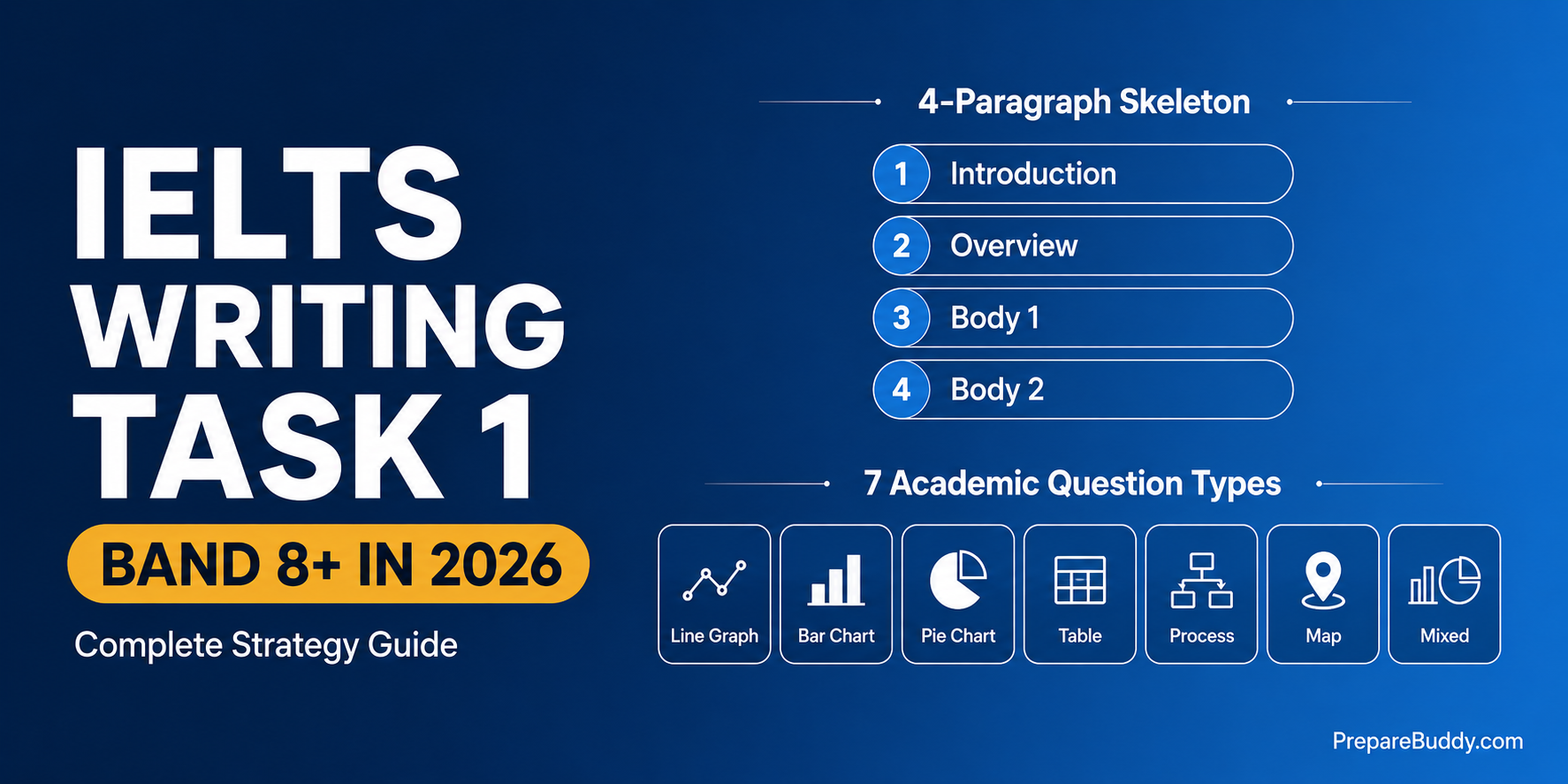
The seven Academic question types (line graph, bar chart, pie chart, table, process, map, mixed chart) all map to the same four-paragraph skeleton. Memorise this, and you stop wasting brain cycles on layout — you spend them on analysis.
The four-paragraph skeleton
| Paragraph | Purpose | Words | Time |
|---|---|---|---|
| 1. Introduction | Paraphrase the question. Do NOT copy phrases verbatim. | 25–35 | 2 min |
| 2. Overview | Two sentences. The biggest trend + the biggest contrast. No numbers. | 40–50 | 3 min |
| 3. Body 1 | First key feature with supporting data (2–3 numbers, comparisons). | 50–70 | 5 min |
| 4. Body 2 | Second key feature with supporting data. Compare to Body 1 if relevant. | 50–70 | 5 min |
Total: ~170–225 words in 15 minutes, leaving 2–3 minutes to proofread. That margin is the difference between Band 7.5 and Band 8.
Question-type playbook
| Question Type | What Examiners Want in Body Paragraphs | High-Value Vocab |
|---|---|---|
| Line graph | Trends over time, peaks, troughs, plateaus, percentage change | climbed, plummeted, levelled off, surged, dipped |
| Bar chart | Comparisons across categories, max / min, ratios | roughly twice, marginally higher, far exceeded |
| Pie chart | Proportions, dominant share, smallest slice | accounted for, constituted, made up roughly |
| Table | Group similar rows; never describe every cell | highest figure, fell within the range of, by contrast |
| Process diagram | Sequential stages, passive voice, time linkers | is first, subsequently, once complete, in the final stage |
| Map | Compass directions, before/after changes | was replaced by, demolished, expanded eastwards |
| Mixed chart (2 visuals) | One paragraph per visual; connect them in the overview | whereas, by comparison, the second figure shows |
Common Band-killer mistakes in Academic Task 1
- No overview, or overview hidden in the conclusion. Put it as paragraph 2. Examiners look for it there.
- Listing data without comparing. Numbers without "higher than," "twice as much as," or "compared with" never breach Band 7.
- Personal opinion. Task 1 is descriptive only. Never write "I think" or "this is good."
- Copying the question stem. Examiners discount copied words from the word count.
- Inventing numbers. Every figure must come from the visual. Round responsibly (47.3% → "approximately half").
General Training Task 1: Three Letter Registers, One Template
General Training Task 1 is a letter of at least 150 words on a real-world situation. You will get three bullet points to cover — these are non-negotiable. Skip one and your Task Achievement drops by a full band.
Register matters more than vocabulary
| Register | Who You Write To | Opening | Closing | Tone Markers |
|---|---|---|---|---|
| Formal | Stranger, employer, official | Dear Sir or Madam, | Yours faithfully, [Full Name] | No contractions, no phrasal verbs |
| Semi-formal | Known professional (manager, landlord) | Dear Mr / Ms [Surname], | Yours sincerely, [Full Name] | Polite but direct; light contractions OK |
| Informal | Friend, family member | Hi [First name], / Dear [First name], | Best wishes, [First Name] | Contractions, questions, exclamations welcome |
The five-paragraph letter template (Band 8 reliable)
Use this for every GT letter. The body's three middle paragraphs map 1:1 onto the three bullet points in the prompt — that is the fastest way to lock in full Task Achievement.
- Greeting (one line)
- Purpose statement — one or two sentences explaining why you are writing.
- Bullet 1 — full paragraph addressing the first prompt bullet.
- Bullet 2 — full paragraph addressing the second prompt bullet.
- Bullet 3 — full paragraph addressing the third prompt bullet.
- Closing line + signature.
Six chunks, ~155–180 words, 18 minutes. Predictable. Repeatable. Band 8 friendly.
Vocabulary & Grammar: The Two Levers That Move You from 7 to 8
Lexical Resource: collocations beat single words
Examiners reward natural pairings, not "big" words. A candidate who writes "the figure climbed dramatically before plateauing in 2020" scores higher than one who reaches for "the figure exhibited an exponential proliferation." Memorise collocation families per visual type, not vocab lists.
| Direction | Verb + Adverb Pair | Noun Equivalent |
|---|---|---|
| Sharp rise | surged dramatically / climbed sharply | a steep rise / a sharp surge |
| Steady rise | rose steadily / grew gradually | a steady increase / a gradual rise |
| Sharp fall | plummeted / dropped sharply | a sharp decline / a steep drop |
| Steady fall | declined steadily / fell gradually | a gradual decline / a slow fall |
| Stability | levelled off / remained stable | a plateau / a period of stability |
| Fluctuation | fluctuated wildly / varied considerably | significant fluctuation / wide variation |
Grammar: four structures Band 8 candidates use weekly
- Participle phrases: "Having peaked in 2018, the figure dropped sharply."
- Relative clauses: "The category which experienced the largest growth was renewables."
- Comparative + double comparative: "the higher the income, the lower the savings rate."
- Passive voice (process diagrams): "The mixture is heated to 200°C, after which it is cooled."
The 4-Week Band 8+ Practice Plan
| Week | Academic Focus | GT Focus | Daily Output |
|---|---|---|---|
| Week 1 | Line graphs + bar charts | Formal letters (complaints, requests) | 1 Task 1 + AI feedback review |
| Week 2 | Pie charts + tables + mixed | Semi-formal letters (work, landlord) | 1 Task 1 + targeted vocab drill |
| Week 3 | Processes + maps | Informal letters (friends, family) | 2 Task 1 (one timed, one redraft) |
| Week 4 | Full 60-min mocks (T1 + T2) | Full 60-min mocks (T1 + T2) | 2 mocks under exam conditions |
The trap most candidates fall into is writing dozens of Task 1 responses without feedback. Without scored, criterion-specific feedback, you repeat the same Band 6.5 mistakes for a month. The plan above only works when every response is graded on the four criteria — which is where AI feedback closes the gap.
How AI Writing Feedback Cuts Your Prep Time in Half
PrepareBuddy's AI Writing Analysis evaluates Task 1 responses against the four official IELTS criteria within seconds. The 120-billion parameter model produces feedback that aligns closely with human graders, and the platform reports 95% AI scoring accuracy across multi-model verification. Students get a per-criterion score (0–9), a paragraph-by-paragraph rewrite suggestion, and a vocabulary upgrade map showing which Band 6 phrases to replace with Band 8 equivalents.
Combined with adaptive testing, the platform learns which question type you are weakest on — and serves more line graphs if you keep losing band points there. Many of our students save 18+ hours weekly that they would otherwise spend hunting for feedback from busy teachers.
Try a free IELTS Writing Task 1 mock with instant AI scoring on the free practice tests page, or see the full IELTS feature set on the IELTS test page.
Frequently Asked Questions
Is Task 1 worth less than Task 2?
Yes. Task 2 carries roughly two-thirds of the Writing band, Task 1 about one-third. But Task 1 is shorter and more structured, so candidates aiming for Band 8 should treat it as their safety net — a near-perfect Task 1 buys forgiveness for a slightly weaker essay.
Can I lose Task Achievement marks for writing more than 150 words?
No. There is no upper limit. The 150-word floor is what matters. Most Band 8 responses run 170–200 words — long enough to develop ideas, short enough to control grammar.
Do I have to write the overview first or last?
Either works, but writing it as paragraph 2 (right after the introduction) is the safest choice. Examiners actively look for it in the first half of the response. Putting it last risks being read as a "conclusion" — and Task 1 has no conclusion.
How do I avoid copying the question in my introduction?
Paraphrase using synonyms (chart → graph, illustrates → depicts), change the sentence structure (active → passive), and combine two short prompt sentences into one. Two to three sentence rewrites is the sweet spot.
Is the General Training letter graded on the same criteria as Academic?
Yes — same four criteria (Task Achievement, Coherence & Cohesion, Lexical Resource, Grammatical Range & Accuracy), each 0–9. The only difference is the content type (letter vs. visual description).
The Path to a Reliable Band 8 in Writing Task 1
Band 8 in Writing Task 1 is not about exotic vocabulary or memorised templates — it is about producing the right structure consistently, hitting all key features with accurate data, and matching register to context. Build the four-paragraph skeleton into your muscle memory, drill the seven question types over four weeks, and use AI feedback to cut the diagnosis-to-improvement loop from days to minutes.
Start your Band 8+ Writing journey today — take a free IELTS Writing Task 1 mock with instant AI scoring at preparebuddy.com/language-tests/free-test/, or sign up for the full IELTS prep platform with adaptive Task 1 question packs.


Join the Discussion