

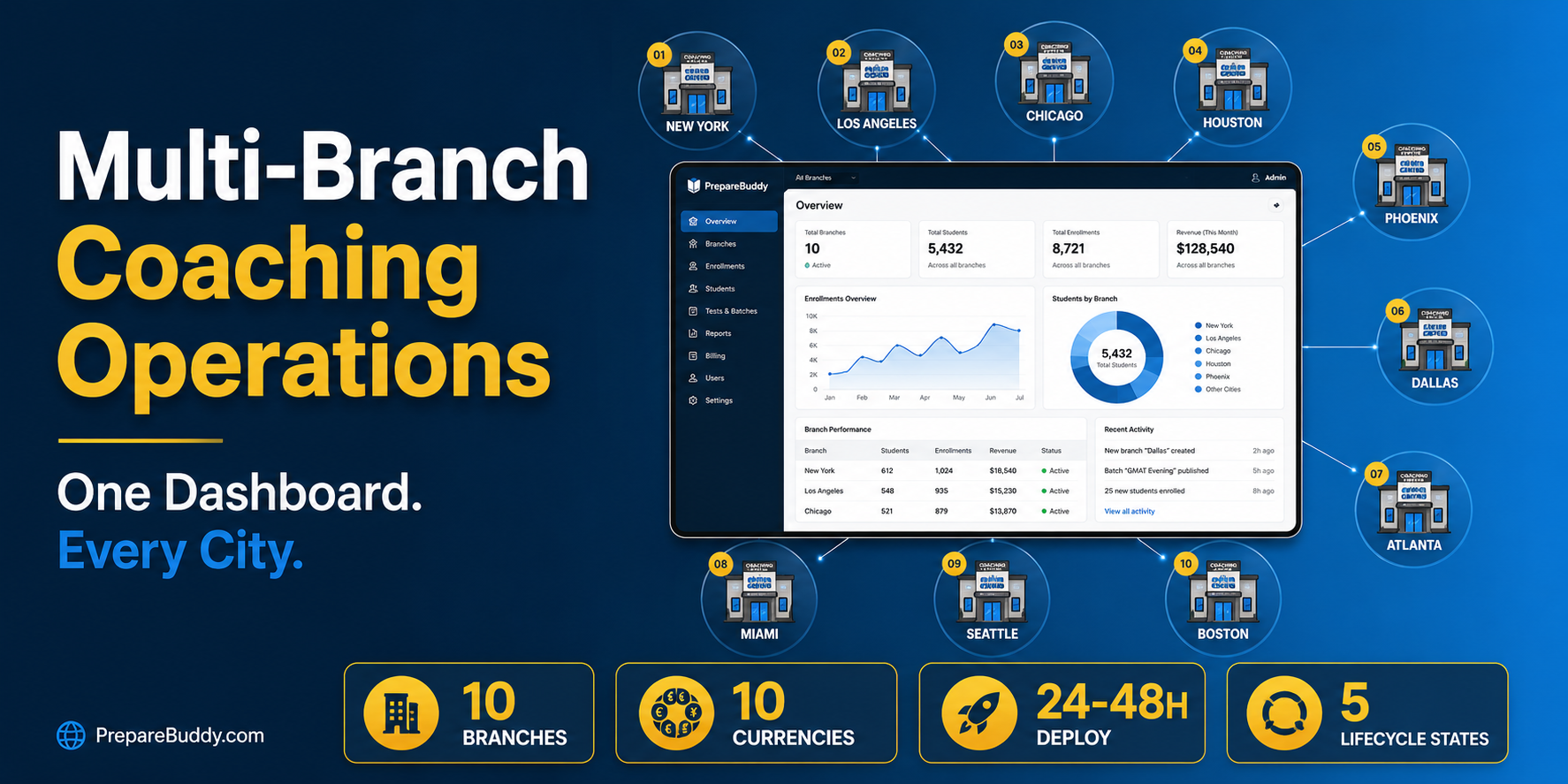
A 4-branch IELTS coaching chain in Pune runs each location like a separate company. Center 1 uses spreadsheets for enrollments. Center 2 has a homegrown LMS. Center 3 still sends invoices over WhatsApp. The owner sees real numbers once a month — by which point three students have already churned and the franchisee in Nashik is quietly using a competitor's question bank. This is not a hypothetical: it is what most growing test prep brands look like by the time they cross 500 students.
Multi-branch coaching center management is not a bigger version of single-branch ops. The fragmentation of data, the duplication of teaching effort, the inability to enforce one brand standard across cities — each of these compounds the moment a second location opens. The fix is not "hire more staff." The fix is one shared platform with per-branch controls, unified billing, and analytics that roll up across the entire brand. This guide walks through what that actually looks like in 2026 and how to operationalize it across 10 branches in 30 days.
The Hidden Cost of Growing a Coaching Center Across Branches
When a coaching center opens its second location, the problems start small. By the fifth, they are existential. The typical operational drag looks like this:
| Operational Pain | What Happens Without Unification | Cost to the Brand |
|---|---|---|
| Enrollment chaos | Each branch keeps its own student records, fee status, course dates | Owners lose 18+ hours weekly reconciling who paid what, when |
| Inconsistent content | Branch A uses one mock test bank, Branch B downloads PDFs, Branch C builds quizzes manually | Students at "the same brand" get wildly different prep quality |
| No cross-branch analytics | Owner cannot see which branch has the worst student outcomes until results day | Underperforming branches stay invisible for 3–6 months |
| Billing fragmentation | Each franchise raises invoices manually, often in different currencies | Revenue leakage of 8–12% and audit nightmares at year-end |
| Brand drift | Each branch puts a different logo on materials, different domain, different look | Marketing spend doesn't compound; each branch builds its own identity instead |
The deeper problem is that traditional LMS and CRM tools were built for single-location operations. They treat "branch" as a tag, not as a first-class entity. The result is that owners either build internal tooling (expensive, slow, never finished) or accept the chaos. Neither is sustainable past 5 locations.
What a True Multi-Branch Operations Stack Must Do
To run 10 branches from a single dashboard, the platform underneath needs to handle four things at the same time: branch isolation (each location sees only its students), brand consistency (every student sees the same product), centralized control (the owner sees everything), and per-student precision (different students inside the same branch can have different feature access).
On the PrepareBuddy coaching center platform, this is the default architecture. The institute management module supports a five-state lifecycle for every student — pending → active → grace_period → expired → offboarded — that transitions automatically based on enrollment dates, with no cron jobs to fail or babysit. Whether a student is in your Mumbai branch or your Sydney branch, the lifecycle logic runs identically. That is the foundation. Once it is in place, every other multi-branch capability can be layered on top.
1. One Platform, Many Branches — With Real Isolation
Each branch operates as its own organization inside the platform. Teachers at the Delhi branch cannot accidentally see student records in the Bangalore branch. Org admins manage their own examiner team, their own pricing, their own batch schedules. But the brand owner gets a roll-up view across every org. This is the multi-tenant pattern that makes scaling viable: no data crossover, no permission collisions, and no need to spin up separate accounts per branch.
2. The Same AI Content, Across Every Location
Content fragmentation is the silent killer of multi-branch quality. PrepareBuddy solves this with a shared AI content engine backed by a 120B parameter model that generates IELTS, PTE, TOEFL, OET, CELPIP, Duolingo, GRE, GMAT, and SAT practice content indistinguishable from official exam questions. Every branch pulls from the same library. Every student gets the same quality of mock test, regardless of which city they study in.
Teachers at any branch can still build custom exams, but those exams flow back into the central library. New branches inherit the entire content base on day one — no rebuild required.
3. Per-Student AI Feature Toggles (The Premium Tier Mechanism)
One of the most underrated capabilities for multi-branch operators is the ability to enable or disable AI features per student, not just per branch. This is how you sell tiered packages without operational chaos.
| AI Feature | What It Does | Typical Use Case |
|---|---|---|
| AI Buddy (AI Tutor) | 24/7 personalized guidance | Premium students only |
| AI Transcript | Detailed AI feedback on every submission | Premium and standard tiers |
| AI Exam Generation | Student can generate their own mock tests | Premium tier |
| Voice AI Speaking Practice | 30+ accent feedback, 48-emotion detection | Speaking-focused packages |
| Teacher Review Gate | Score held 24 hours for teacher review before release | High-stakes exam-bound students |
| Student Journey | 10-stage study abroad pipeline tracking | Study abroad packages |
This lets a coaching center sell three different fee tiers from the same branch — Basic, Standard, and Premium — without anyone having to remember which student gets which feature. The platform enforces it automatically.
4. Unified Billing in 10 Currencies
A coaching chain with branches in India, the UAE, and Australia needs to invoice in three currencies, apply three different tax structures, and consolidate everything into a single owner-level financial view. PrepareBuddy's institute management module supports 10 currencies — USD, EUR, GBP, INR, AUD, CAD, SGD, AED, JPY, CHF — along with GST, VAT, sales tax, and fixed-amount tax types. Every invoice is tracked through a four-state lifecycle (draft → sent → viewed → paid, with branches for overdue or cancelled), giving owners a real-time picture of revenue, collections, and risk across the entire brand.
The Analytics That Actually Move the Needle
Most multi-branch dashboards drown owners in vanity metrics. The four numbers that matter at the brand level are:
| Metric | What It Tells You | Why It Matters Across Branches |
|---|---|---|
| Active student count per branch | Which branch is filling, which is stagnating | Triggers marketing or pricing intervention by location |
| Mock test score trends | Average band/score by branch and by month | Surfaces teaching quality gaps between branches |
| Speaking practice completion | % of enrolled students using Voice AI weekly | Speaking is where most fee-paying students plateau |
| Grace-period students | How many students are within their post-expiry window | Owner can run renewal campaigns before they fully expire |
PrepareBuddy's analytics module rolls these up automatically across every branch. Owners see brand-wide trends; branch managers see only their data. No spreadsheet exports, no monthly reconciliation calls.
White-Label Across Every Branch (One Brand, Many Cities)
The biggest reason coaching center owners hesitate to adopt a SaaS platform is the fear of losing brand identity. PrepareBuddy's white-label platform solves this entirely: each branch sees the parent brand's domain, logo, colors, and email sender. Zero PrepareBuddy branding is visible to end users — the parent owner controls one set of brand assets that flow down to every location.
This matters operationally too. When a student moves from one city to another within the same brand, the experience is continuous. They log in to the same domain. They see the same colors. Their study plan, mock test history, and AI tutor memory follow them. The brand stops being a logo on a banner and starts being a real product.
The 30-Day Multi-Branch Rollout Plan
Most operators assume a multi-branch rollout takes a quarter. With a 24–48 hour deployment turnaround, it can realistically be done in 30 days across 10 branches. Here is the sequence that has worked for institutions on the platform:
| Week | Milestone | What Happens |
|---|---|---|
| Week 1 | Brand setup + Branch 1 live | White-label domain, logo, colors, email sender configured. First branch's students migrated. |
| Week 2 | Branches 2–4 onboarded | Org admins for each city assigned. Student rosters imported. Branch-level pricing set. |
| Week 3 | Branches 5–8 onboarded | Teacher review gates configured for exam-bound students. Per-student AI feature tiers locked in. |
| Week 4 | Branches 9–10 + analytics rollup | Final branches live. Owner dashboard configured. Multi-currency billing tested end-to-end. |
The reason this works is that the platform itself does not need building. The 120B AI model, the 11+ test types, the Voice AI, the adaptive testing, the psychometric assessments, the student journey pipeline — all of it is already there. Onboarding is configuration, not development.
The Outcome: From 4 Spreadsheets to One Dashboard
The coaching center owners who have made this transition report a few common before-and-after patterns. Reconciliation time drops from 18+ hours weekly to under 2. Branch-to-branch quality variance collapses because every location pulls from the same content library. Renewal rates improve because grace-period students are visible to the right person at the right time. And the brand starts compounding because every student in every city is seeing the same product.
None of this requires hiring more operations staff. It requires choosing a platform that treats multi-branch as the default, not as an afterthought.
Frequently Asked Questions
How is a multi-branch coaching center setup different from a single-branch one on PrepareBuddy?
Each branch operates as its own organization with isolated student data, its own admin team, and its own pricing. The parent owner gets a brand-wide rollup view. White-label branding applies to every branch under the parent.
Can different branches have different fee tiers and AI features enabled?
Yes. Branches can set their own pricing in their local currency, and AI features (AI Tutor, AI exam generation, Voice AI speaking, Student Journey, Teacher Review Gate) can be toggled per student enrollment within each branch.
How long does it take to onboard a new branch?
A new branch can be deployed in 24–48 hours. Onboarding includes setting up the org admin team, importing students, configuring pricing, and enabling test types relevant to that location.
Does white-label work the same across all branches?
Yes. The parent brand's domain, logo, colors, and email sender are inherited by every branch. End users never see PrepareBuddy branding regardless of which city they study in.
How does billing work for a multi-country coaching chain?
Each branch can invoice in any of 10 supported currencies (USD, EUR, GBP, INR, AUD, CAD, SGD, AED, JPY, CHF) with appropriate tax handling — GST, VAT, sales tax, or fixed-amount. The owner sees a consolidated revenue view at the brand level.
Run Your Coaching Chain from One Dashboard
If you operate two or more branches today — or plan to in the next year — the operational pain you are absorbing is not a fact of life. It is a tooling choice. Schedule a demo to see how a unified, white-labeled, AI-powered platform handles 10 branches as easily as one, or view pricing built for multi-location coaching brands.


Join the Discussion