

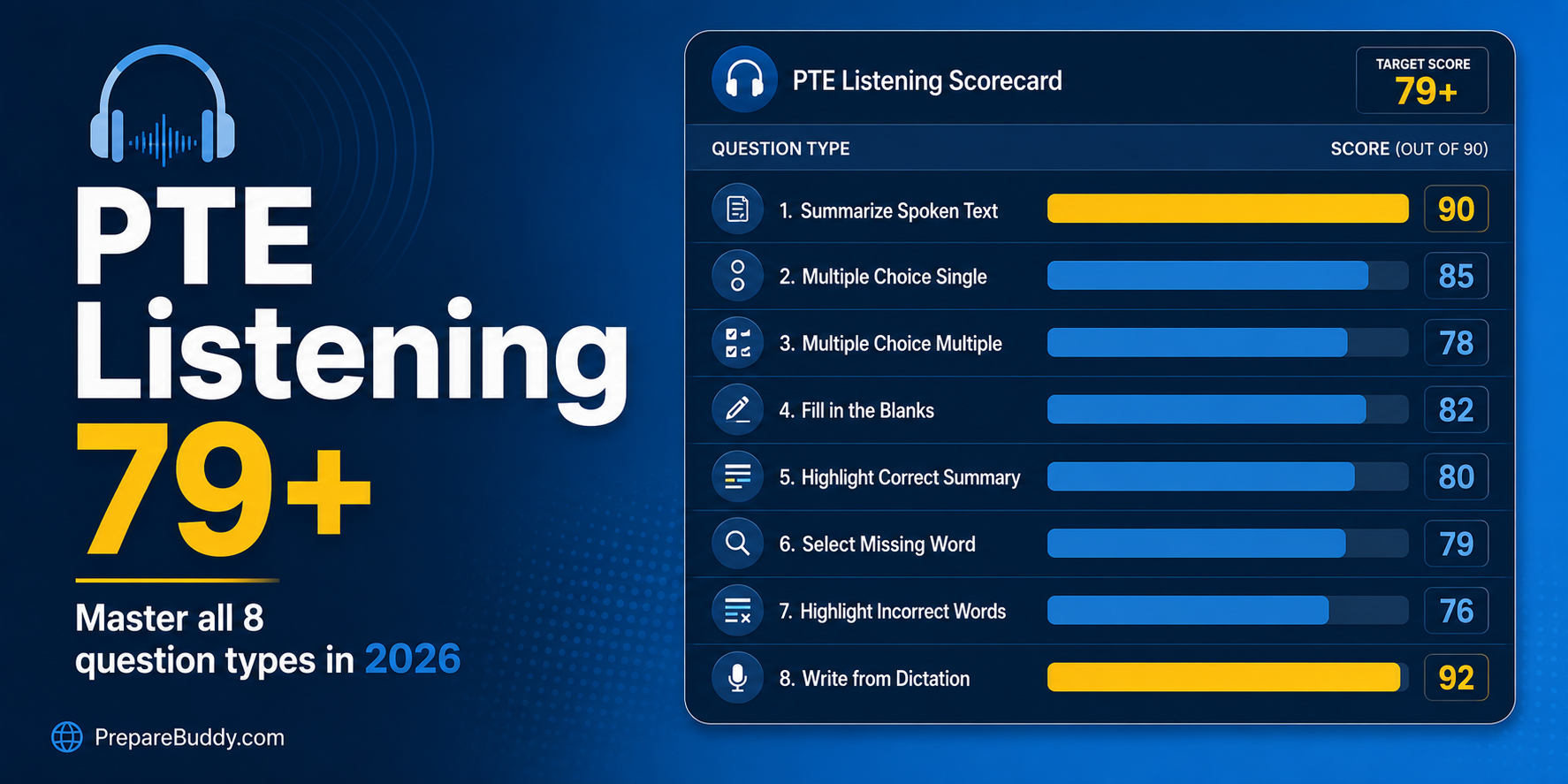
Roughly 30% of Pearson's reported PTE Academic score depends on what happens in the Listening section — and most of that 30% is decided by a handful of high-stakes tasks that tank candidates who haven't studied the marking rules. Write from Dictation alone is the single highest-weighted Listening item type Pearson uses, contributing to both Listening and Writing sub-scores. Get it right and a 79+ overall is realistic. Get it wrong and your Listening band drags down everything else.
This guide walks through every one of the 8 PTE Academic Listening question types under the August 2025 format, the exact scoring logic Pearson applies (including partial and negative marking), a 37-minute timing framework, and the practice setup that gets you to the 79+ band most universities and immigration authorities want.
The PTE Listening Section in 2026: What You're Actually Up Against
PTE Academic Listening (Aug 2025 spec) runs roughly 37 minutes, contains 12–20 tasks, and tests 8 distinct question formats. The audio plays exactly once for almost every task, the on-screen note-taking pad is the only memory aid you get, and several question types use Pearson's real partial-credit and negative-marking rules. That combination — single-play audio, mixed task types, and asymmetric scoring — is why the section punishes guessing and rewards a disciplined, type-by-type strategy.
Here's the official Listening task lineup as it appears on real exams today:
| Task Type | Per Test | Skills Tested | Marking |
|---|---|---|---|
| Summarize Spoken Text (SST) | 1–2 | Listening + Writing | Word-count gate (50–70) + AI semantic eval |
| Multiple Choice, Multiple Answers (MCMA) | 1–2 | Listening | +1 per correct, −1 per wrong, floored at 0 |
| Fill in the Blanks (FIB inline) | 2–3 | Listening + Writing | Per-blank exact match (partial credit) |
| Highlight Correct Summary (HCS) | 1–2 | Listening + Reading | Binary (no negative marking) |
| Multiple Choice, Single Answer (MCSA) | 1–2 | Listening | Binary (no negative marking) |
| Select Missing Word (SMW) | 1–2 | Listening | Binary (no negative marking) |
| Highlight Incorrect Words (HIW) | 1–2 | Listening + Reading | +1 per correct click, −1 per wrong click, floored at 0 |
| Write from Dictation (WFD) | 3–4 | Listening + Writing | Per-word position-by-position match — highest-weighted Listening item |
If you only remember one thing from this article, remember the right column. Three of the eight task types — MCMA, HIW, and WFD — are the difference between Listening 65 and Listening 80+. They use rules most candidates have never explicitly learned.
Scoring 79+: How the Marking Rules Should Shape Your Strategy
The PTE Listening band is built from per-task contributions, then mapped to the 10–90 scale. Two structural truths drive every smart strategy decision:
Negative marking exists on three task types. Multiple Choice Multiple Answers, Highlight Incorrect Words, and (on the Reading side) MCMA all subtract points for wrong selections, with the question floored at 0. That means a wild guess on a 5-option MCMA can wipe the entire question even if you got one option right. The correct strategy is selective: only click options you can defend with evidence from the audio.
Write from Dictation is the highest-yield single task in the section. Pearson's per-word scoring on WFD means a 10-word sentence can deliver up to 10 raw points if typed perfectly, vs. ~1–3 from a typical MCSA. With 3–4 WFD items per test, a candidate who consistently nails 9–10 words per sentence will outscore someone who guesses everywhere else. This is where the 79+ ceiling is built.
| PTE Score | CEFR | IELTS Equivalent | Typical Use Case |
|---|---|---|---|
| 85–90 | C2 | 8.5–9.0 | Top-tier MBA, Australia 189 "Superior" English (20 points) |
| 79–84 | C1 | 7.5–8.0 | Most universities, Australia "Proficient" (10 points), Canada CLB 9 |
| 65–78 | B2 | 6.5–7.0 | Many UG/PG programs, Australia "Competent" |
| 50–64 | B1 | 5.5–6.0 | Foundation/pathway programs, basic visa thresholds |
| 30–49 | A2 | 4.0–5.0 | Below most academic and immigration thresholds |
The 37-Minute Timing Framework
The Listening section is the only PTE section where you have a single hard timer for the entire block (Status Bar countdown), and time saved on one task does NOT roll over to give you more time on the audio of the next task. What rolls over is your reading/answer time. Here's a defensible per-type budget for a 37-minute Listening block:
| Phase | Time Budget | Action |
|---|---|---|
| SST × 2 | ~20 min | 10 min each: 60–90s audio + 9 min note-shaping + draft (50–70 words) |
| MCMA + MCSA + HCS + SMW | ~9 min | ~1.5 min/task — read options BEFORE audio plays |
| FIB + HIW | ~3 min | Decide on first listen; do not wait for instinct |
| WFD × 3–4 | ~5 min | ~75–90s each: type as you hear, don't review until all 3–4 done |
The single most common time mistake at the 79 ceiling: spending 12 minutes on SST trying to perfect the summary. A clean, 60-word summary scoring well on content + form beats a perfect 200-word essay that triggers the word-count penalty.
Task-by-Task Playbook for All 8 Types
1. Summarize Spoken Text (SST)
You hear a 60–90 second academic lecture once and write a 50–70 word summary in 10 minutes. Scoring covers content, form (the 50–70 word window is mandatory), grammar, vocabulary, and spelling. Strategy: take structured notes during the audio (3–5 main idea bullets, not full sentences), then build a single-paragraph summary using one introductory sentence + 2–3 supporting points + one concluding sentence. Hit the word window or you lose form marks instantly.
2. Multiple Choice, Multiple Answers (MCMA)
You hear a recording, then select all answers that apply from 5–7 options. Negative marking: +1 per correct, −1 per wrong, floored at 0. Strategy: pre-read options before the audio plays so you know exactly what to listen for. After the audio, only select options you have explicit textual evidence for. If unsure between 2 and 3 selections, go with 2 — leaving a correct option un-clicked costs only 1 point, but adding a wrong one also costs 1 and risks zeroing the question.
3. Fill in the Blanks (Inline)
A transcript appears on screen with blanks; the audio plays once and you type the missing words inline. Per-blank exact match scoring with partial credit. Strategy: scan the transcript during the 7-second pre-audio gap to predict word types (noun, verb, adjective). During audio, type immediately — don't wait for the sentence to finish. Common spelling traps (American vs. British) are accepted both ways, but typos are not.
4. Highlight Correct Summary (HCS)
You listen to a 30–90 second recording and choose the option that best summarizes it. Binary scoring (no negative marking). Strategy: eliminate options containing factually wrong details first, then choose between the remaining options based on completeness. The correct answer always covers the speaker's main argument plus at least one supporting reason — not just the topic.
5. Multiple Choice, Single Answer (MCSA)
Standard single-answer MC. Binary scoring. Strategy: same pre-read, then listen for paraphrase — Pearson rarely puts the correct answer in the same words used in the audio. If two options seem close, look for the one that's both true AND directly answers the question stem.
6. Select Missing Word (SMW)
You hear a recording that ends with a beep, then choose the word/phrase that should replace the beep. Binary scoring. Strategy: listen for the speaker's tone of conclusion — SMW always tests the logical follow-on, not a random fact. Pay attention to discourse markers ("therefore," "however," "in contrast") in the second half of the audio.
7. Highlight Incorrect Words (HIW)
An on-screen transcript plays alongside the audio; words that differ from the audio must be clicked. +1 per correct click, −1 per wrong click, floored at 0. Strategy: read the transcript at audio speed; click only when you are certain a word doesn't match. The cost of a false positive (−1) is identical to the gain of a true positive (+1), so conservative clicking always beats aggressive clicking. Most 79+ candidates click 5–8 words per task and finish at full marks.
8. Write from Dictation (WFD)
You hear a 7–10 word academic sentence once and type it exactly. Position-by-position per-word scoring — every word in the right slot is worth a point. Strategy: type as you hear, don't try to remember the whole sentence first. If you miss a word, leave a placeholder ("___") and move on — don't sacrifice the next 6 words trying to recall one. After typing, do a 5-second review for capitalization and obvious spelling. Capitalisation does not affect WFD scoring, but spelling does.
Practice Setup That Actually Builds the 79+ Listening Band
Generic listening practice (random podcasts, YouTube TED talks, IELTS Cambridge tests) does not transfer cleanly to PTE Listening because none of those sources match Pearson's exact task formats, single-play constraint, or marking rules. The 79+ candidates we see on PrepareBuddy's PTE Academic platform typically run a 4-week protocol built around three things:
Format-true mocks every 3 days. Each mock should ship the full 8-task-type distribution under the August 2025 spec, with real partial and negative marking enforced on MCMA, HIW, and WFD. Practice that lets you select 7 out of 7 MCMA options without penalty trains the wrong instincts. Our PTE engine ships unlimited mocks generated by a 120B-parameter AI model that produces content 96% indistinguishable from official materials in blind tests, with Real Exam Mode (no audio replay, no scrubbing, hard timers) for the final week of prep.
WFD drills daily. Because Write from Dictation contributes the most points per task, dedicated daily WFD practice (15 sentences, 10 minutes) compounds faster than any other listening drill. Pearson's WFD bank rotates a finite pool of academic sentences; the more you train your brain on the structure ("The X of Y is Z because of A and B"), the closer you get to perfect transcription.
AI-graded SST feedback. Self-evaluating your summary writing is unreliable — you can't see your own grammar gaps. AI writing evaluation trained on Pearson's content/form/grammar/vocab/spelling rubric flags exactly where you lost points: word-count violations, missing main ideas, weak topic sentences, or repeated lexical chunks. Our scoring stays within 95% accuracy of human evaluators across the four IELTS-style criteria, with the same anchored conversion logic for PTE.
The Three Mistakes That Cap Most Candidates at 65
Every plateaued candidate we work with shows the same patterns. Fix these and the band moves up almost mechanically:
Mistake 1: Treating MCMA like a "select all that look reasonable" task. Negative marking means clicking 4 of 5 options when 3 are correct gives you the same score as clicking just the 3 correct ones — but only if your one extra click is wrong. The math always favours conservative clicking.
Mistake 2: Trying to memorise WFD sentences before typing. Working memory caps out at about 7 chunks. The strategy that wins is "type as you hear" — your fingers commit the early words while your ears stay free for the later words.
Mistake 3: Over-writing SST summaries. The 50–70 word window is a hard form gate. Hitting 71 words is the same form penalty as hitting 200. Practice writing 60-word summaries that include exactly one main idea + two supporting points + one conclusion — that template fits within the window every time.
Build Your 79+ Listening Score with PrepareBuddy
If you want a structured 4-week PTE Listening prep plan with unlimited Aug 2025-format mocks, real partial and negative marking, AI-scored WFD and SST drills, and a daily progress dashboard, start with the free PTE practice test to benchmark your current Listening band, then build from there. Our Voice AI handles the speaking side of your prep with the same exam-grade scoring, so you train both sections in parallel without paying for two separate platforms.
Ready to move from "decent" Listening scores to a confident 79+? Sign up free — first month is free, no credit card required, no lock-in.


Join the Discussion