

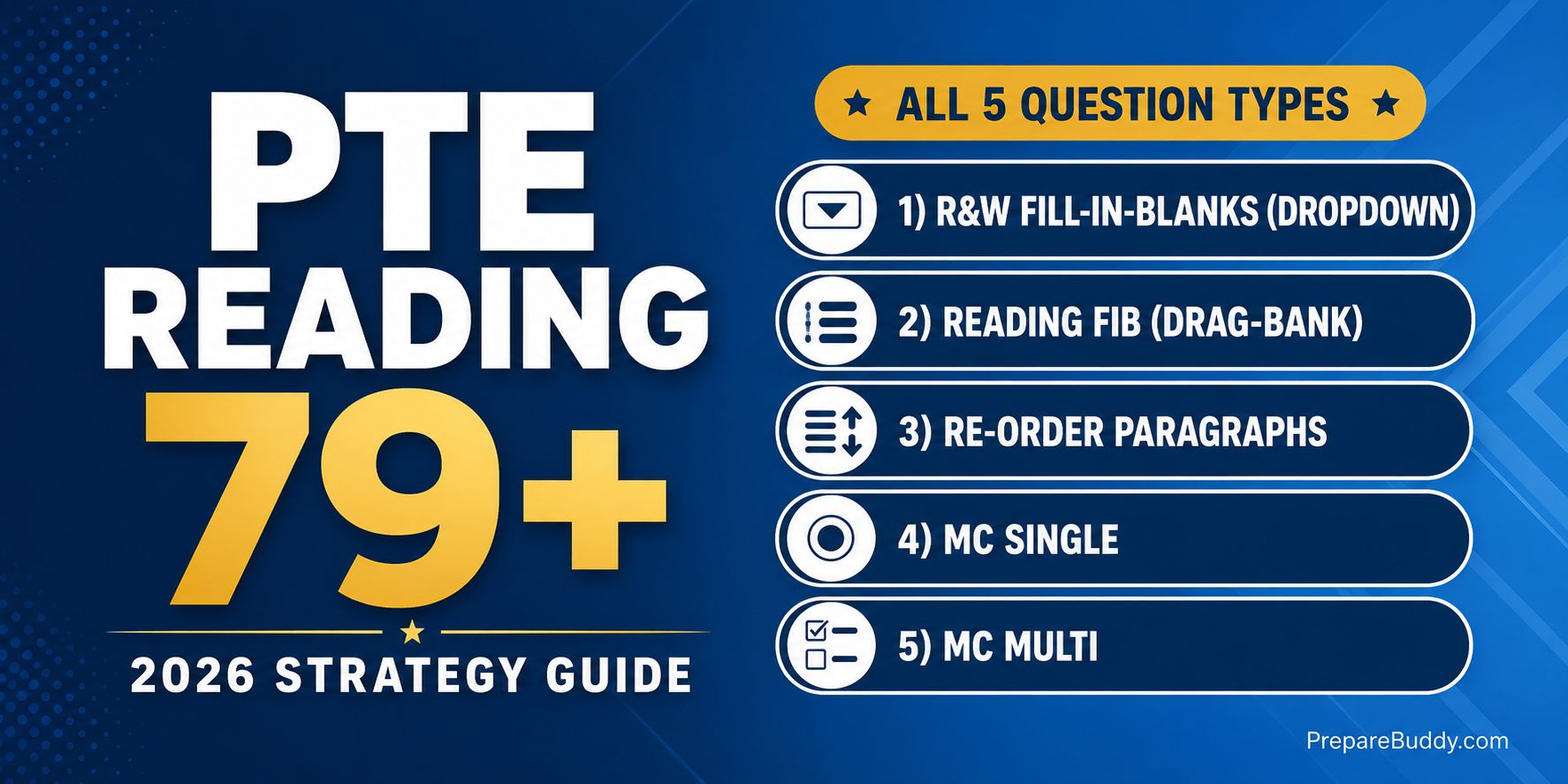
Most PTE Reading candidates do not lose points because the passages are hard. They lose points because they spend 90 seconds on a single Re-order Paragraphs item, get pulled into an MC Multi trap that triggers negative marking, and then run out of time on three drag-bank fill-in-the-blanks worth more partial-credit marks than the question they just over-thought. The Reading section in the August 2025 PTE Academic format runs roughly 30 minutes for 13–18 tasks across five question types — and the fastest, most accurate test-takers are not the strongest readers. They are the candidates who have a different game plan for each question type.
This guide breaks down a PTE Reading 79+ strategy for every task type in the current 2026 format: Reading & Writing Fill in the Blanks (dropdown), Reading Fill in the Blanks (drag-bank), Re-order Paragraphs, Multiple Choice Single Answer, and Multiple Choice Multiple Answers. We will cover how the scoring actually works, where negative marking can quietly drain your score, and how to allocate your 30 minutes so nothing on the screen catches you cold.
How PTE Reading Scoring Works (and Why It Punishes Guessing)
PTE Academic Reading is not a 20-question multiple-choice test. It is a mix of partial-credit blanks, drag-and-drop reorderings, and multi-select questions — some of which take negative marks if you click wrong options. The 79+ band, which most Australian skilled-migration and university admissions use as their target, requires consistent partial-credit accuracy plus near-zero negative penalties.
| Question Type | Count (approx.) | Scoring | Negative Marking? | Skill Tested |
|---|---|---|---|---|
| R&W Fill in the Blanks (dropdown) | 4–6 | Per-blank partial credit | No | Reading + Writing |
| Reading Fill in the Blanks (drag-bank) | 4–5 | Per-blank partial credit | No | Reading only |
| Re-order Paragraphs | 2–3 | Adjacent-pair partial credit | No | Reading only |
| MC Single Answer | 1–2 | Binary (1 or 0) | No | Reading only |
| MC Multiple Answer | 1–2 | +1 per correct option, −1 per wrong option, floor 0 | Yes | Reading only |
Three things to internalise from that table. First, the two fill-in-the-blanks tasks contribute the most points per minute because every blank you get right is an independent partial credit. Second, MC Multi is the only Reading task that can punish a wrong click — guess on it and you may walk out of the question with zero. Third, Re-order Paragraphs is scored on adjacent pairs, not full-sequence accuracy, so even an imperfect ordering can still earn partial credit if your local pairs are right.
Strategy 1: Reading & Writing Fill in the Blanks (Dropdown)
This is the highest-yield Reading task you will see. Each blank presents four dropdown options; correct answer choice depends on grammar, collocation, and meaning together. You will get 4–6 of these and they contribute to both your Reading score and your Writing score, which means a single correct click moves two scaled scores.
Approach: read the entire paragraph once before opening any dropdown. Then for each blank, eliminate options on three filters in this order — (1) part of speech, (2) collocation with the word immediately before or after the blank, (3) overall meaning in context. Most blanks are decidable in 15–20 seconds with this filter. Spend no more than 90 seconds per passage.
Strategy 2: Reading Fill in the Blanks (Drag-bank)
One passage, multiple inline drop targets, one shared bank of 7 chips — 5 correct, 2 distractors. The distractors are the trap. They are usually grammatically valid but semantically wrong, often near-synonyms of correct chips placed there to pull careless test-takers off course.
Approach: read the passage end-to-end first. Then assign the chips you are most confident about — typically 2–3 obvious collocations. Each correctly placed chip removes options from the pool and constrains the remaining blanks. Save the two hardest blanks for last; the distractors will be more obvious once only three chips remain. The drag-bank UI lets you drag chips back to the pool, so do not over-commit on your first pass.
Strategy 3: Re-order Paragraphs
Four to five sentences appear shuffled in a left pane; you drag them into the right pane in the correct order. The scoring is on adjacent pairs, not the full sequence, so a 5-sentence question has 4 pair-points available. Even if you get the global order wrong, you can earn 2–3 of those points.
Approach: find the topic sentence first. It is the one that introduces a concept without referring to any prior idea — no "this", "these", "however", "as a result". Lock it in position 1. Then look for sentences with clear backward-referring connectors and chain them. Pronouns and demonstratives ("it", "this trend", "such findings") are anchor signals; sentences containing them never go first. Spend no more than 90 seconds per Re-order item.
Strategy 4: Multiple Choice Single Answer
The easiest task in the section and the one most candidates over-think. A short to medium passage and one question with four options. No negative marking. Approach: read the question first, then scan the passage for the relevant sentence, then read all four options before clicking. If two options look defensible, the wrong one is almost always the option that paraphrases the passage too literally without capturing the question's intent. Spend under 60 seconds.
Strategy 5: Multiple Choice Multiple Answer — The Negative-Marking Trap
Here is the rule that separates 79+ scorers from 70-range scorers: do not click an option you are not 80%+ confident about. Each wrong click costs you 1 point, and the question floors at 0. Picking 2 correct and 1 wrong gives you the same score as picking 0. Picking 1 correct (sure) is strictly better than picking 1 correct + 1 guess.
Approach: read the passage twice. Mark every option as "support in text", "contradicts text", or "not mentioned". Click only the options where you can point to specific supporting evidence in the passage. If you cannot find evidence, do not click — leaving an option unselected is free; clicking it wrong costs a point.
The 30-Minute Reading Timing Plan
| Task | Recommended Time | Hard Cap |
|---|---|---|
| R&W FIB (per passage, 5–6 blanks) | 75–90 sec | 2 min |
| Drag-bank FIB (per passage, 5 blanks) | 2 min | 2 min 30 sec |
| Re-order Paragraphs | 90 sec | 2 min |
| MC Single | 45–60 sec | 75 sec |
| MC Multi | 90 sec | 2 min |
Move on at the hard cap. Reading is one of the few sections where you can flag and return later (subject to the section-locked timer), so unfinished questions are recoverable; questions you over-spent on are not.
How to Build Reading Stamina Before Test Day
Three habits separate consistent 79+ Reading scorers from candidates who plateau in the 65–75 range. First, practise with realistic UI mechanics — the drag-bank and two-pane Re-order interfaces behave differently from a text answer box, and on test day you do not want to spend two seconds figuring out the chip controls. Second, drill MC Multi with explicit "evidence-or-skip" rules until it is automatic. Third, time every practice session; an untimed practice habit is the single most common reason real-exam timing collapses.
Our PTE Academic practice platform replicates the August 2025 UI for all five Reading task types, including the drag-bank chips, two-pane Re-order, and MC Multi negative marking. Every practice attempt returns a per-question contribution to your scaled Reading score, so you can see exactly which task types are pulling your overall score down. Optional Real Exam Mode mirrors the live test's hard timers and disabled audio replay — useful in the two weeks before your test date. If you are still deciding which English test to target, our test comparison tool shows side-by-side scoring equivalents across PTE, IELTS, TOEFL, and CELPIP.
Common Pitfalls That Stop 65-Scorers from Reaching 79
Three patterns we see again and again from learners on the AI Assessment dashboard. First, over-spending on a single difficult MC Single question and burning two minutes of time better spent on three drag-bank blanks. Second, clicking three options on MC Multi when only two are clearly supported — the third "maybe" click cancels one of the right ones. Third, skipping the topic-sentence step on Re-order Paragraphs and trying to feel out the sequence intuitively; the topic-sentence method is mechanical, faster, and more reliable.
Putting It Together: Your 4-Week Pre-Test Plan
Week 1 — drill each question type in isolation, untimed, until the strategy feels automatic. Week 2 — same drills with the recommended-time clock running. Week 3 — full Reading sections under hard caps, reviewing every wrong answer with the AI explanation. Week 4 — two full mock tests in Real Exam Mode, plus targeted weakness work on whichever task type your scaled score is lowest on.
The candidates who hit 79+ Reading on test day are the ones whose strategy has become reflexive — they do not decide how to approach a drag-bank under exam pressure. They decided weeks earlier and the muscle memory carried them through.
Ready to test where your PTE Reading stands today? Take a free PTE practice test on PrepareBuddy and get an AI-scored Reading breakdown across all 5 question types in under 35 minutes — no credit card, no commitment. You will see exactly which task types are costing you points and which are already at 79+ level.


Join the Discussion