

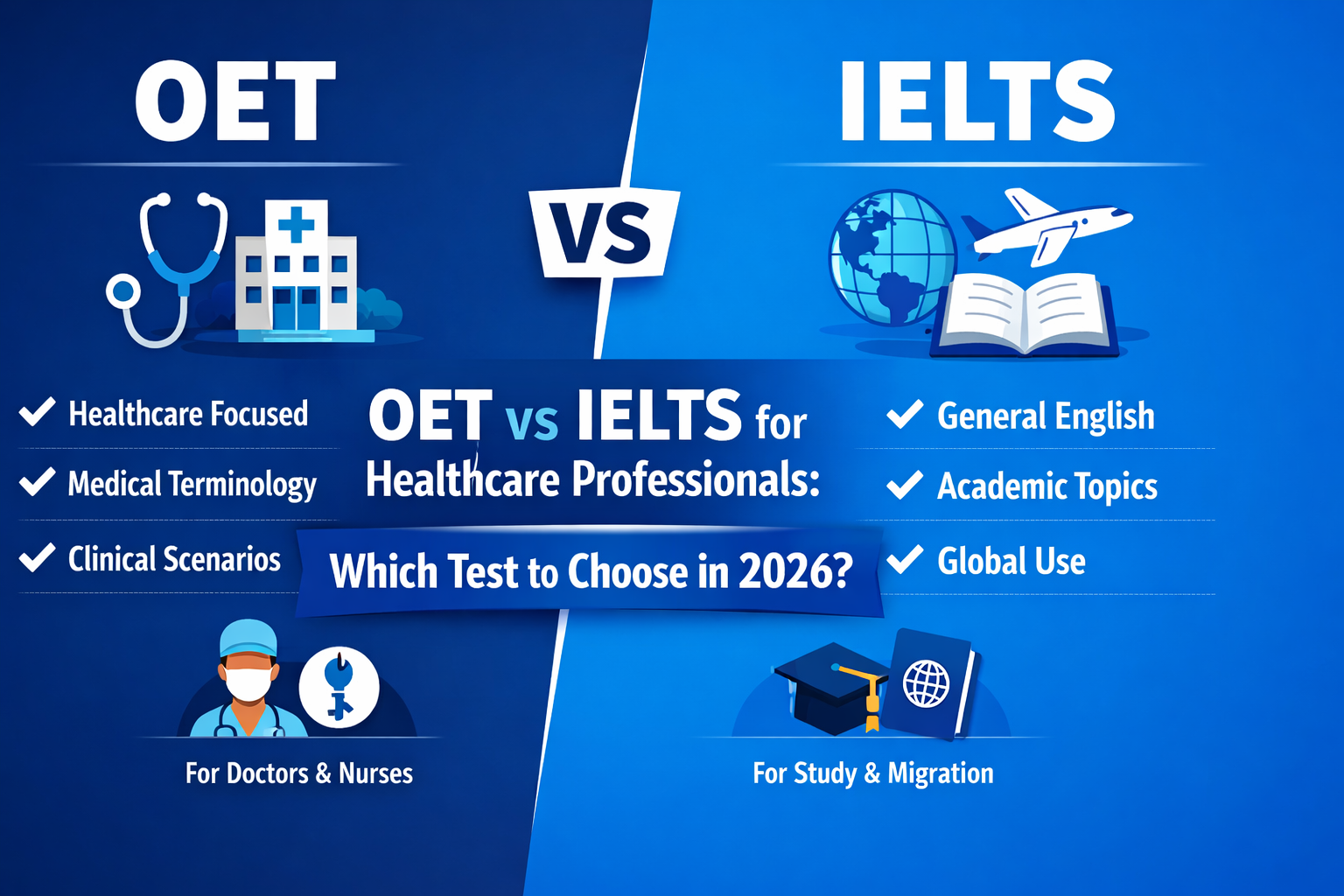
Every year, thousands of nurses, doctors, pharmacists, and allied health workers face the same dilemma: OET or IELTS? Both tests are widely accepted for healthcare registration and immigration — but they test very different things. Choose wrong, and you could spend months preparing for a test your target country or employer doesn't even require (or accept).
This guide breaks down the OET vs IELTS comparison so you can make the right call before you start studying.
OET vs IELTS at a Glance
| Feature | OET | IELTS Academic |
|---|---|---|
| Full Name | Occupational English Test | International English Language Testing System |
| Duration | ~180 min (sometimes split over 2 days) | 165 min (same day) |
| Score Scale | Grade A (highest) to Grade E | Band 0–9 |
| Typical Pass Grade | Grade B in each sub-test | Band 7.0 overall, minimum 7.0 per section |
| Language Content | Healthcare-specific (clinical scenarios) | General academic English |
| Speaking Task | Role-play as healthcare professional with a patient | Conversation with examiner (interview + cue card + discussion) |
| Writing Task | Healthcare correspondence (referral/discharge letter) | Academic report/graph + essay |
| Who It's For | 12 healthcare professions | All industries and purposes |
| Score Validity | 2 years | 2 years |
What is OET — and Who Is It Designed For?
The OET (Occupational English Test) is an English language test specifically designed for healthcare professionals. Unlike general English tests, every reading passage, listening audio, and speaking scenario involves real clinical contexts: patient consultations, medical records, case histories, and healthcare correspondence.
OET is available for 12 healthcare professions, including:
- Nursing
- Medicine (Doctor)
- Dentistry
- Pharmacy
- Physiotherapy
- Occupational therapy
- Optometry
- Radiography
- Dietetics
- Podiatry
- Speech pathology
- Veterinary science
The key difference in the speaking sub-test is that you play the role of the healthcare professional while the examiner plays the patient. This mirrors what you actually do at work — explaining diagnoses, gathering patient history, providing instructions — rather than discussing abstract topics with a stranger.
The writing sub-test requires you to write a healthcare letter (a referral letter or discharge summary), again replicating real clinical writing rather than IELTS-style essays or graph descriptions.
What is IELTS Academic — and When Does Healthcare Use It?
IELTS Academic is the world's most widely accepted English language test, used for university admission, skilled migration, and professional registration across virtually every field. For healthcare workers, IELTS Academic is accepted by most regulatory bodies as an alternative to OET — but it tests general academic English, not healthcare-specific language.
IELTS Reading passages are drawn from academic journals, news, and research — not medical case notes. The Writing section requires an essay and a report based on a graph or chart. The Speaking section follows a structured interview format covering everyday topics, personal experiences, and abstract discussions.
IELTS has one significant advantage: it's a multi-purpose test. A single IELTS score can satisfy your professional registration requirements, university enrollment, and immigration application simultaneously — something OET cannot do.
Acceptance by Country: Where Is Each Test Recognised?
| Country / Body | OET Accepted? | IELTS Academic Accepted? | Typical Requirement |
|---|---|---|---|
| UK — NMC (Nursing) | ✅ Yes | ✅ Yes | OET Grade B / IELTS 7.0 each |
| UK — GMC (Medicine) | ✅ Yes | ✅ Yes | OET Grade B / IELTS 7.5 each |
| Australia — AHPRA | ✅ Yes | ✅ Yes | OET Grade B / IELTS 7.0 each |
| New Zealand — NCNZ | ✅ Yes | ✅ Yes | OET Grade B / IELTS 7.0 each |
| Ireland — NMBI | ✅ Yes | ✅ Yes | OET Grade B / IELTS 6.5–7.0 |
| UAE — Dubai Health Authority | ✅ Yes | ✅ Yes | OET Grade B / IELTS 6.5–7.0 |
| Canada — CRNBC (BC Nursing) | ✅ Yes | ✅ Yes | OET Grade B / IELTS 7.0 each |
Note: Requirements vary by province, profession, and year. Always verify directly with your target regulatory body before registering for either test.
OET vs IELTS: Which Is Right for You?
Choose OET if:
- You are an active healthcare professional comfortable with clinical terminology
- Your sole purpose is professional registration (not immigration or university)
- You struggle with IELTS Writing Task 1 (graphs/charts) — OET writing is clinical letters, which healthcare workers do every day
- You want a test where your professional knowledge gives you a real advantage
- Your target country accepts OET (most major English-speaking destinations do)
Choose IELTS if:
- You need one test to cover professional registration AND immigration/university admission
- You are a student or recent graduate without deep clinical experience
- Your target destination or employer specifies IELTS only
- You prefer a more structured, widely available test format
- You're applying to multiple countries and want a universal score
How to Prepare for OET or IELTS — AI-Powered Practice
Whether you choose OET or IELTS, consistent, feedback-rich practice is the most important factor in your score. PrepareBuddy supports both tests with AI-powered mock exams and speaking practice designed to match real exam conditions.
For OET preparation, the Voice AI Speaking Practice is particularly valuable: the AI plays the patient in a role-play consultation — the exact format you'll face on test day — giving you real-time feedback on fluency, vocabulary, and professional register. You can practice patient consultations across different healthcare scenarios without waiting for a human tutor.
For IELTS preparation, PrepareBuddy's IELTS module generates unlimited full mock tests with all four sections scored against official band descriptors. The AI writing feedback identifies exactly which band descriptor you're missing and shows you how to bridge the gap.
For a side-by-side comparison of all the tests PrepareBuddy supports, see the platform comparison page or explore the full language test system.
Frequently Asked Questions
Is OET harder than IELTS for nurses?
Not necessarily harder — just different. Nurses and other healthcare professionals typically find OET more familiar because the content matches their daily work. IELTS writing (essays + graphs) can be more challenging for those without academic writing experience. The right answer depends on your individual background.
Do I need Band 7 in every section of IELTS for healthcare registration?
Most healthcare regulatory bodies in the UK, Australia, and New Zealand require a minimum Band 7.0 in all four sections — not just the overall score. A Band 7.5 overall with a Band 6.5 in one section typically will not be accepted. OET follows a similar logic: Grade B in each sub-test independently.
Can I take OET online from home?
Yes, OET offers an online at-home test option in most regions. IELTS also offers an online version (IELTS Online), though availability varies by country and regulatory body acceptance may differ from the paper-based version.
Ready to Start Practising?
Both OET and IELTS preparation reward consistent, exam-format practice with detailed feedback. The faster you identify your weak areas, the more efficiently you can improve.
Take a free diagnostic test on PrepareBuddy — available for both IELTS and OET — and get AI-scored results in minutes. No credit card required.
Questions about the right platform for your institute or coaching center? Schedule a free demo and see how PrepareBuddy helps healthcare training centres deliver OET and IELTS preparation at scale.


Join the Discussion