

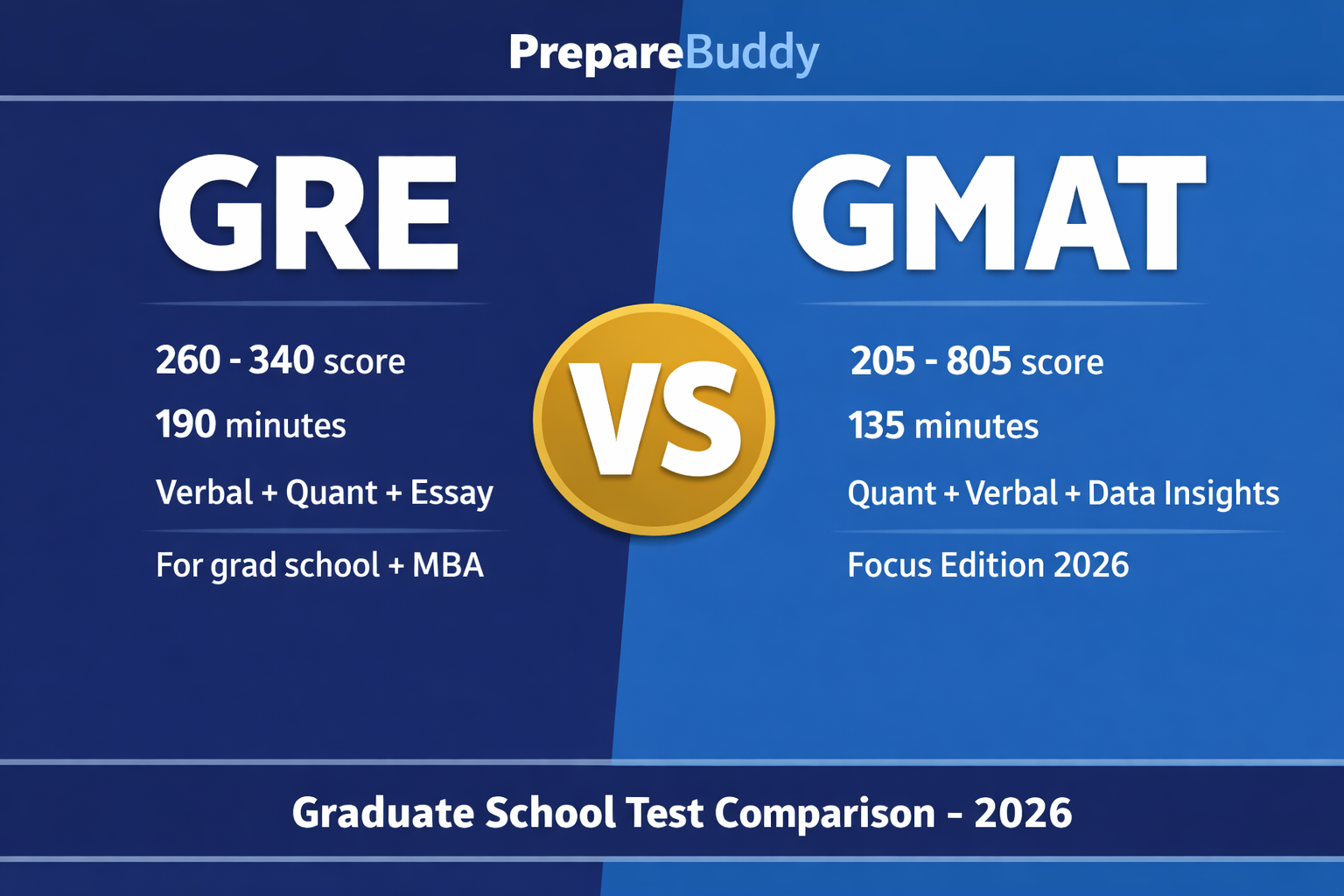
Around 500,000 people take a standardized test for graduate school admissions every year, and the first decision most of them face isn't what to study — it's which test to take: GRE or GMAT. The answer used to be simple (GRE for grad school, GMAT for MBA), but in 2026 more than 90% of business schools accept both, and the new GMAT Focus Edition has reshaped the math entirely.
This guide compares the GRE vs GMAT across every dimension that actually matters — scoring, format, timing, adaptive algorithms, business school acceptance, and cost — so you can decide with confidence. Data tables included.
GRE vs GMAT at a Glance
Here's the fastest way to see how the two tests line up in 2026. Both are computer-adaptive, both are accepted by virtually every major MBA program, and both can be taken at home or at a test center. Beyond that, they differ substantially.
| Feature | GRE General Test | GMAT Focus Edition |
|---|---|---|
| Total duration | 190 minutes (~1 hour 58 min + breaks) | 135 minutes (no breaks required) |
| Score scale | 260–340 (Verbal + Quant combined) | 205–805 (total score) |
| Sections | Verbal (27Q × 2), Quantitative (27Q × 2), Analytical Writing (2 essays) | Quantitative (21Q), Verbal (23Q), Data Insights (20Q) |
| Adaptivity | Section-level adaptive | Question-level adaptive |
| Calculator | On-screen calculator for Quant | On-screen calculator only in Data Insights |
| Essay | Yes (2 essays, Analyze an Issue + Analyze an Argument) | No essays — replaced with Data Insights |
| Question review | Review + change answers within a section | Bookmark + edit up to 3 answers per section |
| Cost (2026) | $220 globally (varies by region) | $275 at a test center / $300 online |
| Valid for | 5 years | 5 years |
| Retake policy | Every 21 days, up to 5 times / 12 months | Every 16 days, up to 5 times / 12 months |
The Big Change: GMAT Focus Edition vs. Classic GMAT
If your test-prep research is older than 2024, ignore it. The classic GMAT (800 scale, with Sentence Correction and AWA essay) was retired in early 2024 and replaced by the GMAT Focus Edition. Focus Edition is 45 minutes shorter, drops the essay entirely, and introduces a dedicated Data Insights section that tests your ability to interpret charts, tables, and multi-source data — a skill modern MBA programs care about more than formal grammar.
The score scale also shifted from 200–800 to 205–805, meaning a "760 classic GMAT" doesn't map one-to-one to a "760 Focus" — it's a slightly different distribution. Most business schools now report Focus Edition scores as the standard.
GRE vs GMAT Scoring: What a "Good Score" Looks Like
Both tests are percentile-based. A 330 on the GRE and a 705 on the GMAT Focus Edition are roughly equivalent — both sit at around the 95th percentile. Here's how the score tiers compare for top programs.
| Target | GRE Score Range | GMAT Focus Score Range | Percentile |
|---|---|---|---|
| Elite MBA (Harvard, Stanford, Wharton) | 328–340 | 695–805 | 90th–99th |
| Top-20 MBA (Kellogg, Booth, MIT Sloan) | 322–330 | 655–725 | 75th–95th |
| Top-50 MBA | 310–322 | 595–665 | 55th–80th |
| Competitive grad programs (STEM/social sciences) | 315–325 (section-weighted) | Not typically used | 70th–90th |
| Average test-taker | ~303 total | ~546 total | ~50th |
One important nuance: MBA admissions committees often care more about individual sub-scores than the total. For quant-heavy programs, you need a strong GRE Quant (~167+) or GMAT Quantitative section score. For a writing-heavy program, a GRE Analytical Writing score of 4.5+ can matter.
Which Test Should You Take? A Use-Case Matrix
Forget the old rule of thumb. The answer depends on your target program, your strengths, and how you want to study.
| Your Situation | Better Choice | Why |
|---|---|---|
| MBA-only applicant, strong at data/charts | GMAT Focus | Data Insights rewards data-literacy; many AdComs still prefer GMAT for MBA |
| Applying to both MBA and MS programs | GRE | Broader acceptance across grad schools; no need to take two tests |
| Strong vocabulary, weaker on charts | GRE | GRE Verbal rewards nuanced reading and vocabulary |
| Strong quant, weaker essay writer | GMAT Focus | No essay required |
| Want a shorter test day | GMAT Focus | 135 min vs 190 min |
| Want lower cost | GRE | $220 vs $275–$300 |
| Engineering/PhD bound | GRE | Many STEM PhD programs still require GRE |
| Specialized Master's in Finance / Analytics | GMAT Focus | Programs weight Data Insights heavily |
How the Adaptive Algorithms Differ
This is where the two tests feel most different on test day. The GRE uses section-level adaptivity: your performance on the first Verbal section determines the difficulty of the second Verbal section (and same for Quant). Within a section you can skip, flag, and return to questions freely.
The GMAT Focus uses question-level adaptivity: every question calibrates the next one based on whether you got the previous one right. Focus Edition added a limited "bookmark and edit up to 3" feature, but you still can't freely skip around the way you can on the GRE.
Why does this matter? If you're the kind of test-taker who benefits from pacing — skimming the section, answering easy ones first, then returning — the GRE plays to your strengths. If you're steady and accurate question-by-question, the GMAT Focus works fine.
Business School Acceptance in 2026
As of 2026, every single top-50 global MBA program accepts both GRE and GMAT scores, and admissions committees publicly state there is no preference. However, GMAT Focus scores still make up 70–75% of submitted applications at the elite level, simply because most business-bound applicants still choose it first. Admissions data also shows GRE-submitters get admitted at similar rates to GMAT-submitters at the same percentile.
For MS programs, PhD programs, and non-business graduate schools, the GRE dominates. The GMAT is rarely accepted outside of business and analytics programs.
How to Prepare for Either Test
Whichever test you choose, the preparation formula is the same: diagnose, drill weak areas, and take full-length practice tests under real conditions. PrepareBuddy's platform covers both tests with unlimited AI-generated practice that matches 2026 format standards — our 120B-parameter AI model produces content that's 96% indistinguishable from official materials in blind tests.
For the GRE, our GRE practice module uses the same section-level adaptive algorithm as the real test: 12 medium questions in Section 1 baseline your score, then Section 2 ramps up or down in difficulty. Question types include Quantitative Comparison, Problem Solving, Numeric Entry, Data Interpretation, Text Completion, Sentence Equivalence, Reading Comprehension, Multi-Select, and Select-in-Passage.
For the GMAT Focus Edition, our GMAT practice module generates all three sections — Quantitative (21Q), Verbal (23Q), and Data Insights (20Q) — with authentic 2024+ format compliance. Data Insights questions cover multi-source reasoning, table analysis, graphics interpretation, and data sufficiency.
Both modules include unlimited full-length mock tests, detailed analytics that surface your weak areas, and AI-written feedback on essays (GRE) and verbal explanations — so you practice deliberately, not just repeatedly.
GRE vs GMAT: The Three-Question Decision Framework
If you're still undecided, answer these three questions:
- Am I applying to any non-business graduate programs? If yes, take the GRE. It's accepted everywhere.
- Do I read data (charts, tables, dashboards) more comfortably than I read dense academic prose? If yes, the GMAT Focus Data Insights section plays to your strengths.
- Am I a strong essay writer? If no, the GMAT Focus lets you skip essays entirely. If you enjoy writing and want to show that skill to AdComs, GRE's Analytical Writing gives you that stage.
Still on the fence? Take a free diagnostic in both formats. A 30-minute baseline will usually reveal which test your brain is wired for.
Start With a Free Diagnostic
The fastest way to decide between GRE and GMAT isn't more research — it's to try both. Take a free diagnostic test on PrepareBuddy in either GRE or GMAT Focus format, get a realistic score estimate within minutes, and see which test feels natural to you. No credit card required, and your first month of full practice is free.


Join the Discussion