

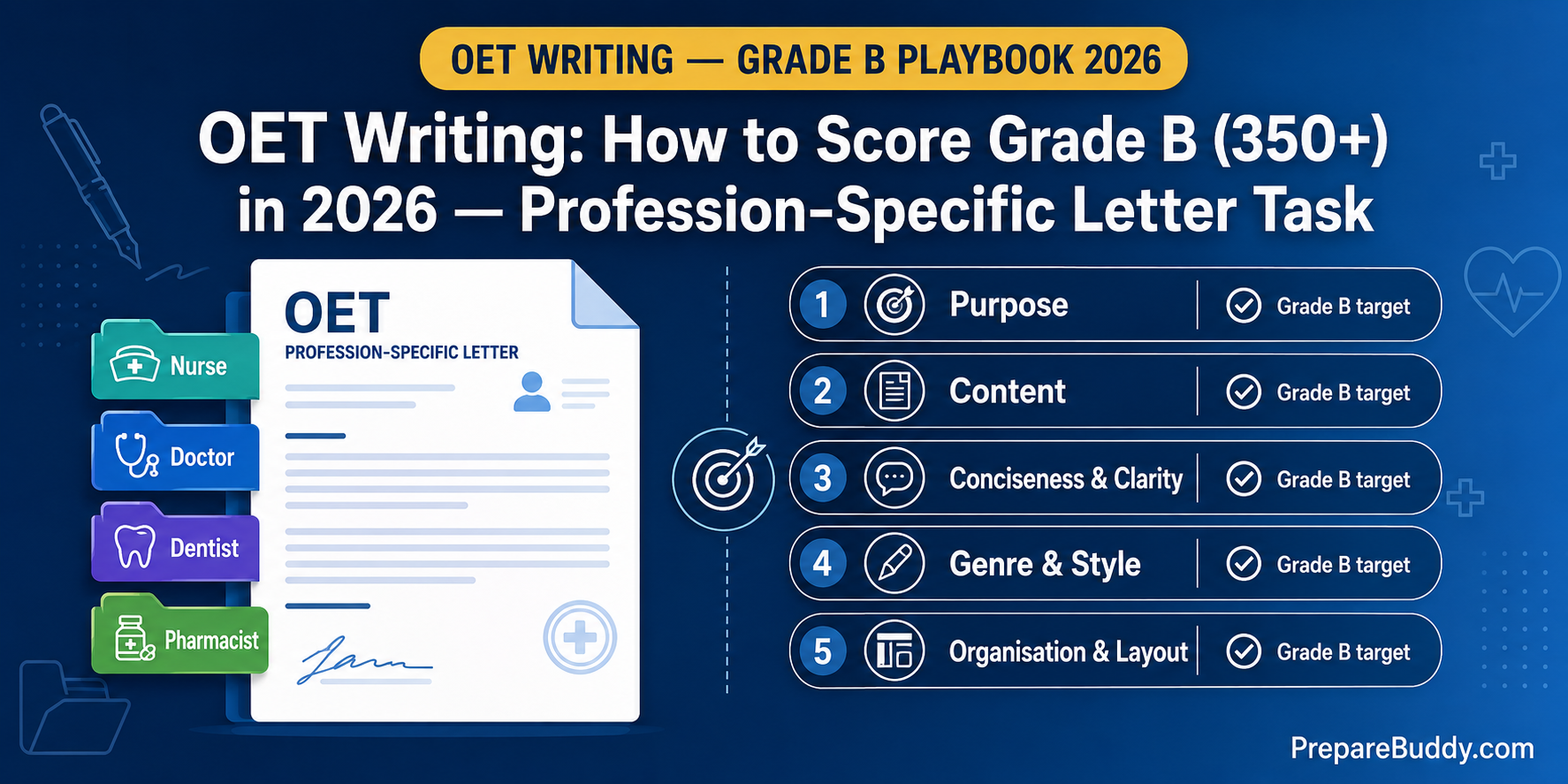
If you are sitting OET in 2026, the Writing sub-test is almost certainly your weakest link. The pass rate for Grade B in Writing sits well below the other three skills — and the reason isn’t your English. It’s that OET Writing is the only section where you must combine clinical content with strict letter conventions, all while a real-OET 2025 rubric scores you on six separate criteria instead of one overall band.
You get 5 minutes of reading time plus 40 minutes to produce one profession-specific letter — referral, discharge, transfer, or advice — to a clearly defined healthcare audience. To reach Grade B (350+ on the 0–500 scale), the raw score floor is 27 out of 38. This guide shows you exactly how to hit that floor, every criterion explained, the 12-item examiner-gotcha list that wrecks most candidates, and a 6-week practice plan you can run on PrepareBuddy’s OET module.
OET Writing 2026: format, timing, and what Grade B actually means
The 2025 OET Writing sub-test runs 45 minutes total: 5 minutes of unrestricted reading time to study the case notes, then 40 minutes to write one letter of approximately 180–200 words in the body. The case notes specify your profession, the recipient, and the clinical situation. You don’t pick the letter type — the task tells you whether you’re writing a referral, a discharge summary, a transfer letter, or an advice/discharge instruction to a patient or caregiver.
OET Writing reports on the 0–500 scale and maps to the A–E grade band. Here is the conversion most candidates never see clearly explained:
OET Writing score ranges 2026
| Raw score (out of 38) | OET Writing scale (0–500) | Grade | What it signals to recruiters & regulators |
|---|---|---|---|
| 38 | 500 | A | Native-equivalent clinical English; rarely awarded. |
| 34 | 447 | A (Grade A border) | NMC, AHPRA, GMC top tier; safe for any visa pathway. |
| 30 | ~400 | B (mid) | Comfortable Grade B; safe margin for AHPRA, NMC, MCNZ. |
| 27 | 355 | B (floor) | The minimum for Grade B; what most regulators require. |
| 22 | ~300 | C+ | Most UK/Aus regulators reject this for registration. |
| <22 | <300 | C or below | Resit required for healthcare registration. |
Anchors verified against the OET 2025 raw-to-scaled conversion: raw 27 → 355 (Grade B floor), raw 34 → 447 (Grade A border), raw 38 → 500.
The implication is brutal but useful: you can afford to drop 11 raw marks across six criteria and still hit Grade B. You can’t afford to fail any single criterion catastrophically. That’s the strategic frame for everything that follows.
The 2025 OET Writing rubric: six criteria, not one band
This is where almost every candidate going from C+ to Grade B gets it wrong. They train as if OET Writing scores one overall band like IELTS Task 1. It doesn’t. The real-OET 2025 rubric — which PrepareBuddy’s AI Writing Analysis mirrors exactly — scores you on six separate criteria:
The six OET Writing criteria explained
| Criterion | Max score | What examiners reward | What wrecks the score |
|---|---|---|---|
| Purpose | 0–3 | The reason for the letter is clear in the first paragraph. | Purpose buried past paragraph 1, or never stated. |
| Content | 0–7 | Clinically relevant information only, selected with judgement. | Copy-paste of every case-note bullet, including irrelevant history. |
| Conciseness & Clarity | 0–7 | Tight sentences, body length controlled, no padding. | Wordy openings (“I am writing in regards to…”), repetition, redundant detail. |
| Genre & Style | 0–7 | Register matches the audience (specialist, GP, patient, caregiver). | Writing to a GP like you’re writing to a patient, or vice versa. |
| Organisation & Layout | 0–7 | Logical paragraphs, correct salutation/closing, proper letter format. | Bullet points in the body, missing salutation, wall-of-text. |
| Language | 0–7 | Accurate grammar, range, appropriate medical terminology. | Tense slips, article errors, lay terms where medical ones are expected. |
Total raw: 38. Grade B floor is raw 27. Look at that distribution again: Purpose caps at 3 and the other five cap at 7. So Purpose is single-most important per point on offer — missing it costs you nearly 10% of the entire raw score and is the easiest thing to get right.
The Grade B blueprint: a paragraph-by-paragraph formula that works for every letter type
OET letters fall into four canonical types. The structure below works for all four because it’s built around the rubric, not around the topic.
Paragraph 1 — State the purpose (score-locker for Purpose criterion)
One sentence. Identify the patient by name, age, and the single most important clinical fact, and state explicitly what you are asking the recipient to do.
Referral example: “I am writing to refer Mrs Diane Patterson, a 68-year-old woman with newly diagnosed type 2 diabetes, for ongoing endocrinology review and titration of her hypoglycaemic therapy.”
Discharge example: “I am writing to inform you of the discharge of Mr Ahmed Khalil, a 54-year-old patient under your care, following a five-day admission for community-acquired pneumonia, and to outline his ongoing community-based management.”
That single sentence locks in 3/3 for Purpose. Most candidates leave 2 raw marks on the table here.
Paragraph 2 — Current clinical picture
Only what the recipient needs to act. Drop social history, past surgical history, family history unless they bear on the clinical decision the recipient is making. This is the Content criterion at work — selection, not transcription.
Paragraph 3 — Relevant background
The one or two prior conditions or medications that change the recipient’s management plan. Use medical terminology. “She has a 12-year history of hypertension, currently controlled on amlodipine 10 mg daily” — not “She’s had high blood pressure for ages.”
Paragraph 4 — The ask, repeated and specified
Close the loop. “I would be grateful if you could arrange…” / “Please follow up…” / “Could you please ensure that…”. Match the verb to the recipient’s authority: a specialist gets “assess and manage”; a community nurse gets “monitor and report”; a patient gets “please continue to…”.
Salutation and sign-off
Match formality to recipient. “Dear Dr Williams” for a named specialist; “Dear Sir/Madam” only when no name is given; “Dear Mrs Patterson” for a named patient. Sign off “Yours sincerely” when the recipient is named, “Yours faithfully” otherwise. Missing or mismatched salutation costs raw points under Organisation & Layout.
The 12 examiner-gotchas that decide Grade B vs C+
PrepareBuddy’s OET writing scorer flags these explicitly on the result page because they map directly to lost raw marks. Memorise this list:
| # | Gotcha | Criterion penalised |
|---|---|---|
| 1 | Wrong audience (writing to a specialist like a patient) | Genre & Style |
| 2 | Copy-paste from case notes verbatim | Content |
| 3 | Bullet points in the body of the letter | Organisation & Layout |
| 4 | Missing or wrong salutation (“Hi Dr Smith”) | Organisation & Layout |
| 5 | Purpose buried past paragraph 1 | Purpose |
| 6 | Including irrelevant social/family history | Content |
| 7 | Body word count well below 180 or above 220 | Conciseness & Clarity |
| 8 | Lay terms where medical terms are expected for a clinician audience | Language |
| 9 | Medical jargon when writing to a patient | Genre & Style |
| 10 | Tense slips (mixing past and present in clinical timeline) | Language |
| 11 | Wrong sign-off (“Yours sincerely” with “Dear Sir/Madam”) | Organisation & Layout |
| 12 | Repeating the same information in multiple paragraphs | Conciseness & Clarity |
Read the list twice before every practice attempt. Most Grade B failures are not English failures — they’re gotcha-list failures.
Word count: the body-only rule that surprises candidates
Word counters in OET preparation tools historically counted everything — salutation, closing, signature block. The 2025 rubric explicitly counts body only: salutation and closing are excluded. The target is 180–200 body words. A letter that “feels” like 200 words because of a long greeting and full sign-off can be running at 160 body words and lose marks for under-development.
PrepareBuddy’s scorer ships a body-only word counter on the result page so you see the real number on every practice attempt. Generic word counters lie to you.
Profession-specific letter types: pick the right template
OET supports 12 healthcare professions: medicine, nursing, pharmacy, dentistry, dietetics, occupational therapy, optometry, physiotherapy, podiatry, radiography, speech pathology, and veterinary science. The letter type changes the structure subtly:
| Letter type | Typical recipient | Structural emphasis | Watch out for |
|---|---|---|---|
| Referral | Specialist / consultant | Clear ask, focused clinical picture, what you’ve already tried. | Don’t over-investigate — you’re asking them to. |
| Discharge | GP / community team | Admission summary, treatment given, ongoing plan, follow-up dates. | Dose details for new meds are non-negotiable. |
| Transfer | Another ward / facility | Reason for transfer, current status, immediate care priorities. | State urgency level explicitly. |
| Advice / patient letter | Patient or caregiver | Lay language, clear actions, reassurance, follow-up signposting. | Strip all medical jargon. Avoid acronyms. |
How AI scoring helps you train smarter
OET Writing improvement is bottlenecked by feedback quality. Two practice letters with detailed examiner-grade feedback beat ten letters scored by a teacher who can only mark them once a week. This is exactly what 24/7 AI scoring fixes.
PrepareBuddy’s OET module uses a 120-billion-parameter AI model with 95% AI scoring accuracy against human raters, and the result page shows what an examiner would actually say: verbatim quotation from your letter under each criterion score, a band-7 rewrite of your weakest paragraph side-by-side with your original, your body-only word count, and the 12-item gotcha checklist with each item flagged green or red. That same feedback loop — and the Voice AI equivalent for the Speaking sub-test — is why 75% time saved on grading is a real PrepareBuddy stat and not marketing.
A 6-week OET Writing study plan that hits Grade B
| Week | Focus | Practice volume | Success signal |
|---|---|---|---|
| 1 | Master the 6 criteria. Annotate sample Grade B and Grade A letters. | 2 reads, 1 letter | Can identify which criterion every gotcha hits. |
| 2 | Drill Purpose paragraph. 10 different case notes, write only paragraph 1. | 10 mini-drafts | 3/3 on Purpose criterion consistently. |
| 3 | Full referral letters with timed 40-min writes. | 3 letters | Body word count 185–200, no bullet points. |
| 4 | Discharge + transfer letters. Switch audiences daily. | 4 letters | Genre & Style criterion not flagged. |
| 5 | Advice letters (patient audience). Strip jargon drills. | 3 letters | Zero medical acronyms in patient letters. |
| 6 | Mixed full mocks. Treat each like exam day. | 4 letters under exam conditions | Raw score ≥ 27 on 3 consecutive attempts. |
The minimum viable practice for Grade B is 17 timed letters with examiner-grade feedback on each. That’s impossible to get from a human tutor in six weeks. It’s a single afternoon of work for the AI scorer.
Common questions about OET Writing 2026
Is the 2025 OET Writing rubric harder than the previous one?
Not harder, but more granular. The previous overall band grade has been replaced by six explicit criteria. The total raw score (38) and Grade B floor (raw 27) are unchanged. If anything, the granular rubric is fairer because it rewards strong candidates who lose a single criterion instead of penalising them globally.
How long is the OET Writing body supposed to be?
180–200 body words. The salutation, recipient address, and sign-off are excluded from the count. Going below 180 risks under-development penalties; going above 220 risks Conciseness & Clarity penalties.
Can I use bullet points in the OET letter body?
No. Bullets are explicitly listed as a gotcha that penalises Organisation & Layout. Continuous prose only. The 5-minute reading time is for selecting and ordering information — not for sketching a bulleted plan that leaks into your letter.
How accurate is AI scoring for OET Writing?
PrepareBuddy’s AI Writing Analysis reports 95% scoring accuracy with human raters, using a 120-billion-parameter model trained on real OET 2025 rubrics. It scores every criterion individually with verbatim evidence quotation and flags each of the 12 examiner gotchas explicitly. You can try it on the free practice test.
Try OET Writing practice with examiner-grade feedback
Grade B isn’t a writing-ability problem. It’s a rubric-literacy problem. Once you internalise the six criteria and the 12 gotchas, every practice letter becomes a deliberate experiment instead of a blank-page guess.
Start with a free, real-OET-2025 practice letter and full criterion-by-criterion feedback today: try a free OET test. Or if you’re coaching candidates and want to deploy this as a study workflow for your students, schedule a demo — we deploy in 24–48 hours with full white-label branding.


Join the Discussion