

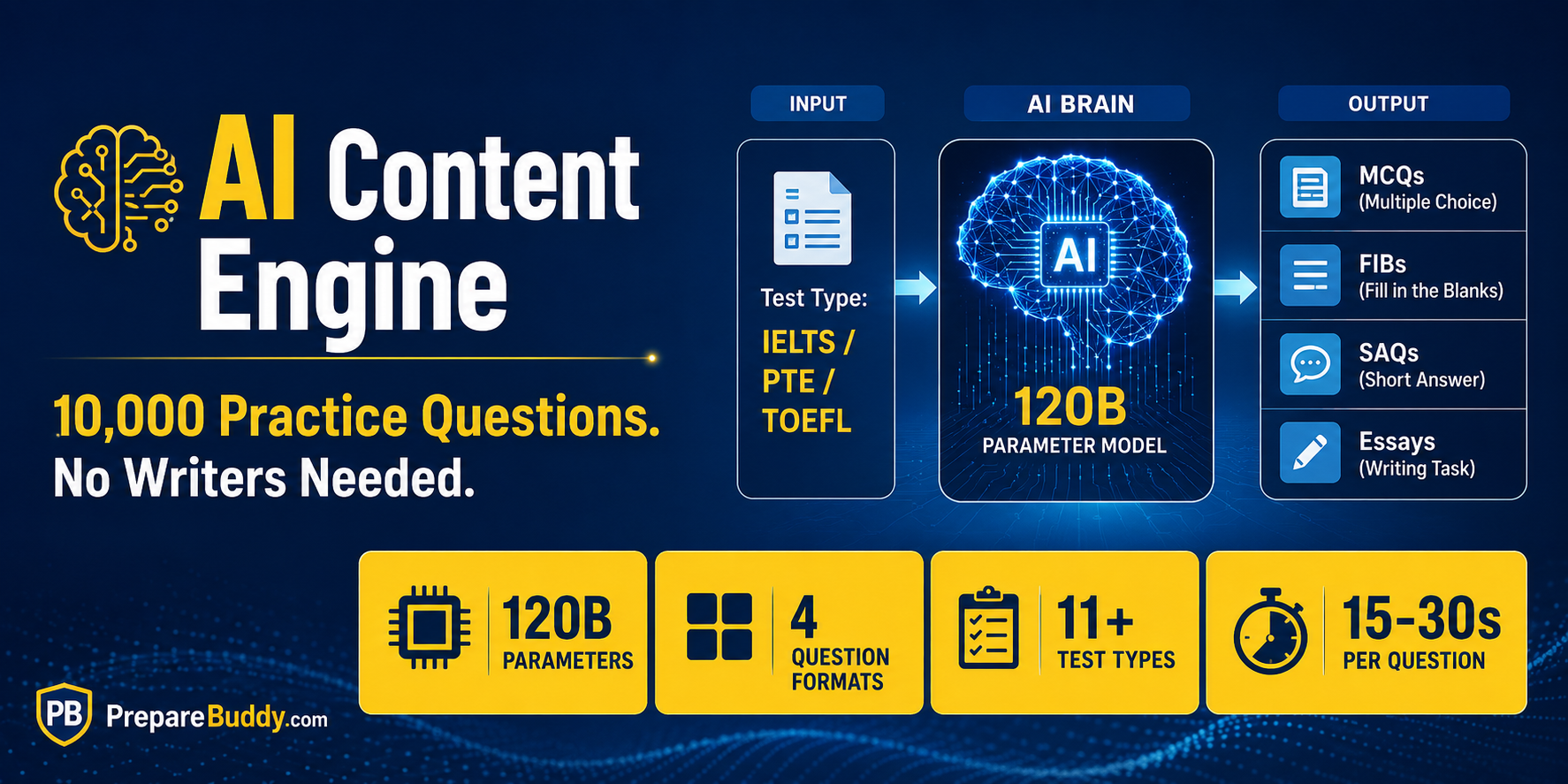
The biggest hidden cost of running a test-prep coaching center in 2026 isn't classroom rent or faculty salaries — it's question content. A 150-student IELTS or PTE coaching center typically burns through 1,000–1,500 fresh practice items per month, and most operators are still sourcing those items the slow way: in-house content writers, subject-matter editors, and a quality-control loop that takes weeks. This guide explains how an AI content engine changes that math, what features actually matter, and how coaching-center owners can evaluate a platform before committing.
Why Content Is the Real Bottleneck for Coaching Centers
Operations leads at coaching centers will tell you the same thing: students chew through practice content faster than teams can produce it. A typical 200-student PTE/IELTS center needs:
- 8–10 fresh full-length mocks per month, per batch
- 50–70 new reading passages with question sets
- 100+ unique speaking prompts (so students aren't reusing recorded answers)
- Updated writing tasks aligned to the latest exam pattern
- Section-wise drills for weak-area remediation
Doing this by hand means hiring a 3–4 person content team or buying outdated question banks that students quickly memorise. Neither option scales as the center grows from one location to three. The third option — AI question generation — has matured rapidly. In 2023, AI-generated items were detectably synthetic. In 2026, with 120B-parameter models trained for educational content, the gap has effectively closed.
What an AI Content Engine Actually Does
PrepareBuddy's content engine isn't a generic chatbot wrapper. It's purpose-built for exam content with four discrete capabilities that matter for coaching centers:
- Four question format types. Single-Select MCQ, Multi-Select, Match Pairs, and Fill-in-the-Blanks — mapped to the actual formats used in IELTS, PTE, TOEFL, CELPIP, DET, GRE, GMAT, SAT, and OET.
- Difficulty calibration. Each generated item is scored on a difficulty scale during generation, so practice sets can target Band 6, Band 7, Band 8 (or PTE 50, 65, 79) explicitly — not random difficulty roulette.
- Educational-standard validation. Generated items are validated against test-pattern rules (IELTS Task 2 prompt structure, PTE Read Aloud word counts, TOEFL Reading passage length) before they go live.
- Unlimited generation. No per-question fee, no monthly cap. Generate as much as your batches need.
The capability sits inside the broader Custom Exams and question-bank tooling. For institute owners who want the full B2B view, the coaching-center solution page covers the deployment workflow.
The Workflow: From Concept to Practice Set in Minutes
Here's what generating a PTE Reading practice set looks like inside a coaching-center admin account:
| Step | Action | Time |
|---|---|---|
| 1 | Select test type + section (e.g., PTE → Reading → Multiple Choice Multiple Answers) | 30 sec |
| 2 | Set difficulty target (e.g., 65–79 score range) | 15 sec |
| 3 | Choose topic theme (optional — e.g., "climate change", "technology") | 30 sec |
| 4 | Set quantity (e.g., 30 items) | 10 sec |
| 5 | Generate + review preview | 2–3 min |
| 6 | Approve, assign to batch | 30 sec |
| Total — 30-item practice set | ~5 min | |
By contrast, a human content writer producing the same set takes 6–8 hours minimum, plus review. That's the unit-economics shift, and it compounds across every batch every month.
Three Ways to Build Exams (Not Just One)
Most coaching centers don't actually want everything AI-generated. Some questions come from existing spreadsheets. Some — especially diagram-heavy math or specialised speaking prompts — need full teacher control. PrepareBuddy's Custom Exam Creator runs three modes, all producing the same standard exam format:
| Mode | Best For | Speed | AI Involved |
|---|---|---|---|
| AI Generate | New exams from topics | 15–30 sec | Yes — 120B model |
| Import Questions | Pasting existing question text | ~1 min | Yes — AI auto-formats |
| Manual Entry | Precise control, images, diagrams | 2–5 min/question | No — 100% teacher-controlled |
The hybrid is what most successful centers settle on: AI Generate for the bulk of reading/listening/speaking content, Import for legacy spreadsheets, and Manual Entry for the 5% of items that genuinely need a human author.
Cost Math: AI Content Engine vs In-House Writers
Let's run the numbers for a 200-student coaching center producing 1,200 fresh practice items per month across IELTS and PTE.
| Approach | Monthly Cost | Items Produced | Cost / Item |
|---|---|---|---|
| In-house content team (3 writers + 1 editor) | $3,000–5,000 | 800–1,000 | $3.50–6.00 |
| Outsourced question-bank subscriptions | $400–800 | ~500 (often stale) | $0.80–1.60 |
| AI Content Engine (PrepareBuddy plan) | $0 marginal | Unlimited | ~$0 |
The shift isn't subtle — it's an order-of-magnitude change in how content economics work. But the bigger win is responsiveness. When the PTE pattern changed in late 2024, centers using AI content engines had updated practice live within a week. Centers running in-house writing teams took 6–10 weeks.
What About Quality? The Honest Answer
Healthy skepticism here is fair. Three years ago, AI-generated exam questions were unreliable. The 2026 reality is more nuanced — and worth being specific about:
| Model Size | Exam Quality Score | Distinguishable from Official Content? |
|---|---|---|
| 8B | 62% | Easily detected as AI |
| 17B | 78% | Sometimes detected |
| 70B | 89% | Rarely detected |
| 120B | 96% | Indistinguishable from official |
The 120B-parameter model used by PrepareBuddy's content engine sits at the top of that table. For numerical answer correctness on SAT/GRE/GMAT items, a second model (Qwen3-32B, which scored 81.4% on AIME 2024) independently re-solves each generated question — disagreement triggers automatic deletion and regeneration. Reading & Writing items go through a separate cross-model consensus pass. Net result: 94% human-grader alignment on the scoring side, with multi-model verification on the generation side.
Best practice we see at high-performing centers: use the AI engine to generate at scale, and keep one senior faculty member doing a 15-minute weekly sample review. That hybrid is cheaper than a full writing team and tighter than purely automated generation.
How This Plugs Into a White-Label Platform
For institutes who want this capability under their own brand, the content engine ships as part of a complete white-label platform for coaching centers. Centers get:
- Their own domain, logo, and branded emails (zero PrepareBuddy branding visible to students)
- AI content generation across 11+ test types
- Voice AI scoring for speaking sections (30+ English accents, 48-emotion detection)
- Adaptive testing that adjusts difficulty per student
- Student journey dashboards, batch management, and analytics
- Multi-tenant hierarchy: Parent → Branch → Department for multi-location chains
Deployment runs in 24–48 hours from kickoff. First month is free, no credit card required, no lock-in contracts.
Buyer's Checklist: What to Ask Before You Sign
If you're comparing platforms, run any vendor through these seven questions before signing:
- Does it support all four question formats (MCQ, Multi-Select, Match Pairs, Fill-in-the-Blanks)?
- Can you set difficulty target during generation, or only post-hoc?
- Does the engine validate against current exam patterns — and how often is the validator updated?
- Is there a per-question cost, or is generation truly unlimited?
- Can you generate across multiple test types, or only the one the platform is built for?
- Does generated content render inside your branded environment, or does it expose third-party branding?
- Can items be exported, edited, bulk-imported via CSV, and reused inside custom exam builders?
A platform that can't answer "yes, unlimited" to question 4 and "yes, multi-test" to question 5 is selling a question bank with a chatbot, not a true content engine.
The Bigger Picture: Where AI Content Frees Capacity
When question content stops being a bottleneck, three things change inside a coaching-center P&L. First, faculty time shifts from authoring practice items to actually teaching and giving feedback. Second, the cost of running parallel batches drops — adding a second IELTS batch no longer means doubling the content load. Third, the center can credibly offer a wider test mix (DET, CELPIP, OET) without standing up new content teams for each one.
For most centers, that last point is the underrated lever. Multi-test capability has been one of the strongest retention drivers we've seen across 200+ institutions using the platform, because students often pivot mid-prep (IELTS to PTE for Australia, or IELTS to CELPIP for Canada) and a center that can absorb that pivot keeps the revenue.
Getting Started
If the content treadmill is consuming bandwidth that should be going to teaching, the fastest way to evaluate fit is to see the engine produce content for your specific test type and difficulty target. You can schedule a demo, view pricing, or start with a free practice test to see how generated items render for your students before involving your full team.


Join the Discussion