

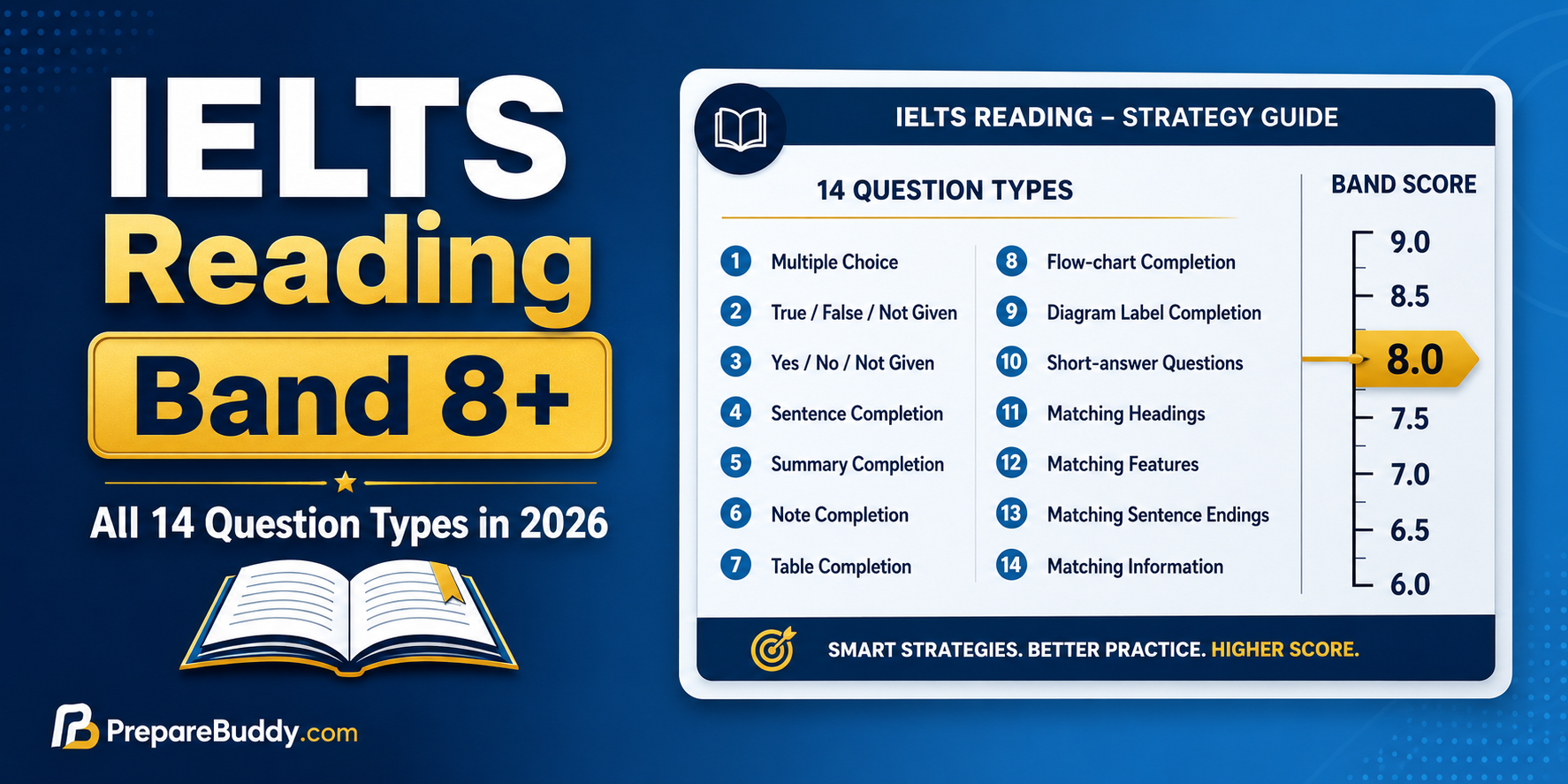
Roughly 6 in 10 IELTS candidates miss Band 8 on Reading by 2 or 3 questions — not because they don't understand English, but because they ran out of time on Passage 3. The test gives you 60 minutes, 40 questions, and three passages of escalating difficulty. There is no extra time to transfer answers. That single constraint is what separates a Band 7 from a Band 8 on IELTS Reading.
This guide breaks down what you actually need to score Band 8+ on IELTS Reading in 2026: the question-by-question accuracy required, a strategy for each of the 14 question types, a minute-by-minute timing framework, and the AI-powered practice loop top scorers use to fix weaknesses in days instead of months.
IELTS Reading at a Glance
Before strategy, understand the surface area. IELTS Reading is one section, two versions (Academic and General Training), and the rules are identical for scoring.
| Element | Specification |
|---|---|
| Duration | 60 minutes (no extra transfer time) |
| Total questions | 40 |
| Passages | 3 long passages (Academic) / 3 sections of progressively academic texts (General) |
| Word count | ~2,150–2,750 words total |
| Score range | Band 0–9 (in 0.5 increments) |
| Question types | 14 distinct types across passages |
| Penalty for wrong answers | None — answer every question |
How Many Right Answers Equal Band 8?
The raw-score to band conversion is fixed. Here is what you need to hit each band on the Academic version.
| Correct Answers (out of 40) | Academic Band | General Training Band |
|---|---|---|
| 39–40 | 9.0 | 9.0 |
| 37–38 | 8.5 | 8.5 |
| 35–36 | 8.0 | 8.5 |
| 33–34 | 7.5 | 8.0 |
| 30–32 | 7.0 | 7.5 |
| 27–29 | 6.5 | 7.0 |
| 23–26 | 6.0 | 6.5 |
| 19–22 | 5.5 | 6.0 |
| 15–18 | 5.0 | 5.5 |
That means Band 8 on Academic Reading requires 35 correct answers out of 40 — you have room for 5 mistakes. On General Training the bar is steeper because the passages are easier; you need 37+ for Band 8.
The Real Reason Most Candidates Plateau at Band 7
Three patterns repeat in nearly every Band 7 test report:
The first is uneven time allocation — candidates spend 25 minutes on Passage 1, 22 on Passage 2, and then 13 panicked minutes on Passage 3 (which carries the hardest questions and the most marks per minute). The second is skim-and-pray reading — moving paragraph-by-paragraph instead of question-driven scanning. The third is over-relying on one question-type strategy for 14 different question formats. Each format has its own trap.
The 14 Question Types and How to Beat Each One
Below is the complete inventory of IELTS Reading question types, the trap each one sets, and the strategy that wins.
| Question Type | What's Tested | Winning Strategy |
|---|---|---|
| 1. Multiple Choice | Detailed comprehension | Read all options first, eliminate two obvious wrongs, locate the keyword in the passage, match phrasing carefully — paraphrase is the trap. |
| 2. True / False / Not Given | Fact-matching to the passage | If the passage neither confirms nor denies the claim, it is Not Given. Do not infer from world knowledge. |
| 3. Yes / No / Not Given | Writer's opinion-matching | Same logic as TFNG but applied to opinions. Look for hedging verbs (suggests, argues, believes). |
| 4. Matching Headings | Paragraph main ideas | Read the first and last sentence of each paragraph. Beat headings against summary, not detail. Eliminate used headings as you go. |
| 5. Matching Information | Locating specific detail | Skim for proper nouns, numbers, and uncommon terms first — they are the fastest anchors. |
| 6. Matching Features | Pairing items to categories | Underline each name/category, then locate each in the passage. Some options may be unused; some may be used twice. |
| 7. Matching Sentence Endings | Sentence completion from a list | Read the half-sentence stem first, predict the grammatical fit of the ending, then narrow to options. |
| 8. Sentence Completion | Specific factual gap-fill | Stay within the word limit (e.g., "NO MORE THAN TWO WORDS"). Use words exactly as they appear in the passage. |
| 9. Summary Completion (with word list) | Synthesizing a paragraph | Predict word class (noun, verb, adjective) before scanning the list. Look for synonyms in the passage. |
| 10. Summary Completion (without word list) | Same, without options | Words must be from the passage. Spelling counts — write the exact form, including plurals. |
| 11. Note / Table / Flowchart Completion | Locating discrete facts | Track the data's order in the passage — it usually appears in the same sequence as the questions. |
| 12. Diagram Label Completion | Process or spatial detail | Cross-reference the diagram with the passage paragraph that contains the process description. |
| 13. Short-Answer Questions | Factual recall | Mind the word limit. Answers are almost always in the same order as the questions. |
| 14. Classification | Sorting items into groups | Highlight the classification keywords (e.g., A, B, C). Track them in the passage with brief margin notes. |
The Minute-by-Minute Band 8 Timing Framework
The most common loss of marks at Band 7+ is not mistakes — it is unanswered questions. Use this allocation as a working default and adjust by 1–2 minutes based on your passage strengths.
| Stage | Time | What You Should Be Doing |
|---|---|---|
| Passage 1 (easiest) | 0:00–17:00 | Skim title and first/last sentences (60 seconds), then answer 13 questions in 16 minutes. |
| Passage 2 (medium) | 17:00–37:00 | Same approach. Spend slightly more time on Matching Headings/Information types. |
| Passage 3 (hardest) | 37:00–58:00 | 21 minutes for 13–14 questions. Answer every question — guess strategically if needed. |
| Final sweep | 58:00–60:00 | Transfer / verify answers. Check spelling and word limits. |
Notice you do not get extra transfer time on paper-based IELTS Reading (it exists on Listening, not Reading). On computer-delivered IELTS, your answers are saved in real time. Either way, leave a 2-minute buffer at the end.
Top 7 Mistakes That Block Band 8
Five mistakes account for the gap between Band 7.5 and Band 8 in most retake patterns:
1. Reading the passage in full before looking at questions. This costs 6–8 minutes per passage. IELTS Reading is a scanning test, not a comprehension test. Read the questions first, then scan.
2. Confusing False with Not Given. False = the passage explicitly contradicts the claim. Not Given = the passage doesn't address it. If you're unsure, it's almost always Not Given.
3. Exceeding word limits in completion tasks. If the instruction says "NO MORE THAN TWO WORDS," a three-word answer is automatically wrong — even if every word is correct. Always re-check the word count rule.
4. Misspelling answers on completion tasks. Spelling counts. Practice writing common academic words (phenomenon, occurrence, technology) until you can spell them without thinking.
5. Leaving questions blank. There is no negative marking. A guessed answer has a 25% chance of being right (or 33% on TFNG/YNNG). A blank answer has a 0% chance.
6. Ignoring the question order pattern. Most question types (Sentence Completion, Short-Answer, Note Completion, Diagram Labelling) follow the order of the passage. Use this — if you found Q23 in paragraph 4, Q24 is rarely in paragraph 1.
7. Translating in your head. If you're translating English to your native language as you read, you've already lost the time race. Drill paragraph-skimming until your brain processes English directly.
How AI-Powered Practice Closes the Gap Faster
Traditional IELTS Reading prep relies on 2–4 official Cambridge practice tests. Most candidates exhaust those in two weeks and have nothing fresh to drill the question types they're weak on. That's why two students with the same study hours can score Band 6.5 and Band 8 — the Band 8 student practiced more targeted material, not more material in general.
PrepareBuddy's IELTS preparation engine generates unlimited authentic Reading passages with all 14 question types using a 120-billion parameter AI model. Practice content is 96% indistinguishable from official Cambridge materials in blind tests, and our adaptive testing engine automatically increases difficulty as you improve — so you never plateau on questions you already mastered.
For Writing and Speaking, our AI writing analysis and Voice AI evaluate against official IELTS band descriptors with 95% AI scoring accuracy and grade against the same criteria human examiners use. The result: 75% time saved on grading compared to manual practice, with 18+ hours saved weekly for teachers who use the platform across batches.
Your 4-Week Band 8 Practice Plan
| Week | Focus | Daily Practice (60–90 min) |
|---|---|---|
| Week 1: Diagnostic | Identify weakest 3 question types | 1 full Reading test + analysis of every wrong answer (write down why you missed it) |
| Week 2: Targeted drilling | Question-type mastery | 3 sets of your weakest type + 1 set of strongest (to maintain). Skip full tests. |
| Week 3: Timing under pressure | Sub-17 minute Passage 1, sub-20 minute Passage 2 | 2 timed passages daily. Strict cutoff — stop at the buzzer. |
| Week 4: Full mocks + recovery | Simulate real-test pressure | 3 full mock tests across the week + 2 rest days. Review each mock the same evening. |
The discipline that separates Band 8 candidates is error logging. Keep a single document where every wrong answer goes, along with the reason (misread word, wrong word class, time pressure, paraphrase confusion). After 50 logged errors, patterns emerge — and patterns are what you fix.
Frequently Asked Questions
Is Band 8 on IELTS Reading harder than Band 8 on other sections?
Generally, no. Reading is the section where most candidates earn their highest band, because it's the most strategy-driven and least subjective. Writing and Speaking sit closer to the candidate's actual proficiency ceiling; Reading rewards practice.
How many practice tests should I take before the exam?
For Band 8, aim for 15–25 full Reading tests over 4–8 weeks, with question-type drilling between them. Quality of review matters more than quantity — a full test that you analyze for an hour is worth three full tests you skim.
Is the computer-delivered IELTS Reading easier than paper?
Same questions, same passages, same scoring. The differences are operational: on computer you get a built-in highlighter, word-count display for completion tasks, and your answers are saved in real time. Paper requires neat handwriting and careful answer-sheet transfer. Most candidates score 0.5 higher on computer-delivered.
Can I score Band 8 if my vocabulary is intermediate?
Yes, if your strategy is strong. IELTS Reading is more about scanning, paraphrase recognition, and question-type technique than raw vocabulary. That said, building 300–500 academic word families (Coxhead's Academic Word List) closes the gap on Passage 3.
What's the best free way to practice IELTS Reading?
Start with our free IELTS practice test for an immediate diagnostic. The 120B AI engine generates fresh passages every time so you never face the same questions twice, and you'll receive a per-question breakdown with your estimated band score.
Ready to Build Your Band 8?
Band 8 on IELTS Reading is a function of three things: knowing the 14 question types cold, owning your timing, and drilling targeted weaknesses with fresh material. The candidates who hit it consistently are the ones who turned Reading into a system — not a hope.
Take a free IELTS Reading diagnostic on PrepareBuddy to see your current band, identify your two weakest question types, and get a personalized 4-week study plan. No credit card required, and the first month of full access is free.


Join the Discussion