

A senior IELTS instructor at a mid-sized coaching center in Pune logs 47 hours a week. About 22 of those hours are not teaching. They are grading: essays, summary writes, speaking recordings, mock test reviews, and personalised feedback emails. By Friday, she has rated 180 writing tasks and listened to 240 speaking responses — and still owes parents three weekly progress emails.
This is the quiet operational crisis of test prep in 2026. Coaching centers don't lose money on the rent or the marketing budget. They lose it in the hours that senior instructors spend on work that an AI grader can now do in seconds — work that, when reclaimed, can be redirected into teaching, batch growth, or hiring fewer instructors at the same scale.
This is a teacher time audit: a structured way to measure where your instructors' hours actually go, and how much of it can be safely automated with AI-powered assessment.
The Five Tasks Where Coaching Center Instructors Lose Time
Across IELTS, PTE, TOEFL, and Duolingo English Test programs, instructor non-teaching time falls into five buckets. The hours below come from typical mid-sized centers running 6 batches with ~120 active students.
| Task | Weekly Hours (Manual) | Weekly Hours (with AI Grading) | Time Reclaimed |
|---|---|---|---|
| Writing task grading (IELTS Task 1/2, PTE essay, TOEFL Integrated) | 8.5 | 0.8 | 7.7 hrs |
| Speaking response evaluation (IELTS Speaking, PTE Speaking, TOEFL Speaking) | 6.0 | 0.5 | 5.5 hrs |
| Mock test review and score break-down | 4.0 | 0.4 | 3.6 hrs |
| Personalised feedback emails to students/parents | 2.5 | 0.3 | 2.2 hrs |
| Weekly progress reports for the batch | 1.5 | 0.2 | 1.3 hrs |
| Total | 22.5 | 2.2 | 20.3 hrs |
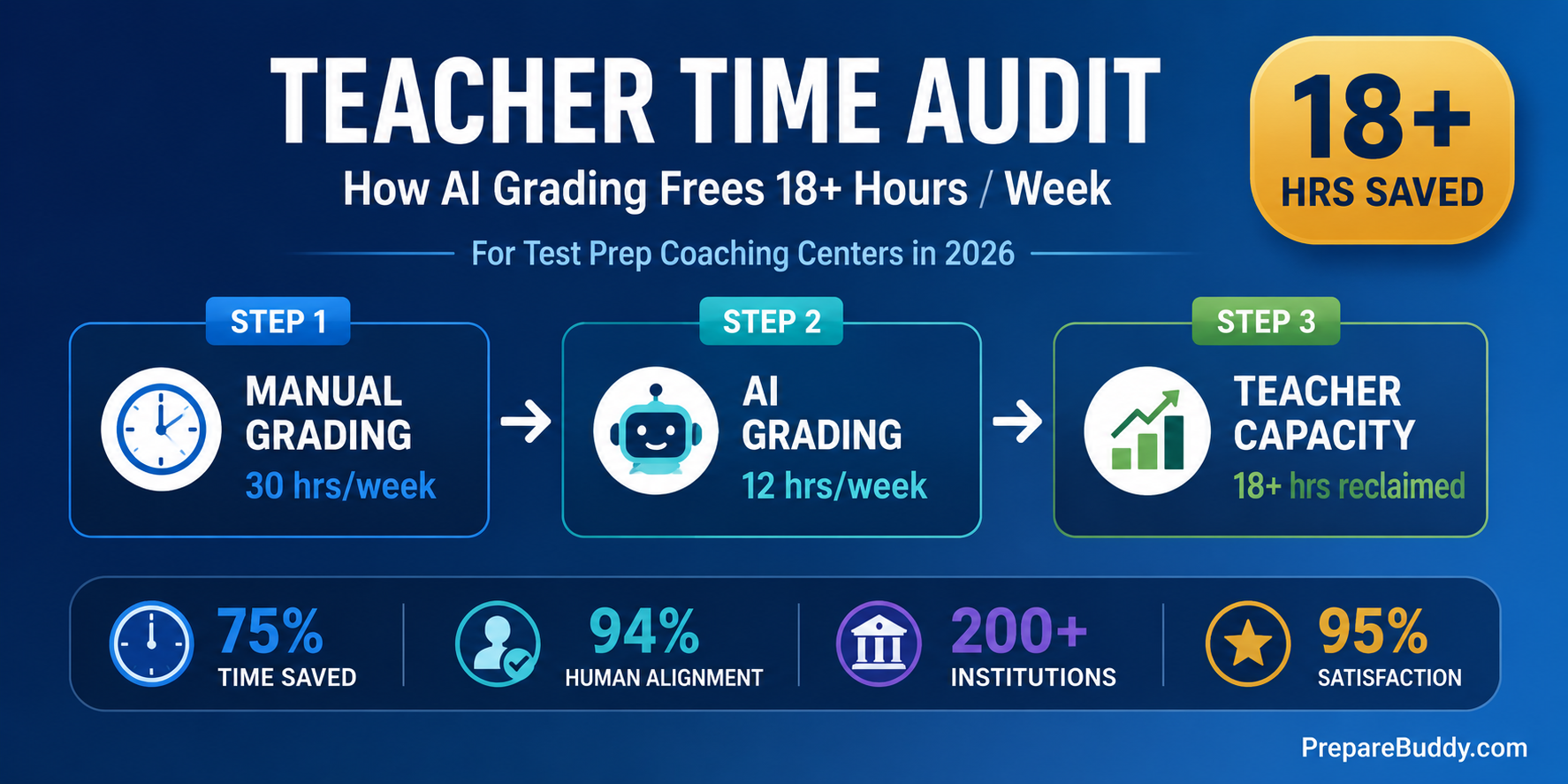
PrepareBuddy's own benchmark across 200+ institutions tracks this at 18+ hours saved weekly on grading and 75% time saved on grading overall — slightly more conservative than the per-task add-up above because most centers automate writing and speaking first, and roll out report automation later. AI Assessment handles the first two rows; Analytics handles the bottom two.
Why the Hours Are Where They Are
Writing and speaking dominate the time audit because both require qualitative judgement, evidence citation, and individualised feedback. A teacher reading an IELTS Task 2 essay isn't just assigning a band — they are evaluating Task Response, Coherence and Cohesion, Lexical Resource, and Grammatical Range and Accuracy, then writing a paragraph of feedback the student can actually act on.
Done manually, this is roughly 8–12 minutes per essay. At 180 essays a week across 6 batches, that is the 8.5-hour figure above. For PTE speaking, where 20 question types include Read Aloud, Repeat Sentence, Describe Image, Re-tell Lecture and Answer Short Question, the listening time alone is unavoidable — unless the recordings are scored automatically the moment they are submitted.
What an AI Grader Has to Do To Replace This Work
Generic chatbot scoring is not enough. To reclaim 18+ hours of senior-instructor time safely, the AI grader has to clear a higher bar:
1. Match how a human rater scores, not just produce a number
PrepareBuddy's assessment engine uses RAG-enhanced evaluation — it retrieves similar high-quality graded examples from your own reference library before scoring a new submission. This produces 94% alignment with human graders, compared to ~85% for generic AI scoring. Practically, that means when your senior IELTS instructor reviews 10 AI-graded essays, she changes the band score on roughly one of them — not five.
2. Show evidence, not just verdicts
Every score returns specific quotes from the submission, the rubric criterion it maps to, and a comparison to similar reference examples. Students get feedback they can act on; teachers get an audit trail for appeals. This is the difference between "Band 6.5" and "Band 6.5 — Lexical Resource pulled down by repetition of important in paragraphs 2 and 4; see Reference Essay #47 for higher-band paraphrase."
3. Handle volume without dropping quality
| Batch Size | Manual Grading Time | AI Grading Time | Time Saved |
|---|---|---|---|
| 50 submissions | 12.5 hours | 15 minutes | 98% |
| 200 submissions | 50 hours | 45 minutes | 98.5% |
| 500 submissions | 125 hours | 2 hours | 98.4% |
4. Stay accountable
Every batch evaluation stores exactly which reference examples were used. Months later, if a student or parent appeals a score, you can reproduce the original evaluation. For centers that prepare students for high-stakes exams, this is non-negotiable.
The Scaling Math: What 18 Hours Per Week Actually Buys You
The single biggest mistake center owners make is treating "time saved" as a soft benefit. It is not — it is a hard input to capacity planning.
| Lever | Without AI Grading | With 18 hrs/week reclaimed per instructor |
|---|---|---|
| Maximum students per instructor | ~20 active students | ~35 active students |
| Mock tests per student per month | 2 (limited by review capacity) | 6–8 (AI-graded same day) |
| Time spent in live teaching | ~50% of work week | ~75% of work week |
| Speed of feedback to students | 2–5 days | Under 5 minutes |
| Cost to grow from 100 to 200 students | Hire 5 more instructors | Hire 1–2 more instructors |
This is why PrepareBuddy customers see 300% ROI within 18 months on average. The cost line item moves down (fewer instructor-hours per student) while the revenue line item moves up (more students per instructor, more mock tests per student, faster turnaround that improves retention).
A 30-Day Rollout Plan for Coaching Centers
Week 1 — Baseline the audit. Ask each instructor to log non-teaching hours for one week. Categorise into the five buckets above. Most centers are surprised: the figure is usually higher than they thought.
Week 2 — Automate writing first. Start with IELTS Writing Task 1 and Task 2 (or PTE essay and Summarize Written Text). These are the highest-volume, highest-hour tasks. Upload 20–30 of your senior instructor's best-graded essays as the RAG reference library so the AI learns your standards, not a generic rubric.
Week 3 — Add speaking. Layer in IELTS Speaking, PTE Speaking, or TOEFL Speaking using Voice AI with 48-emotion detection and 30+ English accent support. Real-time pronunciation scoring and fluency analysis lift the second-largest time bucket.
Week 4 — Wire the feedback loop. Turn on automated weekly progress reports and personalised feedback emails. By the end of week 4, instructors should be reclaiming the full 18+ hours.
Day 30 — Re-audit. Run the time log again. Compare to baseline. Use the freed hours intentionally: assign each instructor more students, increase mock test frequency, or run additional live teaching slots that you couldn't staff before.
What to Look For in an AI Grading Platform
Not all AI graders are built the same. If you are evaluating options, the checklist below separates the platforms built for coaching centers from the generic essay-scoring tools.
| Capability | Why It Matters |
|---|---|
| RAG-enhanced evaluation | Grades to your institutional standards, not a generic rubric |
| Multi-model verification | Cross-checks critical evaluations to reduce hallucinations |
| Voice AI with native accent coverage | Speaking scores need real fluency and pronunciation analysis, not just transcription |
| Batch processing | Handles 500 submissions in 2 hours, not 125 |
| White-label branding | Students see your center's name, not the vendor's |
| Per-student feature controls | Premium AI features for paying students, basics for trials |
| Teacher review gate (optional) | 24-hour hold on AI scores so instructors can verify before students see them |
| Reference snapshot versioning | Reproduce any score months later for appeals |
PrepareBuddy's platform for coaching centers ships all of the above as a turnkey white-label deployment — typically live in 24–48 hours, with zero PrepareBuddy branding visible to your students.
The Hidden Win: Retention, Not Just Hours
Most center owners pitch AI grading internally as a cost play. The bigger long-term win is retention.
When students get scored feedback within minutes of submitting an essay or speaking response — instead of waiting until next week's class — three things change. Practice frequency goes up (students do more mocks because feedback is immediate). Confidence goes up (they know exactly which rubric criterion is dragging their score). And cancellations go down (they feel the platform working for them every day, not just on Saturdays).
The 18+ hours per week is the visible win. The retention curve is the compounding one.
Start the Audit This Week
If you run a test prep coaching center, the lowest-friction next step is a one-week baseline. Pick a single batch — IELTS, PTE, TOEFL, or DET — and log every non-teaching hour your instructor spends on it. You will almost certainly find at least 15 reclaimable hours sitting in the writing and speaking columns.
When you are ready to see how RAG-enhanced AI grading performs on your own students' submissions, schedule a demo or start your free month (no credit card, no lock-in contract). The first batch you grade will tell you more than any whitepaper.


Join the Discussion