

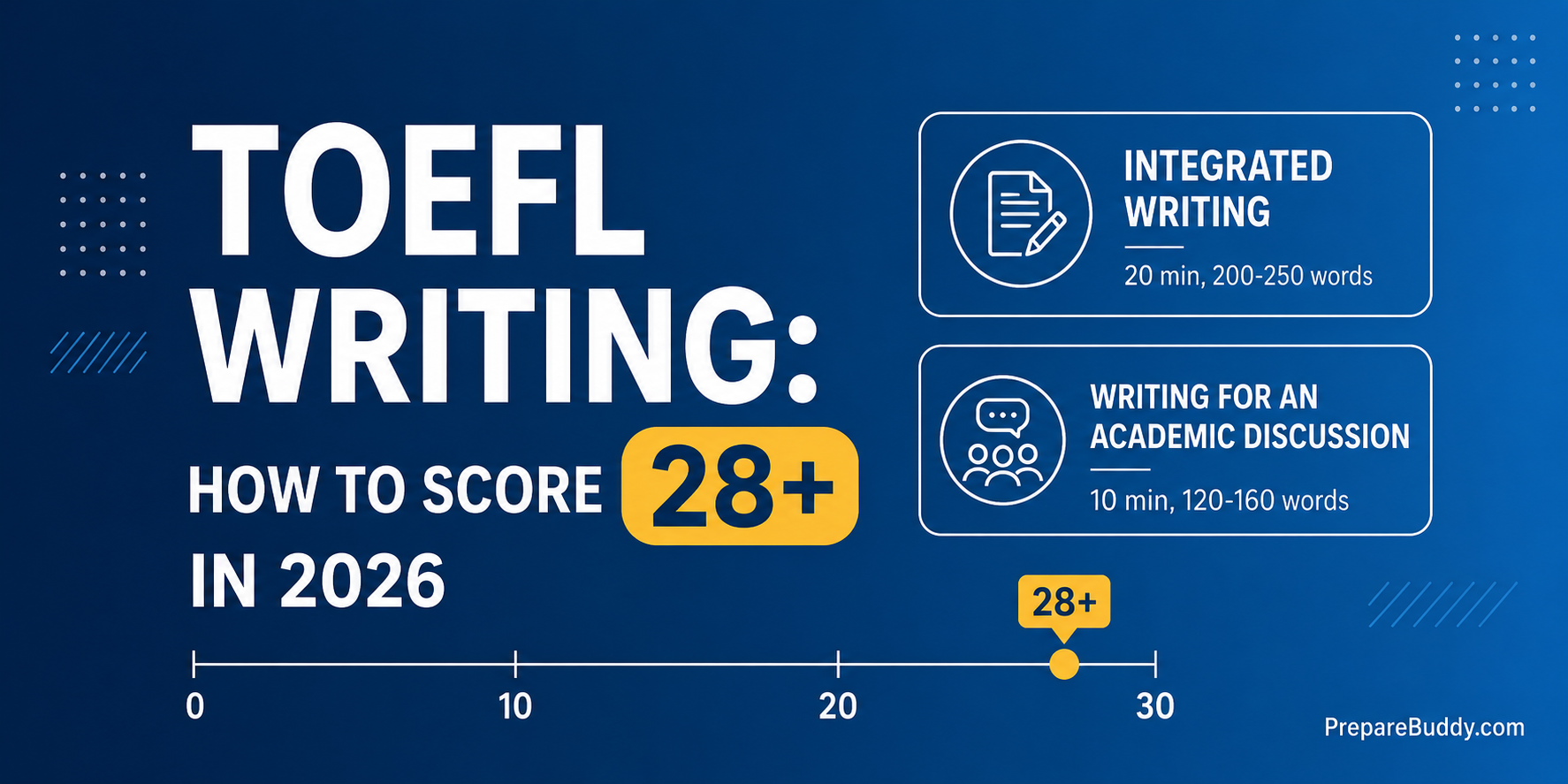
Only about 1 in 4 TOEFL iBT test-takers cracks 28 on Writing in a single sitting. The cutoff isn't talent — it's strategy. The 28+ scorers don't write more; they write what the ETS rubric actually rewards, in the exact order it expects, with the exact density of evidence the human rater is scanning for. This guide breaks down the 2026 TOEFL Writing section task-by-task — Integrated Writing and the Academic Discussion task — and gives you a 4-week framework to go from a high 24 to a steady 28+.
What a 28+ TOEFL Writing score actually means in 2026
TOEFL iBT Writing is reported on a 0–30 scale. Each of your two tasks is rated 0–5 against ETS rubrics, the two scores are averaged, then converted to the section score. 28+ is not a "perfect" mark — it means your tasks averaged a 4.5 with at least one full 5. That's reachable with a checklist mindset, not a vocabulary marathon.
TOEFL Writing score equivalence chart
| Section Score | Avg Task Rating | CEFR Level | What it signals |
|---|---|---|---|
| 30 | 5.0 | C2 | Near-native academic writing |
| 28–29 | 4.5 | C1+ | Ivy League / top-50 graduate ready |
| 25–27 | 4.0 | C1 | Most US universities accept |
| 22–24 | 3.5 | B2+ | Mid-tier admit, borderline for top schools |
| 17–21 | 3.0 | B2 | Conditional admit or ESL placement |
| 0–16 | ≤2.5 | B1 or lower | Below most university minimums |
Top US universities like MIT, Stanford, and Princeton expect 28+ on Writing in particular because graduate coursework is writing-heavy. If you're targeting an MS, PhD, or professional school, this is the section that quietly carries the most weight.
The 2026 TOEFL Writing format at a glance
The current TOEFL iBT Writing section is roughly 30 minutes total and contains two tasks. Since the 2023 redesign, the Independent Essay has been replaced by Writing for an Academic Discussion — a shorter, forum-style response that's much closer to how you'd actually post in a graduate-school class portal.
| Task | Time | Word Target | Rating |
|---|---|---|---|
| Integrated Writing (Read + Listen + Write) | ~20 min (3 min read + ~2 min lecture + 20 min write) | 200–250 words | 0–5 |
| Writing for an Academic Discussion | ~10 min | 100+ words (target 120–160) | 0–5 |
Integrated Writing: scoring 5 with the "point-pair" template
The Integrated task gives you a 250–300 word academic passage with three main points, then a lecture that challenges or contrasts each of those three points. Your job is not to argue — it's to summarize how the lecture responds to the reading.
The single biggest reason students plateau at 23–25 is that they describe the reading and the lecture in two separate halves. A 28+ response weaves each lecture point directly against the matching reading point, in the same paragraph, with concrete details from the audio.
The 4-paragraph point-pair template (use this every time)
- Intro (2–3 sentences, ~30 words): State the reading's main claim and that the lecturer disputes it.
- Body 1 (~60–70 words): Reading point 1 → "However, the lecturer counters…" → specific lecture detail → why the reading is weakened.
- Body 2 (~60–70 words): Same pattern for point 2.
- Body 3 (~60–70 words): Same pattern for point 3.
Total: 210–240 words. No conclusion needed — ETS explicitly says it doesn't help the score.
What the rater is checking (rubric in plain English)
- Coverage: Did you capture all three lecture points and how each responds to the reading?
- Accuracy: Did you misrepresent any lecture detail? One bad paraphrase can drop you from 5 to 4.
- Coherence: Are the connections explicit ("the lecturer challenges this by…")?
- Language: Minor grammar slips are fine. Sentence-level fluency matters more than fancy vocabulary.
Writing for an Academic Discussion: 10 minutes, 28+ moves
This task shows you a short professor prompt and two student replies. You write your own response that contributes to the discussion — agreeing, disagreeing, or extending. The trap: students try to write an essay. The rater wants a focused forum post with a clear stance and one well-developed reason, not three shallow ones.
The 4-move 120-word structure
- Stance + brief engagement (1 sentence): "I see the merit in [Student A's] view, but I'd argue…"
- Clear position (1 sentence): Your specific claim.
- Reason + concrete example (3–4 sentences): One reason, developed with a real-world, academic, or personal example. Specificity beats abstraction.
- Acknowledge + close (1 sentence): Briefly nod to the counter-view, then restate why your position still holds.
Target 120–160 words. Going over 200 in 10 minutes almost always means weaker grammar and at least one off-topic sentence. Both hurt the score.
Top 7 mistakes that keep TOEFL Writers stuck at 24–26
| Mistake | Score Impact | Quick Fix |
|---|---|---|
| Describing reading and lecture separately on Integrated | −1 to −1.5 | Use point-pair template |
| Writing an essay instead of a discussion post | −1 | One reason, deeply developed |
| Memorized templates that don't match the prompt | −1 to −2 | Adapt openings to actual content |
| Quoting the reading verbatim | −0.5 to −1 | Paraphrase using your own structure |
| Ignoring the other students' names in Academic Discussion | −0.5 | Reference at least one classmate |
| Running over word count with filler | −0.5 | Cut adverbs; rewrite long sentences |
| Skipping the 1-minute proofread | −0.5 | Reserve final 60 seconds for typo sweep |
The 4-week prep framework to reach 28+
| Week | Focus | Daily commitment | Milestone |
|---|---|---|---|
| 1 | Master point-pair template on Integrated | 1 Integrated + AI scoring (45 min) | Average 4.0 across 5 essays |
| 2 | Academic Discussion stance + example development | 2 Discussion responses + AI scoring (30 min) | Average 4.0; word count discipline |
| 3 | Cohesion, paraphrasing, lexical range | 1 of each task + targeted rewrites (60 min) | Average 4.5 with one 5 |
| 4 | Full-section timed simulations | 3 full Writing sections under exam timing | Consistent 28+ section score |
How AI-scored practice cuts your prep time in half
The bottleneck for most TOEFL Writers isn't writing — it's the 24–48 hour wait for any kind of feedback on what they wrote. By the time a tutor responds, the student has already moved on. PrepareBuddy's AI Writing Analysis returns rubric-aligned scoring in seconds, citing the exact lecture points you missed on Integrated and quoting your own text where the argument breaks down on Academic Discussion. Across our platform, students save up to 75% of grading time, which translates directly into more reps in the same study window.
Three platform features are particularly useful for TOEFL Writers targeting 28+:
- Unlimited TOEFL practice tests generated fresh every time, so you can't accidentally memorize prompts.
- AI Tutor that remembers your weak rubric criteria and prescribes the next 3 tasks accordingly.
- Adaptive practice that escalates difficulty as your scores climb so you're never stuck at the 25 ceiling.
All practice content is generated by our 120-billion-parameter AI engine and validated against 2023–2025 ETS standards, so what you train on matches what you'll see on test day.
Test-day execution checklist for 28+
- Spend the first 30 seconds reading the prompt twice before you type a word.
- On Integrated, take rough notes on the three reading points BEFORE the lecture starts — leave space for each lecturer counter.
- Type body paragraphs first; intro last (saves 30 seconds and produces a sharper opener).
- For Academic Discussion, decide your stance in the first 60 seconds. Don't change it midway.
- Always reserve the final 60 seconds for proofreading the first paragraph — raters skim it first.
Frequently asked questions
Is the new Academic Discussion task harder than the old Independent Essay?
For most students it's easier — shorter, more concrete, and rewards focused argument over five-paragraph essay scaffolding. The trap is treating it like the old format.
Does TOEFL Writing use AI scoring now?
Yes. ETS uses the e-rater engine paired with a certified human rater. Your score is the harmonized result. That's why rubric-aligned structure (which AI scores reliably) is non-negotiable.
How long should I prepare to move from 24 to 28?
With 4 weeks of consistent daily practice and AI feedback, most B2+ writers reach 28. Below B2, expect 6–8 weeks.
Can I write more than the word target?
Yes, but each extra 50 words after the target raises your grammar-error count without raising the rating. Stick to the range.
Start practicing today
Reading about the rubric won't move your score — graded reps will. Take a free AI-scored TOEFL Writing test right now and see exactly where your current essays land against the 28+ band. You'll get a rubric breakdown, a band-aligned rewrite of your weakest paragraph, and a personalized next-step plan inside the dashboard — no credit card required.
Talk to our team if you're a coaching center or consultant wanting to give every TOEFL student this kind of instant-feedback loop under your own brand.


Join the Discussion