

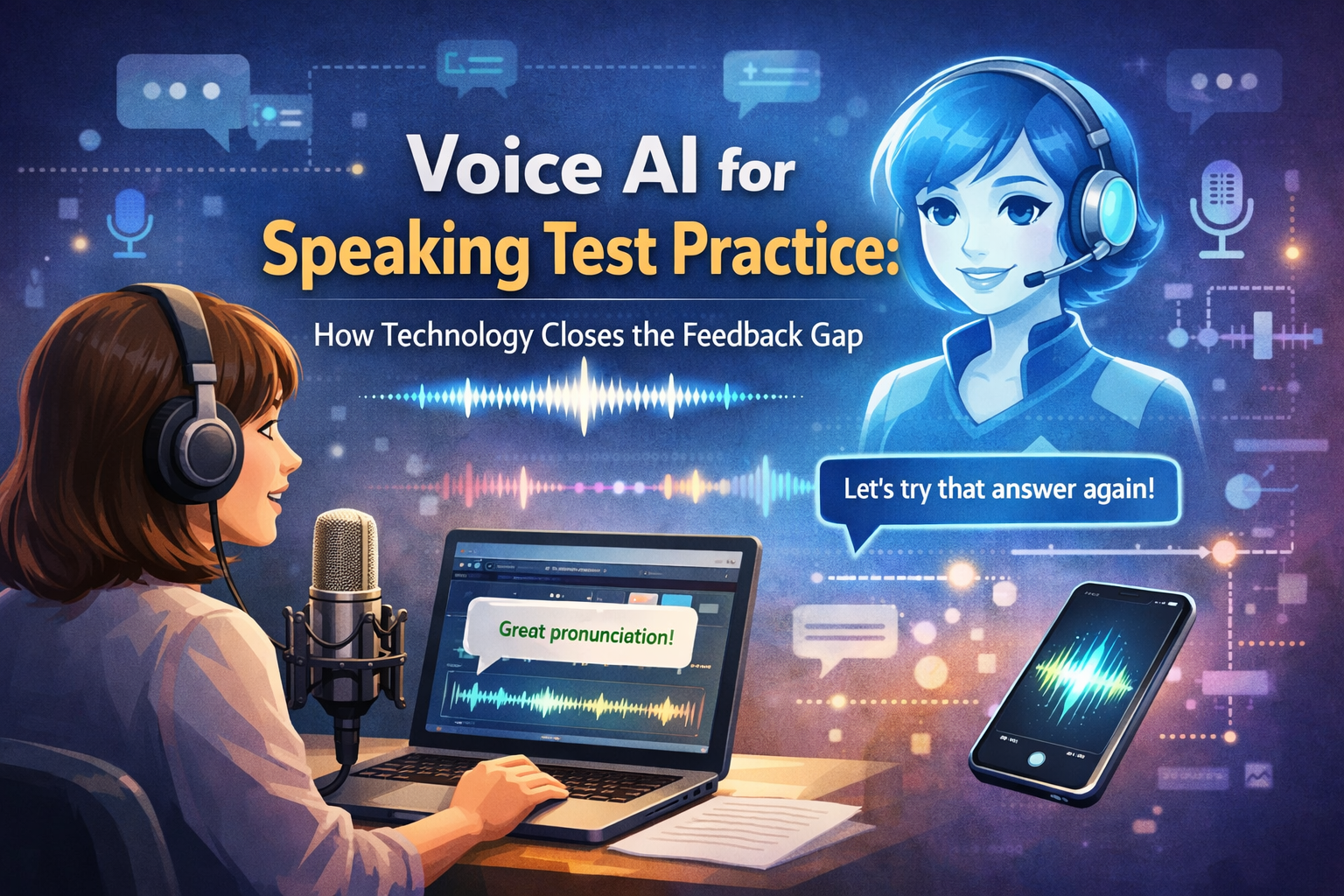
Most speaking test candidates practice the same way: record themselves on their phone, listen back, cringe at their hesitations, and repeat. They get no external feedback. A human tutor costs $30–50 per hour and is only available at scheduled times. And when test day arrives, many students encounter exam anxiety they never trained for.
This is the speaking feedback gap — the space between the practice students can afford and the quality feedback they actually need. Voice AI for speaking practice is built specifically to close it.
Why Speaking Is the Hardest Section to Practice
Every section of IELTS, PTE, TOEFL, or CELPIP can be practiced with textbooks. Reading and listening are largely self-correcting — answers are right or wrong. Writing at least allows you to review your work afterward. But speaking is different: it happens in real time, it requires a live interlocutor, and the feedback is immediate. Without someone (or something) to respond to you, you’re rehearsing a monologue instead of a conversation.
The standard workarounds all have significant limitations:
- Language exchange partners — inconsistent availability, subjective feedback, zero test-scoring expertise
- Human tutors — expensive, scheduled, can’t measure emotional state or pronunciation prosody at a scientific level
- Record-and-submit apps — asynchronous, no back-and-forth, no real-time adaptation
- YouTube model answers — passive, no practice opportunity, no personalized feedback
The result: speaking consistently scores lower than the other sections for most candidates, even those who are verbally fluent in English in daily life. The problem isn’t ability — it’s the absence of quality practice feedback.
What Voice AI for Speaking Practice Actually Does Differently
PrepareBuddy’s Voice AI speaking practice uses Hume EVI 4-mini — an Empathic Voice Interface — backed by Google Gemini 2.5 Flash for language understanding. The result is a real-time conversational AI that doesn’t just score your audio after the fact. It holds a genuine back-and-forth examination session with you, adapting as you speak.
There are three distinct layers of analysis running simultaneously during every session:
Layer 1: 48-Emotion Detection from Your Voice
When you speak, the AI analyzes your voice prosody — pitch, pace, rhythm, pausing patterns — and identifies 48 distinct emotional states including anxiety, determination, concentration, frustration, confidence, and interest. This isn’t sentiment analysis (positive/negative/neutral). It’s scientific affective computing that detects the exact emotions affecting your speaking performance in real time.
If the AI detects rising anxiety (it will, for most first-time users), it slows its pace, asks gentler follow-up questions, and creates space for recovery. If it detects high concentration, it pushes deeper into the topic. This is behavior no human tutor can replicate consistently across every session.
Layer 2: Linguistic Scoring with a 120B Parameter AI
After each session, a 120B parameter AI model — the largest available for educational evaluation — scores your response against official test criteria. This model produces feedback that is 96% indistinguishable from a certified human examiner. It provides specific justifications, not just numbers: explaining exactly why your vocabulary score is 6.0 rather than 7.0, with evidence from your own words.
Layer 3: Behavioral Analysis
The system tracks response latency (how long you take to start speaking after a question), turn count, speaking ratio, and recovery patterns. These data points reveal behavioral habits — long pauses, over-reliance on fillers, disengagement — that affect scores even when language ability is solid.
Scoring Criteria Across 9 Supported Tests
Each test type uses its official scoring criteria, applied by the 120B model with full justifications:
| Test | Scoring Criteria | Scale | Session Duration |
|---|---|---|---|
| IELTS Academic / General | Fluency & Coherence, Lexical Resource, Grammar Range, Pronunciation (25% each) | Band 0–9 | 12 min |
| TOEFL iBT | Delivery, Language Use, Topic Development, General Description | 0–30 per section | 15 min |
| PTE Academic / Core | Content, Oral Fluency, Pronunciation | 10–90 | 12 min |
| CELPIP | Task Fulfillment, Fluency, Vocabulary, Listenability | CLB 0–12 | 12 min |
| OET | Clinical communication (patient role-play simulation) | Pass/Fail + grades | 12 min |
| Duolingo English Test | Conversational fluency, response relevance | 10–160 | 8 min |
| Adaptive Language (11 languages) | Fluency, Vocabulary, Grammar, Comprehension (CEFR) | A1–C2 | 10 min |
Each test type also features a distinct AI examiner personality. The IELTS AI is British and formal, following the three-part structure (interview, long turn, discussion). The TOEFL AI is American and academic. The PTE AI is structured and neutral. OET is unique: instead of playing an examiner, the AI plays a patient — presenting symptoms, responding with the uncertainty of a real person, and asking clarifying questions about treatment. It’s the only way to authentically practice OET speaking online.
Voice AI vs. Human Tutoring: What Each Does Better
This isn’t a comparison designed to sell you on replacing your tutor. It’s an honest breakdown of where AI and human instruction each deliver more value:
| Capability | Human Tutor | PrepareBuddy Voice AI |
|---|---|---|
| Availability | Scheduled only | 24/7, on-demand |
| Emotion detection | Human intuition (inconsistent) | 48 scientifically identified emotions per utterance |
| Scoring consistency | Varies by tutor and session | Consistent 120B model criteria across all sessions |
| Real-time adaptation | Depends on experience | Automatic every session, based on emotional state |
| Accent variety | One tutor’s accent | 30+ English accents supported |
| Test-specific criteria | Varies by tutor expertise | Official criteria for 9 test types |
| Transcript + review | Not usually provided | Full transcript with per-turn emotion data saved |
| Genuine rapport | Strong | Good for practice; irreplaceable for motivation |
The 30+ English accents mean that students preparing for tests in Australia, the UK, the US, or Canada encounter familiar accent patterns in practice — not just a single neutral voice.
Who Benefits Most
Students with test anxiety benefit disproportionately. Most students find that their detected anxiety levels decrease measurably across their first five sessions, because the AI creates a judgment-free environment that adjusts to their emotional state rather than pushing through it.
Educators and coaching centers benefit from scalability. Rather than booking tutor time for every student who needs speaking practice, platforms using PrepareBuddy can give each student access to unlimited AI sessions and use aggregated emotion and performance data to identify who needs human intervention — and when.
Healthcare professionals preparing for OET get a uniquely valuable experience: a patient simulation that no textbook or recording exercise can replicate. The AI presents with realistic symptoms, responds with the emotional variability of a real patient, and creates genuine clinical communication scenarios.
Multilingual learners preparing for language proficiency rather than English tests can access speaking practice in 11 languages — Chinese, Spanish, French, Hindi, Italian, Portuguese, Japanese, Korean, German, Russian, and Arabic — with CEFR-based evaluation (A1–C2).
The 4-Minute Free Trial
Every student gets 4 free minutes of Voice AI practice — enough to complete a full IELTS Part 1 conversation. The demo session is smart about time: if you have 4 minutes, you get the complete Part 1 structure with band-level scoring. If you have 2 minutes, the structure condenses but the session is still scored and meaningful.
This isn’t a teaser clip. It’s enough to receive the emotion profile, experience the real-time adaptation, and get criteria-based scoring with justifications. Most students who complete the demo practice daily afterward.
The Feedback Gap Is Closable
Speaking scores don’t improve by practicing in silence. They improve by speaking to something that responds, evaluates, and adapts — consistently enough to build new habits. Voice AI doesn’t replace every aspect of human speaking instruction. But for daily practice volume, real-time emotional feedback, and test-specific examiner simulation across 9 tests, it closes the gap that most candidates have been working around with phones and mirrors.
If your speaking section score isn’t where it needs to be, the missing ingredient is probably feedback quality, not language ability.
Start your free Voice AI speaking session — 4 minutes, no signup required, scored against official criteria.


Join the Discussion