

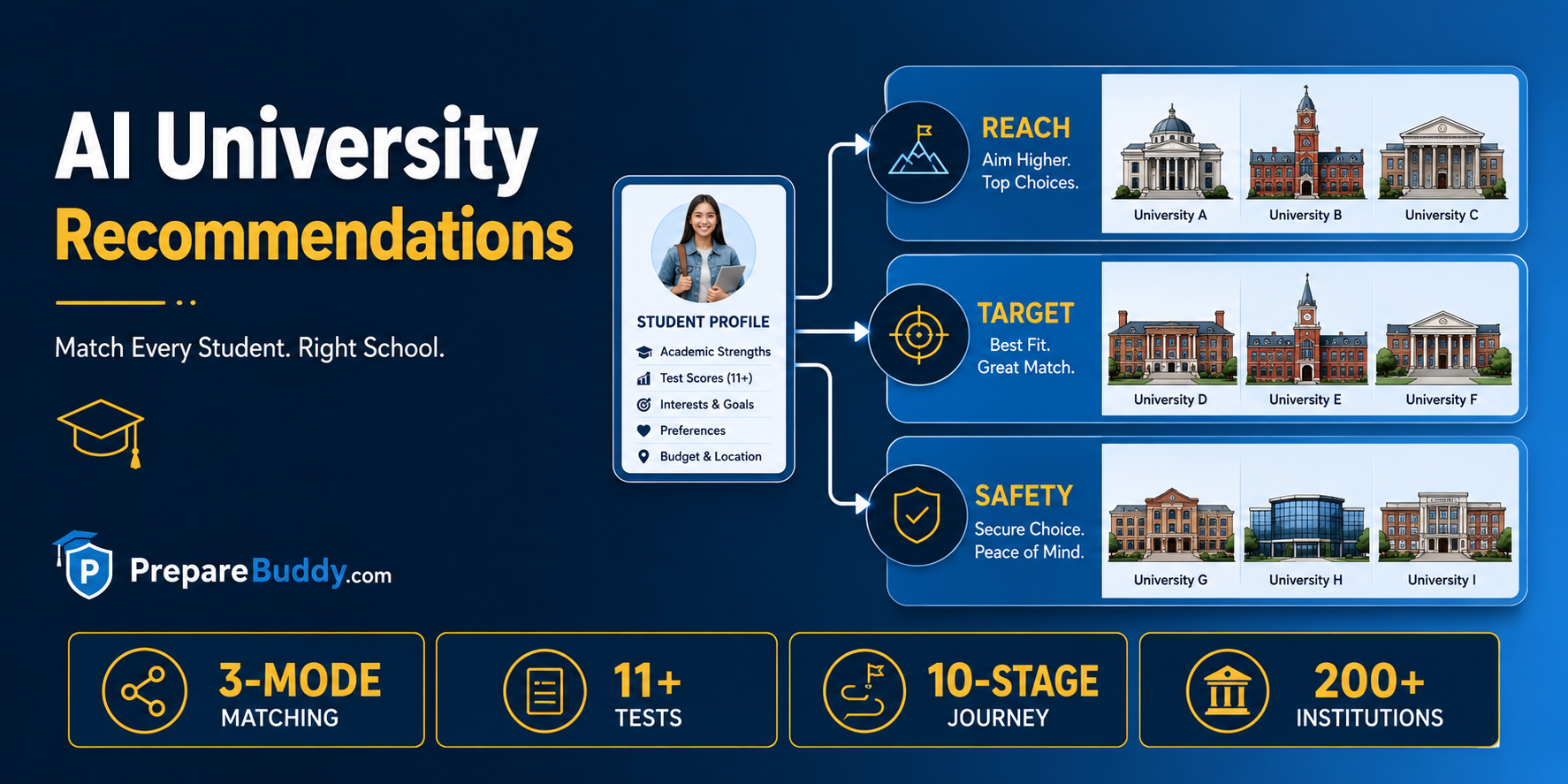
A counselor at a mid-size study-abroad agency just spent 90 minutes on a single student call. The student wanted to apply to "any good university in Canada or the UK." By the end, the counselor had a sticky note with seven school names — three of which the student had no realistic chance at, two were a poor program fit, and the other two were old favourites the agency always recommended. Multiply that by 200 students per year. That's the silent productivity tax that AI university recommendation engines are now removing from education consultancies.
Education consultants don't lose deals on price. They lose them on time-to-shortlist and on shortlist quality. A student who waits two weeks for a researched list goes elsewhere. A student who applies to five universities and gets rejected by all five doesn't refer their cousin. In 2026, the consultancies winning the referral game are the ones using AI recommendation engines that combine deterministic scoring with counselor oversight — not raw ChatGPT prompts and not static Excel sheets.
Why traditional shortlisting breaks at scale
The legacy shortlisting workflow looks like this: counselor hears the student's profile, opens a country guide PDF, mentally indexes 5–10 universities they remember, then sends an email. It's fast for the first three students of the day. By the tenth, fatigue sets in and the same five "safe" universities get recommended regardless of fit. Students who deserve ambitious reach schools never see them; students who can't qualify for top-50 universities still get pitched MIT.
The fix is not "use ChatGPT to recommend universities." Generic LLMs hallucinate rankings, invent acceptance rates, and recommend programs that don't exist. The fix is a deterministic scoring engine that grades the student first, then constrains the AI to only recommend schools in the right tier. That's what a purpose-built AI university recommendation engine does — and it's what changes consultant economics.
How a modern AI university recommendation engine works
PrepareBuddy's University Recommendations module uses a two-step pipeline. First, an 8-dimension deterministic scorer computes a 100-point Applicant Strength Score (ASS) from the student's profile. Then the AI is told which university tier the student qualifies for, and only recommends within that tier. Every recommendation is classified as Safe (also marketed as Safety), Target, or Ambitious (also marketed as Reach), with a numeric gap shown on each card.
The deterministic scoring is what makes the system trustworthy. Here is the actual 100-point breakdown:
| Dimension | Max Points | What It Measures |
|---|---|---|
| Academic | 35 | CGPA, university tier, backlogs, academic trend |
| Test Score | 15 | IELTS / TOEFL / GRE / GMAT (country-adjusted) |
| Program Match | 15 | Field alignment plus prerequisites covered |
| Work Experience | 10 | Years and relevance to intended field |
| Research | 10 | Publications, projects, depth |
| Leadership | 5 | National, college, or participation level |
| SOP + LOR | 5 | Recommendation strength plus SOP quality |
| Selectivity | 5 | Bonus for combined academic plus test strength |
| Total | 100 | Student index used for matching |
Once the score is computed, the engine compares it against each university's Competitiveness Score (UCS) — a 35–95 scale derived from world ranking, acceptance rate, and elite-department flags. The gap between the student's ASS and the university's UCS determines the category:
| Score Gap (ASS − UCS) | Category | Counsellor Reads This As |
|---|---|---|
| +10 or more | Safe | High admission likelihood — confident pitch |
| −5 to +9 | Target | Well-qualified — a strong primary application |
| Less than −5 | Ambitious | Reach school — needs a standout application |
Country-specific weights remove a hidden source of error
Consultants who serve multiple destinations know the same student profile is rated differently in different countries. The PrepareBuddy engine applies country-specific multipliers automatically: UK boosts academic weight by 1.28x and caps test scores when IELTS or TOEFL are missing, Germany ignores GRE and GMAT entirely, USA doubles the SOP and LOR weight and boosts research, Canada and Australia both apply 1.1–1.15x academic multipliers, and Ireland enforces an IELTS/TOEFL floor on the test score component. A student applying to UK and US universities sees two different score profiles in the same session. That's the kind of nuance no Excel template can replicate without breaking.
Counselor Co-Pilot: the feature that makes consultants trust the engine
The biggest objection consultants have to AI shortlisting is loss of control. PrepareBuddy answers this with Counselor Co-Pilot Mode. On every recommendation, the counselor can override the match category, pin a university to the top of the list, hide a recommendation from the student, or add a personal note that displays as a blue callout on the student's results page. The student sees a "Counselor Reviewed" badge on the session header — turning the AI shortlist into a counselor-blessed shortlist, which is what students actually want.
This matters commercially. A pure-AI shortlist feels generic. A counselor-reviewed AI shortlist feels like premium service. Same engine, different perception, different pricing power.
Add-on tools that turn shortlisting into a full advisory workflow
The recommendation engine isn't a one-shot tool. It opens up adjacent revenue and stickiness:
- Dream University Goal Tracker — A student enters any target university (e.g., "University of Toronto"), and the engine computes their gap and generates an AI action plan to close it. This converts "no chance" conversations into a 12-month coaching engagement.
- SOP Draft Generator — Each recommendation card has a Draft SOP button. The AI writes a personalized SOP using the student's questionnaire answers and target university; counselors can review and approve. SOP services that used to be billed at $200–$500 each become a 15-second click.
- Application Outcome Tracker — Every shortlisted university has a status button: Applying, Applied, Interview, Admitted, Rejected, Waitlisted. This becomes the consultancy's pipeline view and a renewable touchpoint with the student.
- Score Card PDF Export — A downloadable, branded report with the 100-point breakdown and full recommendation list. Consultants email this as the "deliverable" that justifies the shortlisting fee.
- Student Journey integration — The shortlist auto-links to Stage 2 of the 10-stage Student Journey pipeline, so deadlines, document tracking, and post-arrival checklists all flow from the same recommendation session.
The business case for consultants
The numbers are simple. PrepareBuddy customers report 75% time saved on grading and assessment, 24–48 hour deployment, and the platform serves 200+ institutions and 50,000+ students. For a consultant running a study-abroad agency, the equivalent translation is: minutes-to-shortlist drops from 60–90 minutes per student to under 15. That's the difference between handling 8 students a day and 30. With consultancy fees typically ranging from $500 to $5,000 per student, the throughput math justifies the platform within the first month.
The platform is offered as a complete white-label B2B solution — agency domain, agency logo, agency colors, agency-branded emails. Students never see PrepareBuddy. They see the consultancy's brand, with all the AI sophistication baked in.
How to evaluate a recommendation engine before you buy
If you're comparing AI university recommendation tools, ask vendors these questions:
- Is the student score deterministic, or does the AI guess it? (Deterministic prevents hallucinated MIT recommendations for unqualified students.)
- Are country-specific weights applied automatically, or does the counselor have to remember them?
- Can counselors override AI categories without the student seeing the original AI label?
- Does the system support uploading your own university database alongside global AI recommendations?
- Does it integrate with downstream workflows like SOP drafting, deadlines, and visa prep — or stop at the shortlist?
- Is it fully white-label, including domain and branded emails?
If the vendor can't answer all six with a clear yes, you're buying a demo, not a system.
The takeaway
Shortlisting is the highest-leverage workflow in an education consultancy. Get it right, and every downstream service — applications, SOPs, visa prep, post-arrival — runs on a stronger foundation. Get it wrong, and the agency rebuilds the same shortlist three times before submission deadlines. AI university recommendation engines, designed correctly, fix this. The good ones combine deterministic scoring, country-aware weighting, counselor override, and full white-label branding into a single platform that students experience as their counselor's own intelligence — not a generic AI tool.
Want to see how PrepareBuddy's University Recommendations module fits your consultancy? Visit our solution page for education consultants or schedule a demo — the platform deploys in 24–48 hours with first month free, no credit card required, and no lock-in contracts.


Join the Discussion