

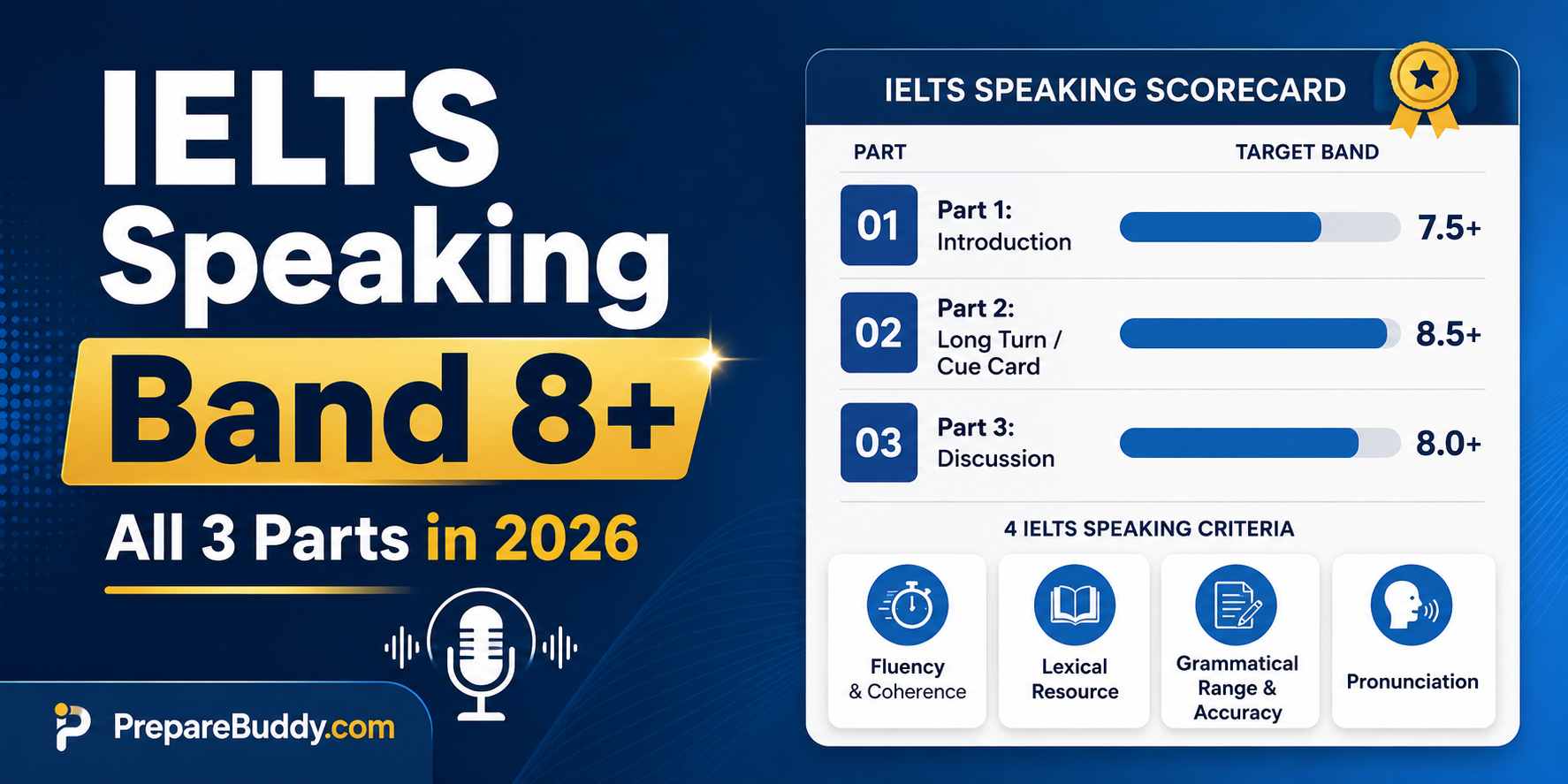
Band 8 in IELTS Speaking is the line where a "good" candidate becomes a "very good" one — and the line that separates rejection from admission at top universities, professional registration boards in healthcare and engineering, and high-CRS Express Entry profiles. According to the British Council's global score data, fewer than 12% of test-takers achieve a Band 8 overall, and Speaking is the section where ambitious candidates most often plateau at 6.5 or 7.0. The reason is rarely vocabulary or grammar in isolation. It's how the four official IELTS Speaking criteria — Fluency & Coherence, Lexical Resource, Grammatical Range & Accuracy, and Pronunciation — are scored together, and how examiners weigh "natural extended discourse" over memorised answers.
This guide breaks down what Band 8 actually requires in each of the three Speaking parts, the four scoring criteria examiners use, and the specific practice routine you can run with AI-powered Voice AI feedback to close the gap from Band 7 to Band 8 in 4 to 6 weeks.
What Band 8 Means in IELTS Speaking
The IELTS Speaking test runs 11 to 14 minutes and is scored on the official 0-9 band scale. Each of the four criteria contributes 25% of the total Speaking band, and each is independently scored from 0 to 9. Your final Speaking band is the average, rounded to the nearest half band. To land on Band 8, you typically need three criteria at Band 8 and the fourth no lower than Band 7 — there is no shortcut around the weakest area.
| Speaking Criterion | Band 7 Descriptor (Summary) | Band 8 Descriptor (Summary) | What Changes |
|---|---|---|---|
| Fluency & Coherence | Speaks at length, occasional self-correction | Speaks fluently with only occasional repetition; develops topics coherently | Less hesitation, smoother topic development |
| Lexical Resource | Uses vocabulary flexibly; some less common items | Uses a wide range of vocabulary readily and flexibly; uses idiomatic language naturally | Idiomatic accuracy + precise word choice |
| Grammatical Range & Accuracy | Uses a range of complex structures with some flexibility | Wide range of structures; majority of sentences error-free | Complex structures used without errors |
| Pronunciation | Uses a range of pronunciation features with mixed control | Uses a wide range of pronunciation features; sustained at higher level | Stress, rhythm, and intonation under control |
The most common reason Band 7 candidates fail to reach Band 8 is not weak grammar — it's self-correction. Repeated false starts, filler phrases ("you know", "like"), and topic abandonment under pressure pull Fluency & Coherence down to 7 even when vocabulary and grammar are at 8. Fix fluency first.
The Three Parts of IELTS Speaking — and What Band 8 Sounds Like
Part 1: Introduction and Interview (4-5 minutes)
The examiner asks 8-12 short questions on familiar topics: home, work, study, hobbies, family, hometown. Most candidates over-prepare Part 1 with rehearsed scripts. Band 8 candidates do the opposite — they answer naturally with two to three sentences per question, extending answers with a reason, an example, and a personal connection.
Band 7 answer: "I live in Mumbai. It's a big city in India. I like it because there's a lot to do."
Band 8 answer: "I'm based in Mumbai — it's been home for around twelve years now. What I genuinely enjoy is the unpredictability of it; you can be stuck in traffic for an hour and end up having the most interesting conversation with the auto-rickshaw driver. That said, the monsoon really tests your patience."
Notice the difference: a discourse marker ("That said"), a less common collocation ("tests your patience"), an idiomatic flourish ("the most interesting conversation"), and a complex grammatical structure ("you can be… and end up…"). All four criteria visibly improve in one 30-second answer.
Part 2: Long Turn — The Cue Card (3-4 minutes)
You receive a cue card, get one minute to prepare, then speak for 1-2 minutes uninterrupted. Band 8 here is built on three habits: structuring the response with a clear opening-middle-close, using the entire 2 minutes without trailing off, and weaving in narrative tenses (past perfect, past continuous, conditional) naturally.
The most reliable Part 2 framework is WHO-WHAT-WHEN-WHY-HOW-FEEL. In your one-minute prep, jot one keyword for each. This guarantees coverage of all bullet points on the cue card and gives you natural transitions to extend the response.
Part 3: Discussion (4-5 minutes)
This is where most Band 7 candidates lose half a band. The examiner pushes you with abstract, opinion-led questions linked to your Part 2 topic. Band 8 candidates do three things consistently: take a 1-2 second pause before answering (signalling thoughtful processing, not hesitation), use a discourse hedge ("That's an interesting question — I'd say…"), and offer a balanced answer with one supporting reason and one counterpoint.
The 6-Week Band 7-to-8 Practice Plan
Reaching Band 8 requires three things simultaneously: volume of speaking practice (most candidates speak fewer than 30 minutes per week), specific feedback on the four criteria (general "speak more" advice doesn't move bands), and real-test conditions (an examiner who interrupts, redirects, and pushes follow-ups). Self-recording solves volume but not feedback. Human tutors solve feedback but rarely scale to daily practice.
This is where PrepareBuddy's Voice AI closes the gap. The AI examiner runs 12-minute live sessions that mirror real IELTS Speaking timing, evaluates your response against the official Band 0-9 descriptors for all four criteria, and detects 48 emotion markers to flag hesitation patterns you don't hear in yourself. With 30+ English accents supported, you can practise with a British, Australian, North American, or South Asian examiner voice — useful preparation, since real IELTS examiners come from across the English-speaking world.
| Week | Daily Focus | Voice AI Session Type | Criterion Targeted |
|---|---|---|---|
| Week 1 | Part 1 — natural extension, no scripts | 4-min demo + 12-min full session | Fluency & Coherence |
| Week 2 | Part 2 cue cards — WHO-WHAT-WHEN-WHY-HOW-FEEL framework | 12-min full session, Part 2 emphasis | Lexical Resource |
| Week 3 | Part 3 — opinion + counterpoint structure | 12-min full session, Part 3 emphasis | Grammatical Range |
| Week 4 | Mixed full mock, focus on weakest criterion | Full 12-min session daily | All 4, weakest criterion priority |
| Week 5 | Pronunciation drills + idiom integration | 12-min session + 30-day-plan AI Tutor review | Pronunciation + Lexical |
| Week 6 | Full mocks under timed conditions, daily | 2× 12-min sessions/day, alternating accents | All 4, polish |
The Four Mistakes That Cap You at Band 7
After analysing thousands of speaking sessions across PrepareBuddy's IELTS preparation platform, four mistakes consistently keep candidates at Band 7 instead of Band 8.
Memorised answers. Examiners are trained to spot scripts within seconds. The moment you sound rehearsed, your Fluency & Coherence is capped at 6.5. Practise frameworks, not full answers.
Avoiding complex grammar. Sticking to safe simple sentences keeps your accuracy high but caps Grammatical Range at 6. Band 8 requires attempted complex structures even if a few have minor errors. Mix conditionals, perfect tenses, and relative clauses.
Single-word answers in Part 3. When a Part 3 question feels too abstract, candidates often answer with one short opinion. Band 8 expects 30-45 second responses with reason + example + counterpoint, even on hard questions.
Pronunciation neglect. Most prep focuses on grammar and vocabulary. Pronunciation is treated as either "you have it or you don't." That's wrong — sentence stress, thought groups, and intonation are trainable in 2-3 weeks of focused drills, and a full band on Pronunciation alone shifts your overall result by 0.25 bands.
Why AI-Powered Feedback Beats Self-Recording
The fastest path to Band 8 is daily practice with criterion-level feedback. PrepareBuddy's AI scoring engine applies the official IELTS Speaking band descriptors at the response level — you see exactly which criterion held you back, with verbatim quotes from your own response and a Band 8 rewrite you can study. The AI scoring layer reaches 95% alignment with human IELTS examiners across multi-model verification, and 30+ accent support means your pronunciation feedback isn't biased against your home accent.
Compare that to self-recording, where you can hear that "something is off" but can't pinpoint whether it's hesitation (Fluency), word choice (Lexical), or sentence structure (Grammar). Compare it to human tutors, who can give precise feedback but typically once per week, with a 2-3 day delay. Daily AI feedback is what compresses a 12-week improvement curve into 6.
Quick Reference: Band 8 Checklist
Use this before every practice session and every real test:
| Criterion | Band 8 Habit | Self-Check Question |
|---|---|---|
| Fluency | No more than 1 self-correction per minute | Did I restart any sentences? |
| Coherence | Use 3+ discourse markers per long turn | Did I signal transitions clearly? |
| Lexical Resource | Use 2+ idiomatic phrases per Part 2 | Did I sound natural, not textbook? |
| Grammar | Mix 3 tense families per Part 2 | Did I use past perfect or conditional? |
| Pronunciation | Sentence stress on content words | Did I emphasise the right words? |
Start Practising With AI-Powered Speaking Sessions
You don't need a tutor in a different time zone or a friend with native English to reach Band 8. You need 12 minutes of focused speaking practice with criterion-level feedback every day for the next 6 weeks. Try PrepareBuddy's free IELTS practice test to get a baseline score across all four criteria, then upgrade to unlimited Voice AI sessions to lock in daily practice. Coaching centres preparing batches of IELTS students can schedule a demo to see how the white-label platform handles speaking evaluation at scale, with deployment in 24-48 hours and zero PrepareBuddy branding visible to your students.
Band 8 is built one 12-minute session at a time. Start today.


Join the Discussion