

Most "AI speaking practice" is a recording booth with extra steps. You read a prompt, record 45 seconds, upload the clip, wait for a score. Nobody learns to speak a language that way — because nobody speaks that way. Real speaking is interruption, hesitation, recovery, and answering a question you did not see coming.
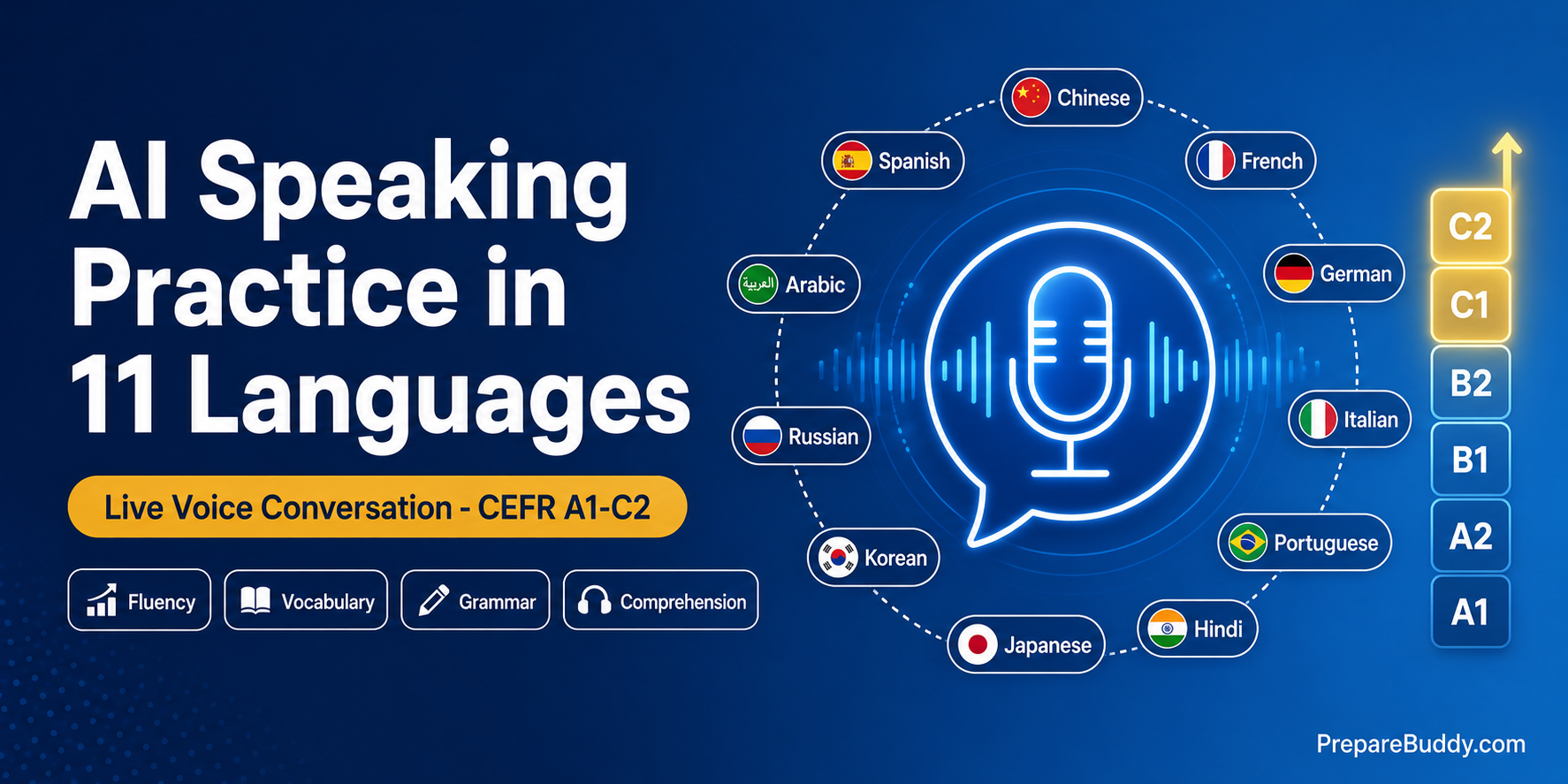
PrepareBuddy's AI speaking practice works differently. You pick one of 11 languages, press start, and hold an actual back-and-forth conversation with a voice AI that speaks your target language, matches its level to yours, and scores you against CEFR criteria when the session ends. This guide covers exactly what happens in a session, how your CEFR speaking level (A1–C2) is calculated, and where live conversation beats record-and-submit.
The 11 languages you can practise speaking in
Live AI speaking practice is available across the full Adaptive Language Proficiency language set — the same 11 languages used for CEFR reading, listening, writing and speaking tests, with native-quality audio and script-aware rendering.
| Language | Script | Live AI conversation | CEFR scoring (A1–C2) |
|---|---|---|---|
| Chinese (Mandarin) | Simplified Han | Yes | Yes |
| Spanish | Latin | Yes | Yes |
| French | Latin | Yes | Yes |
| German | Latin | Yes | Yes |
| Italian | Latin | Yes | Yes |
| Portuguese | Latin | Yes | Yes |
| Hindi | Devanagari | Yes | Yes |
| Japanese | CJK | Yes | Yes |
| Korean | Hangul | Yes | Yes |
| Russian | Cyrillic | Yes | Yes |
| Arabic | Arabic (right-to-left) | Yes | Yes |
One framework, eleven languages. The same CEFR scale, the same four skills, the same evaluation logic — so a B1 in Portuguese means the same thing as a B1 in Korean.
What a live AI speaking session actually looks like
An AI speaking practice session in one of the 11 languages is a free conversation, not an exam simulation. Here is the flow:
- You pick your language. The AI greets you in it — "¡Hola! ¿De qué te gustaría conversar hoy?" — and stays in that language for the whole session. No English scaffolding.
- You choose the topic. Travel, food, hobbies, films, work, culture. If you have no preference, the AI suggests something everyday and starts there.
- You talk for roughly 10 minutes. The AI adjusts its own vocabulary and sentence complexity to match you: simpler words and slower pacing for A1–A2, natural fluency for B2–C1.
- Mistakes get rephrased, not red-penned. If you conjugate something wrong, the AI folds the correct form into its next reply instead of stopping to correct you. That is how conversation partners actually help.
- Emotion runs in the background. The Voice AI tracks 48 emotional signals throughout — interest, concentration, anxiety, confidence — which is why the closing report can tell you where you froze, not just where you were wrong.
- The session ends and the evaluation runs. You get a CEFR speaking level, per-criterion scores, an emotional profile, behavioural notes, a full annotated transcript, and specific improvement tips in the context of your target language.
How AI speaking practice is scored against CEFR A1–C2
Speaking is graded on four criteria rather than one blended "speaking score", so you can see whether your ceiling is grammar or nerve:
| Criterion | What the AI is actually judging |
|---|---|
| Fluency | Speech flow, hesitation patterns, how you recover after a stumble, self-correction |
| Vocabulary | Range, accuracy and whether word choice is appropriate for the CEFR band |
| Grammar | Sentence complexity, accuracy, conjugation and agreement under real-time pressure |
| Comprehension | Whether you understood the AI's questions and answered them in context |
Those criterion scores roll up into an internal 0–100 score, which maps onto CEFR:
| CEFR level | Score range | What it means for speaking |
|---|---|---|
| C2 | 85–100 | Mastery — understands and expresses virtually everything |
| C1 | 68–84 | Advanced — expresses ideas fluently and spontaneously |
| B2 | 51–67 | Upper intermediate — interacts with fluency and spontaneity |
| B1 | 34–50 | Intermediate — copes with most everyday situations |
| A2 | 17–33 | Elementary — handles simple, routine exchanges |
| A1 | 0–16 | Beginner — uses familiar everyday expressions |
Because speaking is reported per skill as well as overall, you can hold a B2 in reading and a B1 in speaking without one hiding the other. That gap is the single most common pattern in self-taught learners — and the one live practice closes fastest.
Live conversation vs record-and-submit: what the difference buys you
| Record-and-submit apps | Text chatbots | PrepareBuddy live Voice AI | |
|---|---|---|---|
| Interaction | One-way clip upload | Typed, not spoken | Real-time spoken back-and-forth |
| Unscripted questions | No — prompts are fixed | Sometimes | Yes — follow-ups depend on your answer |
| Language of the session | Often English instructions | Mixed | Entirely in the target language |
| Level adaptation | None | Limited | AI matches your proficiency live |
| Error handling | Score only | Explicit correction | Natural rephrasing, then a full report |
| Emotional / behavioural read | No | No | 48-emotion detection across the session |
| Output | A number | A chat log | CEFR level + 4 criterion scores + annotated transcript + tips |
| Languages | Usually one | Varies | 11, on one framework |
The six speaking task types in a full CEFR test
Conversation practice builds the reflex; the graded test measures it. A full CEFR assessment on the platform covers six speaking task formats, all delivered in the target language:
- Read Aloud — pronunciation and fluency from a written passage
- Speak About Photo — spontaneous description from a visual prompt
- Listen and Speak — integrated listening plus spoken response
- Read Then Speak — integrated reading plus spoken response
- Interactive Speaking — conversational production under exam conditions
- Speaking Sample — extended oral production on a set topic
Spoken and written responses also receive multi-perspective AI feedback, including an examiner-style critique that names the specific CEFR descriptor you fell short of — not just a band.
How to get the most out of each session
- Pick a topic you will need in real life — a job interview, a doctor's appointment, describing your work. Practising small talk you will never use is wasted minutes.
- Do not switch to English when you get stuck. Paraphrase around the missing word. That workaround skill is exactly what separates B1 from B2.
- Read the annotated transcript afterwards. Hesitation clusters show you which grammatical structures are not yet automatic.
- Alternate conversation and testing. Practise conversationally, then take a graded CEFR diagnostic every few weeks to confirm the level is actually moving.
- Track the criterion, not the level. Jumping from B1 to B2 takes months; moving your Fluency sub-score takes weeks and tells you sooner whether the practice is working.
For language institutes and universities
Institutes running multilingual programmes use the same engine under their own brand. Live speaking practice, CEFR placement and progress testing across all 11 languages sit inside a white-label platform with 100% custom branding — your domain, logo, colours and emails, with no PrepareBuddy branding visible to students. Deployment takes 24–48 hours, and AI scoring runs at 95% accuracy through multi-model verification, saving roughly 75% of grading time.
That matters most for speaking, which is the skill institutes normally cannot assess at scale: a human examiner can run maybe 20 speaking assessments a day, while Voice AI runs them concurrently for an entire cohort. More than 200 institutions and 50,000+ students use the platform today, with a 95% satisfaction rate. See language proficiency testing for the institutional view.
Start speaking today
Reading about speaking practice does not move your CEFR level. A ten-minute conversation does. Pick your language, take a free practice test to see where your speaking actually sits, and start the first session — first month free, no credit card required.
Running a language school, university programme or consultancy and want this under your own brand? Schedule a demo or email [email protected].


Join the Discussion