

Most “free French level tests” online are a 20-question multiple-choice grammar quiz. You click through, get told you are “B1”, and learn nothing about whether you can actually hold a conversation, follow a recording, or write a paragraph a French reader would accept. Grammar recognition is one skill out of four — and it is the easiest one to fake.
If you want to practice French online and come away with a level you can trust, the test has to do four things: assess all four skills, present them in French, span the whole A1–C2 range, and score what you produced rather than what you recognised. This guide explains how PrepareBuddy's adaptive French assessment does that, what the test actually contains, and how to read your result.
What a real CEFR French test has to measure
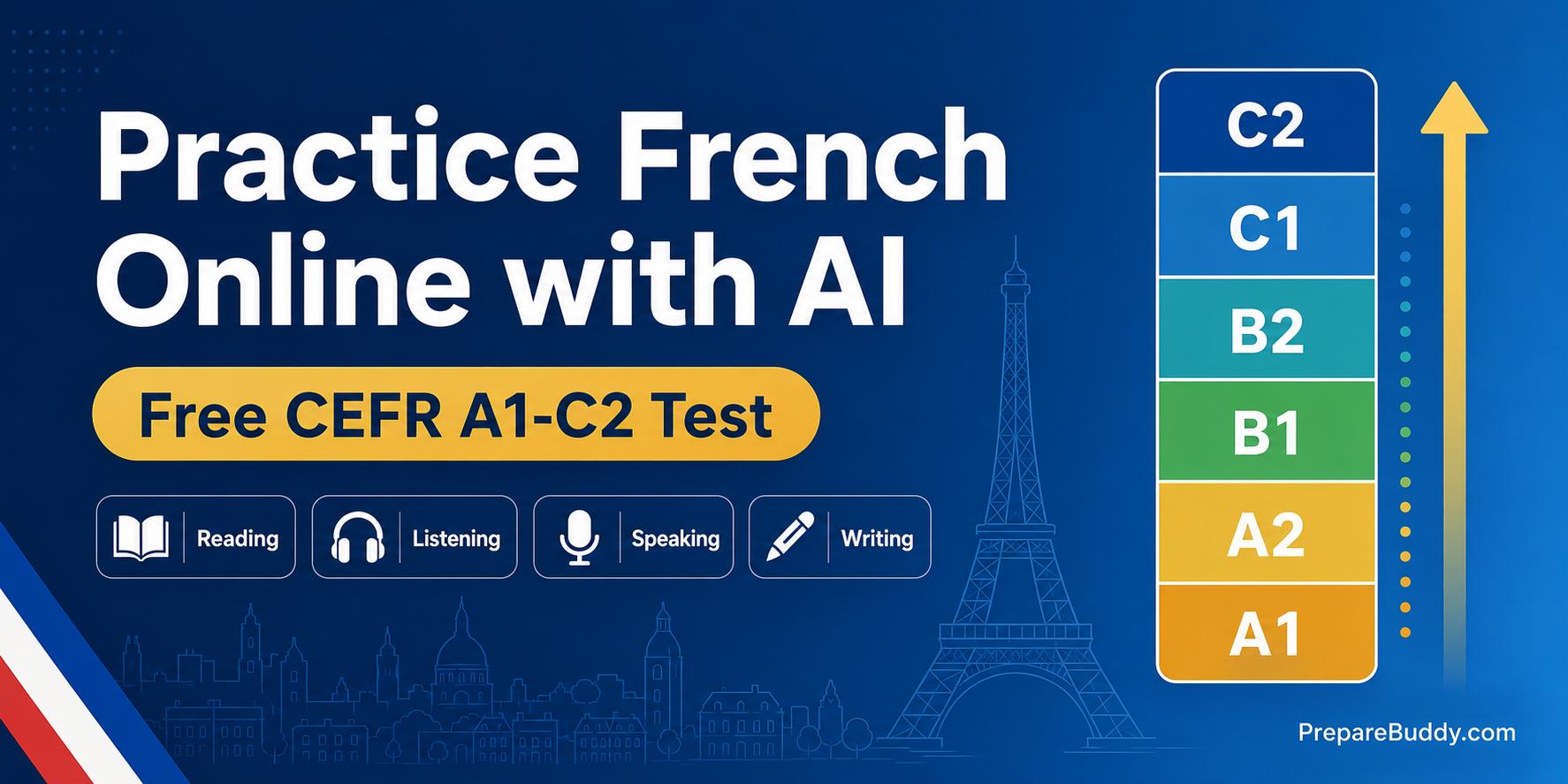
The Common European Framework of Reference organises proficiency into six levels — A1, A2, B1, B2, C1 and C2 — grouped as Basic, Independent and Proficient User, and defined through “can-do” descriptors rather than grammar checklists. That matters: a descriptor like “can interact with a degree of fluency and spontaneity” cannot be verified by a dropdown question.
PrepareBuddy's Adaptive Language Proficiency engine maps an internal 0–100 score onto the six CEFR bands, and reports the band for each skill separately as well as overall:
| CEFR Level | Score Range | What it means in French |
|---|---|---|
| C2 | 85–100 | Mastery — can understand virtually everything you hear or read |
| C1 | 68–84 | Advanced — can express ideas fluently and spontaneously |
| B2 | 51–67 | Upper intermediate — can interact with fluency and spontaneity |
| B1 | 34–50 | Intermediate — can deal with most situations while travelling |
| A2 | 17–33 | Elementary — can communicate in simple, routine tasks |
| A1 | 0–16 | Beginner — can use familiar everyday expressions |
A typical result looks like this: overall 62 → B2, with reading C1, listening B2, speaking B2 and writing B2. That per-skill split is the useful part. Plenty of learners read at C1 and speak at B1 — an averaged single number hides exactly the gap you need to work on.
The test is in French — all of it
This is the detail most platforms skip. On a lot of “French tests”, the passages are French but the surrounding experience is English: English instructions, English button labels, English task names. That is not how any French exam works, and it quietly makes the test easier than the thing it is meant to predict.
On PrepareBuddy, roughly 86 interface strings are maintained per language, so a French test renders in French throughout: task instructions, question-type labels, photo-task prompts, on-screen buttons, recording-status messages and confirmation dialogs. The one thing deliberately left untranslated is your own answer — the point of the test is to make you produce French.
Audio uses a language-specific text-to-speech voice (Elodie for French) with consistent voice assignment per speaker across a test, so a two-speaker listening item sounds like two speakers rather than one flat narrator.
18 question types across four skills
The engine uses 18 purpose-built question types, mapped to skills. Some test two skills at once — Read Aloud counts toward both speaking and reading, for example.
| Skill | Types | Examples |
|---|---|---|
| Reading | 7 | Read and Select, Complete Word, Complete Sentences, Identify Main Idea, Title the Passage, Highlight Answer, Interactive Reading |
| Listening | 2 | Listen and Type (dictation), Interactive Listening (multi-turn) |
| Speaking | 6 | Read Aloud, Listen and Speak, Speak About Photo, Read Then Speak, Interactive Speaking, Speaking Sample |
| Writing | 3 | Write About Photo, Interactive Writing, Writing Sample |
Content is generated around 30 language-neutral topics — daily routines, travel, food traditions, workplace, media, environment, cultural customs and so on — so two attempts are not the same test with the questions shuffled.
Placement mode: the test finds your level, you don't guess it
There are two ways to run the assessment, and the difference is significant.
Targeted mode measures you against a level someone has already chosen — useful when a teacher knows roughly where a class sits. Placement mode chooses nothing. The generator produces content spread across all six CEFR bands, roughly nine items per band for about 54 items in total, tags each item with its band, and derives your level from how you handle the full range.
Two design decisions keep that honest:
- Full-denominator scoring. Every question in the test counts and unanswered questions score zero. You cannot place high by answering half the test brilliantly and skipping the rest — the blanks count against you, and the result page says so and invites you to finish.
- A separate comprehension-by-band diagnostic. Alongside your headline level, the result shows your success rate per CEFR band on the objective questions and the highest difficulty you sustained (60% or better across that band's full item set). Speaking and writing tasks are excluded from this chart because they are graded on production quality rather than correctness — they still count toward your per-skill score.
Difficulty is weighted rather than flat: easy items are multiplied by 0.85, medium by 1.0, hard by 1.15 and very hard by 1.25. Getting a C1 item right is worth more than getting an A2 item right, which is the whole point of a full-range test.
Speaking French, not describing French
Speaking is where most online French practice quietly gives up. Record a 45-second clip, submit it, get a number. That tells you nothing about whether you can survive an actual exchange.
PrepareBuddy's Voice AI runs a live conversation of roughly 10 minutes, entirely in French. The AI greets you in French, lets you pick the topic, adapts its vocabulary and grammar to your level, and handles mistakes by naturally rephrasing them in its next turn rather than interrupting to correct you. For beginners it defaults to formal vous, matching how a French speaker would address a stranger.
At the end you get a CEFR speaking level scored on four criteria — fluency (speech flow, hesitation, self-correction), vocabulary (range and appropriateness for the level), grammar (sentence complexity, accuracy, conjugation) and comprehension (whether you understood the questions and answered in context) — alongside 48-emotion analysis, behavioural observations and a full transcript. A four-minute free demo is available if you want to hear what it sounds like before committing.
Feedback you can act on
Every French speaking and writing response also gets a multi-perspective feedback panel with three angles on the same answer:
- Examiner — rubric-focused critique naming the specific CEFR descriptor gaps.
- Study Coach — one actionable improvement, with a before/after rewrite of your own sentence.
- Fellow Student — what the mistake cost you in score terms, plus a practical study technique.
One rule to know: French responses must be in French. A speaking or writing answer produced in another language is capped at 1 out of 9 across all criteria.
How long it takes
| Format | Duration | Coverage | Best for |
|---|---|---|---|
| Quick diagnostic | ~10 minutes | 3–5 questions per skill | A fast, honest first read on your level |
| Full diagnostic | ~20 minutes | 5–8 questions per skill | A more stable placement before enrolling in a course |
| Full adaptive test | Full length | All 18 question types | Tracking progress and simulating exam conditions |
| Voice AI conversation | ~10 minutes | Speaking only | Building fluency between assessments |
Both diagnostics use the same CEFR scoring engine as the full test, so a 10-minute result and a full-length result are read on the same scale.
A sensible way to use it
- Take a placement diagnostic first. Do not pick a level — let the test find it. Answer everything, including the items that feel above you, because blanks score zero.
- Read the per-skill breakdown, not the headline. If reading is C1 and speaking is B1, your study plan writes itself.
- Attack the weakest skill for two weeks. Weak speaking means daily Voice AI conversations; weak writing means Writing Sample tasks and reading the Study Coach rewrite each time.
- Retest, and compare band charts. Watch the highest sustained difficulty move up — that is a cleaner progress signal than the overall number, which moves slowly.
If you are learning more than one language, the same 18 question types, the same CEFR engine and the same live conversation practice run across all 11 supported languages — French, Spanish, German, Italian, Portuguese, Chinese, Japanese, Korean, Hindi, Russian and Arabic — so a French B2 and a Spanish B1 on your dashboard mean the same thing.
Find out where your French actually sits
You can take a free AI-scored French assessment covering reading, listening, speaking and writing, and get an overall CEFR level plus a level for each skill.
Take the free French CEFR test →
Prefer the short version? Start with the 10-minute diagnostic. Running a language school or university department and want this under your own branding? Talk to us about a demo.
Related reading: Practice Spanish online with AI, check your language level free online in 11 languages, and how CEFR levels map to IELTS, TOEFL, PTE and Duolingo scores.


Join the Discussion