

Here is the uncomfortable truth about most online "placement tests": they do not place you. They ask you — or your teacher, or an enrolment form — to pick a level first, then score you against that guess. Choose B1 and score 78%? You are told you are B1. Choose C1 and score 78%? You are told you are C1. Same performance, different label.
A genuine CEFR placement test works the other way round: nobody picks a level, the test spans every band from A1 to C2, and your level is detected from how you actually perform across the whole difficulty range. This guide explains exactly how that detection works, why unanswered questions have to count against you, and how to read a placement result properly.
Targeted testing vs. genuine CEFR placement
Both modes have a legitimate use. The mistake is treating the first one as if it were the second.
| Targeted mode | Placement mode (level detection) | |
|---|---|---|
| Who picks the CEFR level? | The operator, before the test | Nobody — there is no pre-selection |
| Content difficulty | Written to one band | Spread across all six bands, A1–C2 |
| What the score means | How well you met a level someone assumed | Where you actually sit on the scale |
| Best used for | Cohorts whose level you already know | Enrolment, streaming, first-time learners |
| Failure mode | A wrong guess invalidates the result | None — the range covers every outcome |
If a school is streaming new students into classes, or a learner genuinely does not know whether they are A2 or B1, targeted mode cannot answer the question being asked. That is why placement is the recommended default for enrolment on PrepareBuddy's adaptive language testing engine.
How A1–C2 level detection actually works
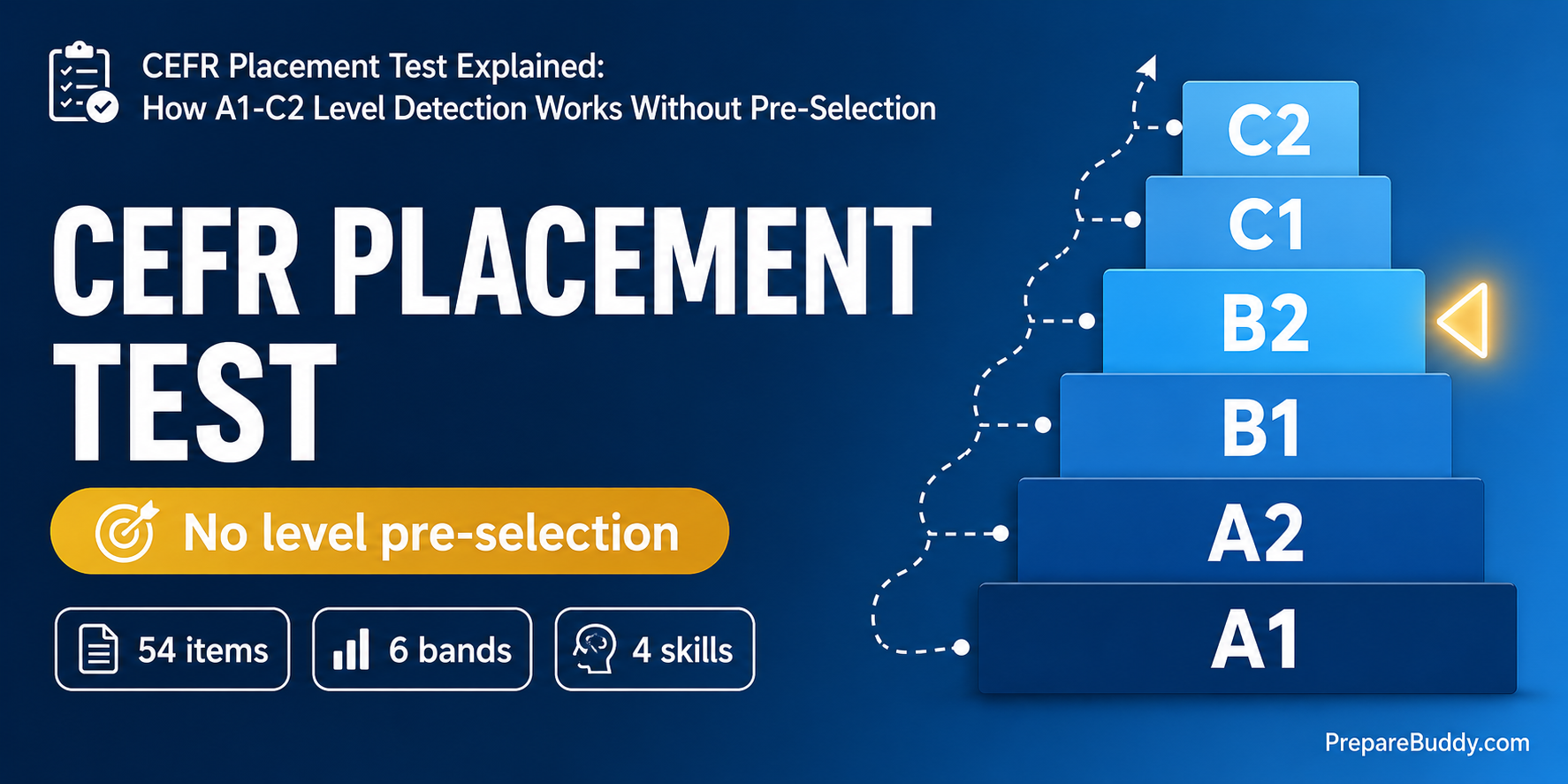
When a test runs in placement mode, the generator builds content deliberately spread across the full CEFR range — roughly nine items per band across all six bands, about 54 items in total. Every item carries a tag recording which band it was written to.
You then sit the test as normal, across all four skills. Your overall CEFR level is your balanced per-skill score — reading, listening, writing and speaking — mapped onto the CEFR scale. Because the item pool covers A1 through C2, that single score reflects how you handle the entire difficulty range rather than how you handle one band somebody chose in advance.
The per-skill breakdown is shown alongside the headline level, so the overall result always sits naturally among your four skill levels. A learner who reads at B2 but speaks at A2 sees exactly that, instead of a flat average with no explanation.
The CEFR score bands
Internal scoring runs 0–100 and maps to CEFR as follows:
| CEFR level | Score range | What it means in practice |
|---|---|---|
| C2 | 85–100 | Mastery — can understand virtually everything |
| C1 | 68–84 | Advanced — expresses ideas fluently and spontaneously |
| B2 | 51–67 | Upper intermediate — interacts with fluency and spontaneity |
| B1 | 34–50 | Intermediate — deals with most situations while travelling |
| A2 | 17–33 | Elementary — communicates in simple, routine tasks |
| A1 | 0–16 | Beginner — uses familiar everyday expressions |
Why unanswered questions score zero
Placement scoring is full-denominator — real-exam style. Every question in the test counts toward your score, and anything you leave blank is scored zero.
This surprises people, so it is worth being explicit about why it has to work this way. If blanks were simply excluded, a learner could answer nine easy items brilliantly, skip the other forty-five, and place at C1. That result would be meaningless — and a school streaming students on it would put a beginner in an advanced class.
So: a learner who completes half the test cannot place high, however good those answers were. The result page says so directly and invites them to finish the test to raise the score. The same rule applies to productive tasks — an empty or placeholder speaking or writing response scores zero, with no floor credit. A real spoken attempt, however, keeps its score even if the score is low, because the audio evaluation is what gets graded, not the answer stub.
The comprehension-by-band diagnostic
Alongside the headline level, a placement result shows a second view: your per-band success rate on the objective questions, and the highest difficulty you sustained — defined as scoring at least 60% across that band's full item set.
Two design rules keep this honest:
- Correctness-graded questions only. Speaking and writing tasks are graded on production quality rather than right-or-wrong, so they are excluded from the band chart. They still count toward your per-skill score.
- A band needs enough items before it can count as your ceiling. One lucky answer on a C1 item cannot promote you to a C1 ceiling.
The band diagnostic is deliberately kept separate from the headline level. It describes receptive ability — what you understood — while the headline level is balanced across all four skills. Keeping them apart means the two numbers can never contradict each other, and a teacher reading the report can see where comprehension broke down, not just that it did.
Placement across 11 languages
The same framework runs across 11 languages — Chinese, Spanish, French, Hindi, Italian, Portuguese, Japanese, Korean, German, Russian and Arabic — using 18 purpose-built question types across the four skills, with native-quality audio and script-aware rendering (including full right-to-left support for Arabic).
One detail matters more than it sounds: the entire test interface is localised, not just the content. On a German placement test the instructions, question-type labels, buttons and confirmation dialogs are all in German. That removes the odd hybrid experience of English instructions wrapped around target-language items — and it removes a confound, because a learner struggling with English instructions is not the same as a learner struggling with German.
How to take a CEFR placement test
- Pick your language, not your level. If a form asks you to declare a CEFR level before you start, you are in targeted mode, not placement mode.
- Choose your format. A quick diagnostic runs 10–20 minutes across all four skills; a full placement runs longer with more items per band.
- Answer everything. Guess rather than skip. Blanks are scored zero, and skipped items are the single most common reason a result comes back lower than expected.
- Actually speak and write. Real attempts are scored on quality, so a weak answer beats an empty one every time. Voice AI handles the speaking evaluation.
- Read both views. Take the headline CEFR level as your placement, and use the band diagnostic to see where your comprehension ceiling sits.
For schools and institutes
If you are placing incoming students, placement mode is the mode you want — it removes the enrolment-form guess entirely and gives you a defensible per-skill breakdown for each learner. Institutes run it under their own branding through the white-label platform, with the same CEFR scoring and reporting across all 11 languages.
Find out where you actually sit. Take a free CEFR placement test across reading, listening, speaking and writing — no level to pick, no credit card required. Running placement for a cohort? Talk to us about a demo.


Join the Discussion