

The most expensive word in a study-abroad consultancy is "probably". A student says their German is "probably B1". The counsellor builds an application timeline around it. Three months later the destination institution runs its own language check, the student lands two bands lower, and the placement collapses — after the counselling hours, the document work and the fee expectation are already sunk.
Language testing for study-abroad consultants is the fix, and it is not test prep. It is a short, evidence-producing check that tells a counsellor — before anything is promised — where a student actually sits on the CEFR scale in the destination's language, across reading, listening, speaking and writing. PrepareBuddy runs that check in 11 languages under the consultancy's own brand, on the same adaptive engine used by universities and language institutes for enrolment placement.
The language blind spot in non-English destinations
English-track counselling has a safety net: IELTS, TOEFL, PTE and Duolingo all produce a number, and everyone in the chain reads that number the same way. The moment a student is heading to a German-, French-, Spanish-, Italian-, Japanese- or Korean-medium programme, that net disappears. Three things break at once:
- Self-reporting replaces measurement. Students describe their level from memory of a course they finished two years ago, or from an app streak.
- Speaking is never checked. Even consultancies that run a written quiz almost never assess spoken production — usually the weakest skill, and the one an interview or oral placement exposes first.
- There is nothing to show. When a programme or authority asks the consultancy for evidence of a CEFR level, an internal opinion is not evidence.
The commercial consequence is not that a student fails a test. It is that the consultancy discovers the problem late, when the only options left are an expensive language course, a deferred intake, or a refund conversation.
What a usable CEFR result looks like
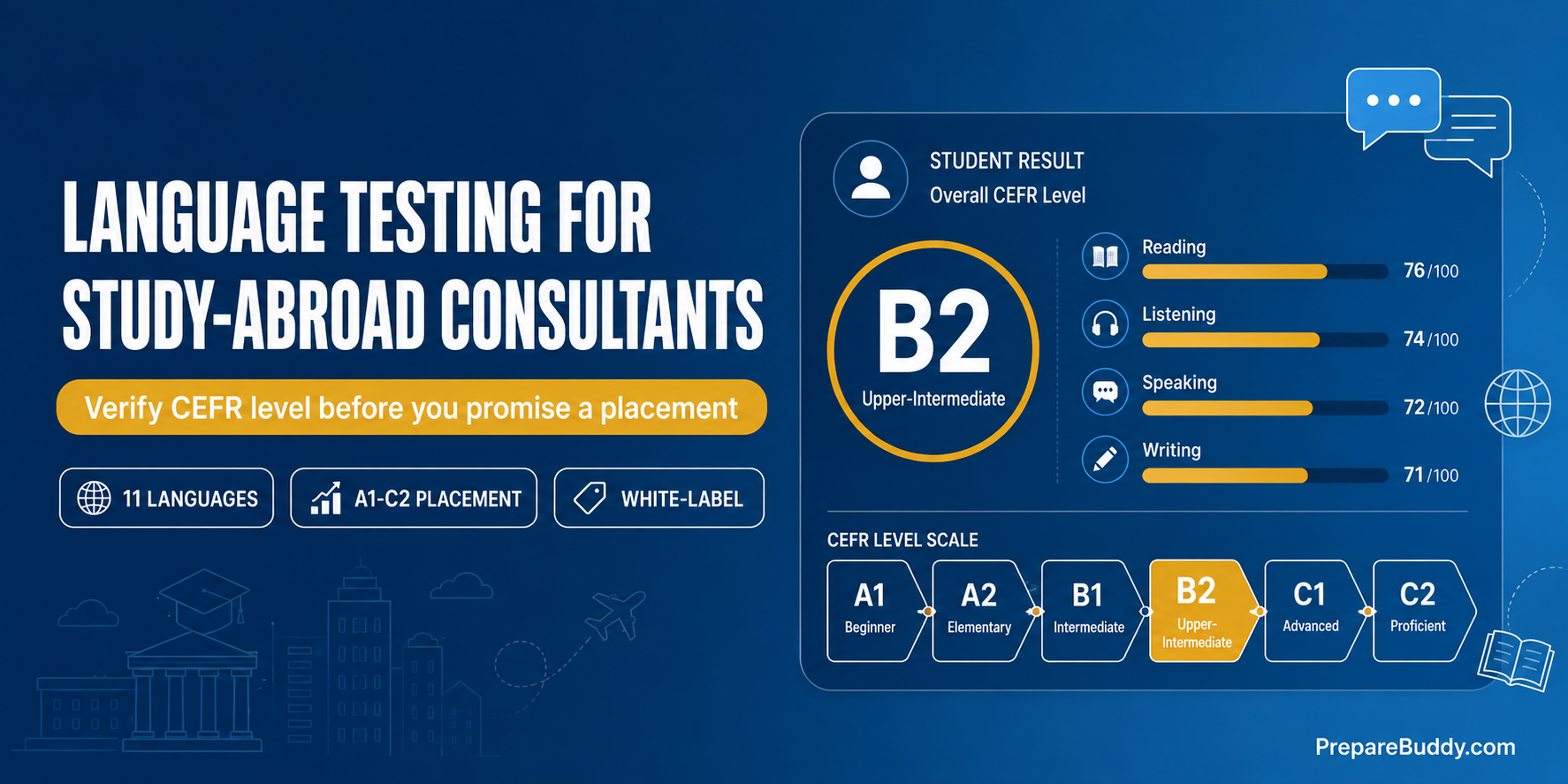
CEFR is the reference everyone in the chain already speaks, from A1 (beginner) to C2 (mastery). PrepareBuddy scores on a 0–100 internal scale and maps it to CEFR, both overall and per skill, so a counsellor sees not just "B1" but which skill is dragging the profile down.
| CEFR level | Score band | What the student can do |
|---|---|---|
| C2 | 85–100 | Mastery — understands virtually everything encountered |
| C1 | 68–84 | Advanced — expresses ideas fluently and spontaneously |
| B2 | 51–67 | Upper intermediate — interacts with fluency and spontaneity |
| B1 | 34–50 | Intermediate — handles most situations while travelling |
| A2 | 17–33 | Elementary — communicates in simple, routine tasks |
| A1 | 0–16 | Beginner — uses familiar everyday expressions |
A typical result returns an overall level plus a per-skill breakdown — for example reading C1, listening B2, writing B2, speaking B2. That split is the actionable part. A student who reads at C1 but speaks at B1 needs a very different intervention, and a very different promise, from one whose profile is flat.
Placement, not a guess measured against a guess
Most "level checks" ask the operator to pick a level first, then measure the student against it — so the result is only as good as the initial guess. PrepareBuddy's adaptive language module runs a genuine placement mode: the counsellor picks nothing. The test is generated across all six CEFR bands (roughly nine items per band), each item tagged with its band, and the level is detected from performance across the full range.
Two design choices make the output defensible rather than flattering:
- Full-denominator scoring. Every question counts and unanswered questions score zero. A student who answers half the test brilliantly still cannot place high — the blanks count. A placement is only meaningful when the whole range has been attempted.
- Comprehension-by-band diagnostic. Alongside the headline level, the result shows the success rate per CEFR band on objectively graded items and the highest difficulty the student sustained — so a counsellor can see the ceiling, not just the average.
How the three approaches compare
| Capability | Self-report / interview | Consumer language app | PrepareBuddy placement |
|---|---|---|---|
| Languages covered | Whatever staff speak | Varies — built for learning, not testing | 11 languages, one framework |
| Result format | Opinion | Internal points, streaks, levels | CEFR A1–C2, overall + per skill |
| Speaking assessed | Rarely | Text chatbot at best | Live AI voice conversation |
| Writing assessed | No | No | AI-evaluated extended production |
| Level detection | Guess | Not designed for it | Detected from A1–C2 content, no pre-selection |
| Time to result | Days of back-and-forth | Not applicable | 10–20 min test, AI-scored |
| Branded as yours | — | No | Full white-label |
| Shareable record | No | No | Result page + PDF |
The four skills, actually tested
The module carries 18 purpose-built question types mapped across the four skills — seven reading, two listening, six speaking and three writing formats — so productive ability is measured, not inferred from multiple choice. The entire test interface is localised into the target language (instructions, question-type labels, buttons), so a German test reads as a German test rather than an English shell wrapped around German passages.
Speaking is the piece most consultancies cannot run in-house. PrepareBuddy's Voice AI holds a live conversation in the target language, adapts its vocabulary to the student's level, and returns CEFR-aligned scoring on fluency, vocabulary, grammar and comprehension — plus a full transcript. Written and spoken responses also return a multi-perspective feedback panel (examiner critique, coach rewrite, study technique), which turns a diagnostic into something a counsellor can hand back to the student.
| Format | Duration | Questions per section | Best used for |
|---|---|---|---|
| Quick diagnostic | ~10 minutes | 3–5 | First-call screening, lead qualification |
| Full diagnostic | ~20 minutes | 5–8 | Pre-application level evidence |
| Full placement test | Longer form | ~54 items across A1–C2 | Defensible placement before a commitment |
Running it as an operation, not a one-off
The workflow a consultancy actually needs is simple to state: every new enquiry for a non-English destination takes the check before the second call. That is five steps.
- Generate the placement test in the destination language, with CEFR selected as the result output format.
- Add the student to your organisation and set their visible-test limit to zero, so their dashboard shows only what you assign — no browsing your wider library.
- Assign the test. The student logs in and sees exactly one thing to do.
- Review before release, if you want to. An optional 24-hour teacher-review hold lets a counsellor add context or annotations before the student sees the score, with a hard auto-publish guarantee at the 24-hour mark so nobody is left waiting.
- Act on the per-skill split — push it into the student's file and destination shortlist via Student Journey, and watch cohort patterns in analytics.
What it changes commercially
The point of language testing for study-abroad consultants is not the test. It is what an early, credible number does to the shape of the business.
| Where it lands | Without a level check | With CEFR placement at intake |
|---|---|---|
| Qualification | Counsellor hours spent on students who cannot meet the language bar | Screened on the first call in ~10 minutes |
| Destination shortlist | Built on an assumed level | Built on a measured level, per skill |
| Late-stage failure | Discovered when the institution checks | Discovered at intake, with runway left |
| Revenue line | Placement fee only | Placement fee plus a language-prep track you already own |
| Brand | Third-party tools visible to the student | Your domain, logo, colours and emails throughout |
The white-label layer matters more here than it does for an institute. A consultancy's product is its judgement, and a branded assessment that returns a professional CEFR report positions the consultancy as the authority rather than a reseller of somebody else's app. Across the platform, institutions see 95% AI scoring accuracy through multi-model verification, 75% time saved on grading, and 300% ROI within 18 months — and standing up a branded environment takes 24–48 hours, not a development cycle.
Getting started
The lowest-risk way in is to run the check on your own pipeline before you standardise it. Take ten current students heading to non-English destinations, put them through a 20-minute placement in the target language, and compare each result against what the student told you. The gap in that comparison is the size of the problem you have been carrying.
PrepareBuddy is used by 200+ institutions and has prepared 50,000+ students, with the first month free, no credit card required and no lock-in contract. To see the consultant-side workflow end to end — branded placement, assignment, per-skill reports and journey handoff — book a walkthrough, or read how the platform is deployed for study-abroad consultancies.


Join the Discussion