

A 200-student PTE coaching center owner once told us he stopped enrolling new speaking-prep batches in November because his lead teacher couldn't review more than 14 speaking submissions per day. Every additional student meant a 3-day delay in feedback, and delayed feedback meant cancelled re-enrollments. The bottleneck wasn't sales — it was a single human throat reviewing audio files at 11 PM.
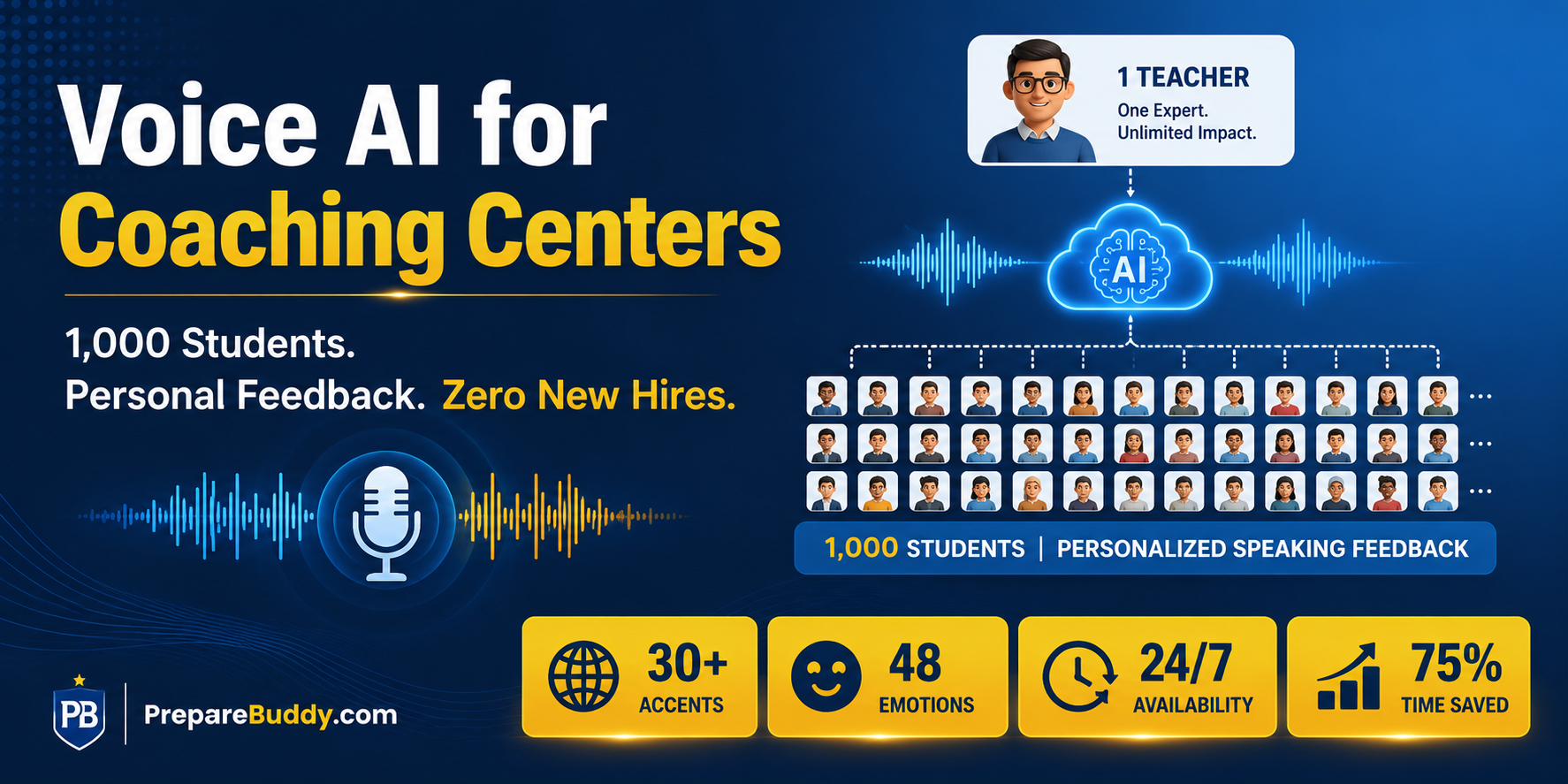
This is the quiet ceiling that almost every test prep coaching center hits between 200 and 500 active students: speaking practice doesn't scale on human teachers. Voice AI for coaching centers changes the math entirely. Instead of one teacher per ten students, one Voice AI session can deliver real-time pronunciation scoring, 48-emotion detection, and exam-style examiner conversation to every single student — at the same time, in 30+ English accents, with feedback that arrives the second the session ends.
Why Speaking Practice Is the #1 Scaling Bottleneck for Coaching Centers
Reading and writing scale. You hand out a passage, students complete it, automated scoring grades it. Listening scales. You play audio, students answer multiple-choice questions, the answer key is binary. Speaking is the only section where every student needs a unique, real-time conversational partner who can ask follow-up questions, react to nervous pauses, and produce exam-style feedback. Until recently, that partner had to be a human.
The result is the speaking practice paradox: it's the section most students lose marks on, the section institutes charge premium rates for, and the section that single-handedly caps how many students one center can teach. Most centers solve it by either (a) capping speaking sessions to 15 minutes per student per week — which means students walk into test day under-prepared — or (b) hiring more teachers, which obliterates the unit economics covered in our test prep center unit economics breakdown.
What Voice AI Actually Does (And Why It's Different from Recorded Practice)
Most platforms market "AI speaking practice" but only offer record-and-submit: the student speaks into a microphone, the audio is uploaded, and an AI returns a score 30 seconds later. That's not Voice AI — that's automated grading on a voice file. Real Voice AI is a two-way conversation: the AI examiner asks Question 1, listens to the student's response, decides what to follow up on, asks Question 2 in a natural voice with realistic pacing, detects whether the student sounds anxious or unsure, adjusts difficulty in real time, and produces a rubric-aligned score at the end of the session.
PrepareBuddy's Voice AI handles 30+ English accents, 48-emotion detection, real-time pronunciation scoring, and examiner-style conversation across IELTS, TOEFL, PTE Academic, PTE Core, OET, CELPIP, Duolingo, and the Adaptive Language Proficiency suite covering 11 languages with CEFR scoring. Each test type has its own examiner personality and structure — IELTS Speaking Part 1/2/3, PTE's Read Aloud and Repeat Sentence, OET role-plays — so the practice mirrors the actual exam, not a generic chatbot.
The Math: Human Teacher vs Voice AI for Speaking Practice at Scale
This is the breakdown most coaching center owners never see laid out side by side. The numbers below are based on a typical center running PTE/IELTS prep with 1,000 active students, where each student needs roughly 2 hours of speaking practice per week to reach a band 7+ or 79+ score:
| Capacity Dimension | Human Teacher Model | Voice AI Model |
|---|---|---|
| Sessions delivered per hour | 1 (one teacher, one student) | Unlimited concurrent |
| Feedback turnaround | 1–3 days (after grading) | Instant (end of session) |
| Accent coverage | 1–2 (whatever the teacher knows) | 30+ English accents |
| Emotional adaptation | Subjective, varies by teacher | 48-emotion detection, consistent |
| Cost per student-hour | ₹400–₹800 (teacher salary basis) | Per-minute usage rate (volume tiers) |
| Available hours | Class hours only | 24/7 |
| Consistency across students | High variance (mood, fatigue) | Identical examiner behavior every time |
| Maximum students supportable | ~10–14 per teacher | 1,000+ on the same system |
The cost-per-student-hour calculation is what flips the model. A teacher costing ₹40,000/month delivering 100 productive speaking-feedback hours costs roughly ₹400/hour, before overhead. Voice AI sessions are billed in minutes through a volume-tiered allocation system, so a center allocating 2,000+ minutes of monthly Voice AI usage drops to enterprise-tier rates. The crossover point — where Voice AI becomes outright cheaper than adding another teacher — typically lands around 80–120 students. Past that point, adding more students adds zero new headcount.
What Coaching Centers Actually Do with Voice AI
1. Daily Speaking Drills That Run Without a Teacher
Centers schedule a fixed daily window — usually 6 PM to 10 PM — where students must complete one Voice AI speaking session. The session runs the same exam-format questions a teacher would ask, but every student gets one. Teachers spend the next morning reviewing the auto-generated transcripts and scores, flagging students who scored below a threshold for live attention, and sending bulk encouragement messages to those above it.
2. Diagnostic Sessions for New Enrollments
Every new student takes a Voice AI diagnostic in the first week. The AI maps their starting band/score across pronunciation, fluency, lexical resource, and grammatical range — the same dimensions human examiners assess. The center's counselor uses that diagnostic to assign the right batch and decide whether the student needs the standard 8-week prep or an accelerated 4-week intensive. This replaces the unstructured "trial class" that most centers use today.
3. Pre-Mock Speaking Confidence Sessions
The week before a scheduled mock test, students do 3–5 Voice AI sessions back-to-back. Because Voice AI sessions feel like the real exam (timed, scored, with an examiner-style voice), students walk into the mock with their nerves already calibrated. Centers report mock-day no-show rates dropping from 18% to under 5% after introducing pre-mock Voice AI cycles.
4. Premium-Tier Add-On Revenue
Most centers package Voice AI as a paid add-on at ₹2,000–₹4,000 above their standard prep fee. Because the underlying cost is per-minute and volume-discounted, the gross margin on this add-on typically sits between 65% and 80%. Centers running the calculation correctly recover their entire monthly Voice AI bill from 8–12 add-on customers and pocket the rest.
How to Roll Out Voice AI in Your Coaching Center: A Practical Sequence
Week 1 — Allocate test minutes. Start with 4 free minutes per student to let everyone try the system. PrepareBuddy's billing model is allocation-based, so you only pay when an admin assigns minutes to a student — unused minutes don't waste budget. Get teachers to run a session themselves first so they understand the experience before pitching it to students.
Week 2 — Run the diagnostic protocol. Every active student takes a 6-minute diagnostic Voice AI session. Pull the score reports into a single sheet and segment students into three tiers: needs-rescue (scored 2+ bands below their target), on-track, and exam-ready.
Week 3 — Replace one human speaking session per week with Voice AI. Don't replace teachers entirely — replace one of the two weekly speaking practice slots. Students still get human feedback once a week, plus unlimited Voice AI practice in between. Adoption usually exceeds 70% by week 2 because students prefer the lack of judgment.
Week 4+ — Switch to Voice AI as primary, teacher as reviewer. Teachers shift from delivering speaking practice to reviewing Voice AI transcripts and intervening on flagged students. One teacher can now "oversee" 80–120 speaking students per week instead of 12–15.
Voice AI Plus AI Tutor: The Real Multiplier
Voice AI alone solves the live-conversation bottleneck. Pair it with PrepareBuddy's AI Tutor and the multiplier compounds. The AI Tutor remembers each student's prior Voice AI session results, identifies recurring pronunciation slips and grammatical weak spots, and assigns targeted practice between sessions. Students arrive at their next Voice AI session having already drilled the specific issues flagged in the previous one — so the AI examiner and AI tutor function as a closed feedback loop without a human teacher in the middle.
The White-Label Angle: Your Center, Not Ours
If you run a coaching center, your students should never see the words "PrepareBuddy." Voice AI runs under your domain, your logo, and your branded emails — the same way the rest of our coaching center platform deploys. Students experience speaking practice as your product. Renewals, retention, and word-of-mouth referrals all accrue to your brand, not ours.
What Voice AI Doesn't Replace
To be fair: Voice AI does not replace the part of a teacher's job that involves motivation, life advice, and the trust that comes from a human knowing your story. Students still need someone to tell them their target IELTS band is realistic, their writing essay was actually decent, and that test day nerves are normal. What Voice AI replaces is the mechanical, time-consuming, repeatable part of speaking practice — the listening, scoring, and rubric-aligned feedback. The human work moves up the value chain to coaching, mentorship, and intervention.
Frequently Asked Questions
Is Voice AI accurate enough to replace teacher scoring?
For exam-style speaking sections (IELTS, PTE, TOEFL, OET, CELPIP, Duolingo), yes — Voice AI applies the same rubric dimensions a human examiner uses (pronunciation, fluency, lexical resource, grammatical range, coherence). It's not designed to replace the conversational coaching part of teaching, just the structured scoring part.
Will students complain that they want a human teacher?
A small subset will. The majority report preferring AI for speaking practice because there's no judgment, they can repeat sessions until they feel confident, and feedback is instant. Centers that introduce Voice AI as "unlimited extra practice" rather than "replacement for teachers" see the highest adoption.
How is Voice AI billed?
Per-minute, with volume tiers. Higher monthly usage drops the per-minute rate. Every student gets 4 free minutes by default to try the system before any paid usage begins.
Can we white-label Voice AI under our coaching center brand?
Yes. The entire platform — including Voice AI — runs under your custom domain, logo, and branded emails. Students never see PrepareBuddy branding.
Which tests does Voice AI support?
IELTS, TOEFL iBT, PTE Academic, PTE Core, OET, CELPIP, Duolingo, plus 11 languages of Adaptive Language Proficiency with CEFR scoring. Each test has its own examiner personality and exam-format question structure.
Stop Hiring Speaking Teachers. Start Scaling.
The next 200 students you enroll don't need 20 more speaking teachers. They need a Voice AI examiner that runs 24/7, scores against the same rubric every time, and lets your existing teachers focus on the human work that actually moves bands — coaching, motivation, and intervention. Schedule a demo to see Voice AI in action under your branding, or try a free Voice AI session yourself before pitching it to your students.


Join the Discussion