

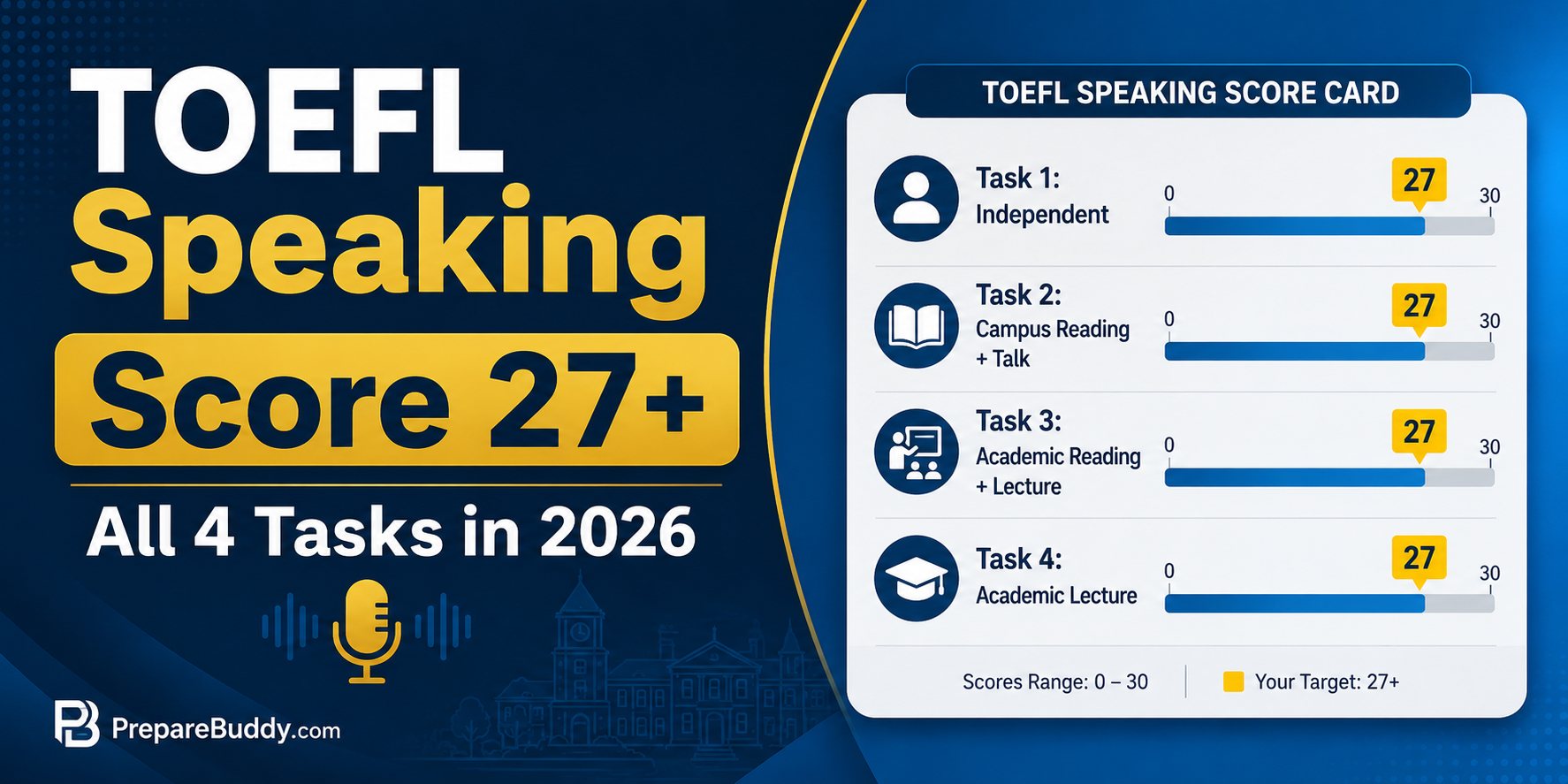
The TOEFL Speaking section is exactly 16 minutes long, contains four tasks, and ends before most students fully realize what just happened. Score 27 or higher and you unlock graduate admissions, scholarships, and professional licensing programs that demand a Speaking section near the top of the 0–30 band. Score 22, and you join the largest cluster of TOEFL takers worldwide — competent, but invisible.
This guide breaks down the four tasks, the official ETS rubric, the timing templates that consistently produce 27+, and the AI-powered practice methods that close the gap faster than human tutoring alone.
Why a 27+ TOEFL Speaking score matters
The Speaking section is scored 0–30 in 1-point increments. It is the section where Indian, Chinese, Korean, Japanese, and Latin American test-takers most frequently underperform — not because their English is weak, but because the four-task format rewards a very specific delivery style. Below 26, top US graduate schools start to ask for waivers or retakes. At 27+, your Speaking score stops being the bottleneck.
The 4 TOEFL Speaking tasks at a glance
The 2026 TOEFL iBT Speaking section keeps the same structure that has been stable since 2019: one Independent task and three Integrated tasks. Total Speaking time is 16 minutes including instructions.
| Task | Type | Prep Time | Response Time | What You Do |
|---|---|---|---|---|
| Task 1 | Independent | 15 sec | 45 sec | Express a personal opinion or preference on a familiar topic |
| Task 2 | Integrated (Read + Listen + Speak) | 30 sec | 60 sec | Read a campus announcement, hear a student react, summarize the student's opinion and reasons |
| Task 3 | Integrated (Read + Listen + Speak) | 30 sec | 60 sec | Read an academic concept, hear a lecture with examples, explain how the lecture illustrates the concept |
| Task 4 | Integrated (Listen + Speak) | 20 sec | 60 sec | Hear a lecture on an academic topic, summarize the main idea and supporting examples |
How TOEFL Speaking is actually scored
Each of the four responses is scored 0–4 by trained ETS raters and an AI scoring system (SpeechRater). The four scores are averaged and converted to the 0–30 scale. To hit 27+, you need an average rubric score of approximately 3.5, which means you cannot afford a single weak task.
| Rubric Score | Avg Across 4 Tasks | Approx. Scaled Score | What it Signals |
|---|---|---|---|
| 4.0 | 4.00 | 30 | Native-like fluency, full task fulfillment |
| 3.5 | 3.50 | 27–28 | Highly intelligible, minor lapses |
| 3.0 | 3.00 | 23–24 | Generally clear, some hesitation, minor gaps |
| 2.5 | 2.50 | 20 | Listener effort required, choppy delivery |
| 2.0 | 2.00 | 17–18 | Limited content, frequent pauses |
ETS raters score on three dimensions: Delivery (pace, pronunciation, intonation), Language Use (grammar, vocabulary range, accuracy), and Topic Development (coherence, completeness, idea progression). Most students who plateau at 22–24 are losing points on Delivery and Topic Development — not on grammar.
Task 1 (Independent): the 45-second template
Task 1 is the only task where you can prepare reusable language. Use a strict 4-part structure: state your opinion (5 sec), give reason 1 (15 sec), give reason 2 (15 sec), close with a one-line takeaway (10 sec). High scorers use specific examples — a real classmate, a real city, a real moment — not abstract claims.
Example opener: "I strongly prefer studying in groups, mainly because of accountability and exposure to different problem-solving approaches." Then immediately deliver one specific anecdote per reason. The 27+ response always sounds personal and specific.
Tasks 2 and 3 (Integrated Reading + Listening + Speaking)
The single biggest mistake students make on Tasks 2 and 3 is paraphrasing the reading too much and the listening too little. ETS raters expect 65–75% of your 60-second response to come from the listening passage. Your reading summary should be 10–12 seconds maximum.
Task 2 timing template: Reading summary (10 sec) → Speaker's opinion (5 sec) → Speaker's reason 1 with detail (22 sec) → Speaker's reason 2 with detail (22 sec). Practice this until it is automatic.
Task 3 timing template: Concept definition from reading (12 sec) → Lecture example 1 with detail (24 sec) → Lecture example 2 with detail (24 sec). The phrase "to illustrate this concept, the professor describes…" is your friend.
Task 4 (Listen + Speak): the highest-leverage task
Task 4 is pure academic listening. There is no reading. You hear a 60–90 second lecture, then have 20 seconds to organize and 60 seconds to deliver. The lecture always has the same structure: main idea + 2 examples. Your response must mirror that structure exactly.
Note-taking is non-negotiable. Use a two-column system: left column for the main concept, right column for examples and signal words like "for instance," "however," "in contrast." The 27+ response uses 2–3 transition phrases ("the professor first explains…", "the second example involves…") to create audible structure.
The 30-day TOEFL Speaking 27+ practice plan
The most underrated truth about TOEFL Speaking: you cannot improve by reading strategy guides. You improve by recording yourself, listening back, and getting feedback on the exact pronunciation and pacing issues a human rater would flag. Most students cannot self-diagnose because their inner ear lies.
| Week | Focus | Daily Time | Target Output |
|---|---|---|---|
| Week 1 | Master Task 1 template + record 3 responses/day | 45 min | Hit 3.0 consistently on Task 1 |
| Week 2 | Tasks 2 and 3 timing drills + paraphrase practice | 60 min | 65%+ time spent on listening content |
| Week 3 | Task 4 note-taking + lecture summary drills | 60 min | 2–3 transition phrases per response |
| Week 4 | Full 16-min Speaking sections under exam timing, 5 per week | 90 min | Average 3.5+ across all 4 tasks |
Where AI-powered practice changes the math
PrepareBuddy's Voice AI runs a real-time conversational examiner trained on the TOEFL Speaking format with a 15-minute target session duration that mirrors the real test. The AI gives you a TOEFL examiner persona, runs all four task types, and scores you on Delivery, Language Use, and Topic Development with 95% AI scoring accuracy. Voice AI detects 48 emotions and supports 30+ English accents, so it does not penalize an Indian, Filipino, or Nigerian accent the way underbuilt platforms sometimes do.
The AI Assessment engine compares your spoken response to ETS rubric anchors and gives you specific feedback — "your reason 2 was 8 seconds short," "your transition between examples was abrupt," "your sustained pitch dropped on the conclusion." That granular feedback is what private tutors charge $80–$150 an hour for, and what self-study cannot replicate.
Common reasons strong English speakers still score below 27
Three patterns dominate Speaking scores in the 22–25 range. First: filler words. "Um," "like," "you know" used more than 4–5 times in a 60-second response drops you a full rubric point. Second: sing-song intonation that does not match the meaning of your words. Third: running out of time mid-sentence on Task 1, which signals poor planning to the rater. AI feedback catches all three faster than a human listener can.
Frequently asked questions
Is TOEFL Speaking 27 the same as IELTS Speaking 7.5? Roughly. ETS publishes a TOEFL-IELTS comparison where TOEFL Speaking 26–28 maps to IELTS Speaking 7.5. See our TOEFL feature page for full score equivalence tables.
How long should I prepare? If you already speak fluent English with a clear accent, 4 weeks of structured practice is enough. If you have a heavy regional accent or limited speaking practice, 8–10 weeks is more realistic.
Does ETS use AI to score TOEFL Speaking? Yes. SpeechRater scores your responses alongside human raters, then the scores are combined. Practicing with AI evaluators that use similar criteria gives you a structural advantage.
Try a free TOEFL Speaking practice session
You can simulate a full 4-task TOEFL Speaking section — with real-time AI scoring, 30+ accent support, and rubric-aligned feedback — at PrepareBuddy's free test page. No credit card. First month is free, no lock-in. The fastest way to find out exactly what is keeping your score below 27 is to record one session today and read the AI's response side-by-side with the ETS rubric.


Join the Discussion