

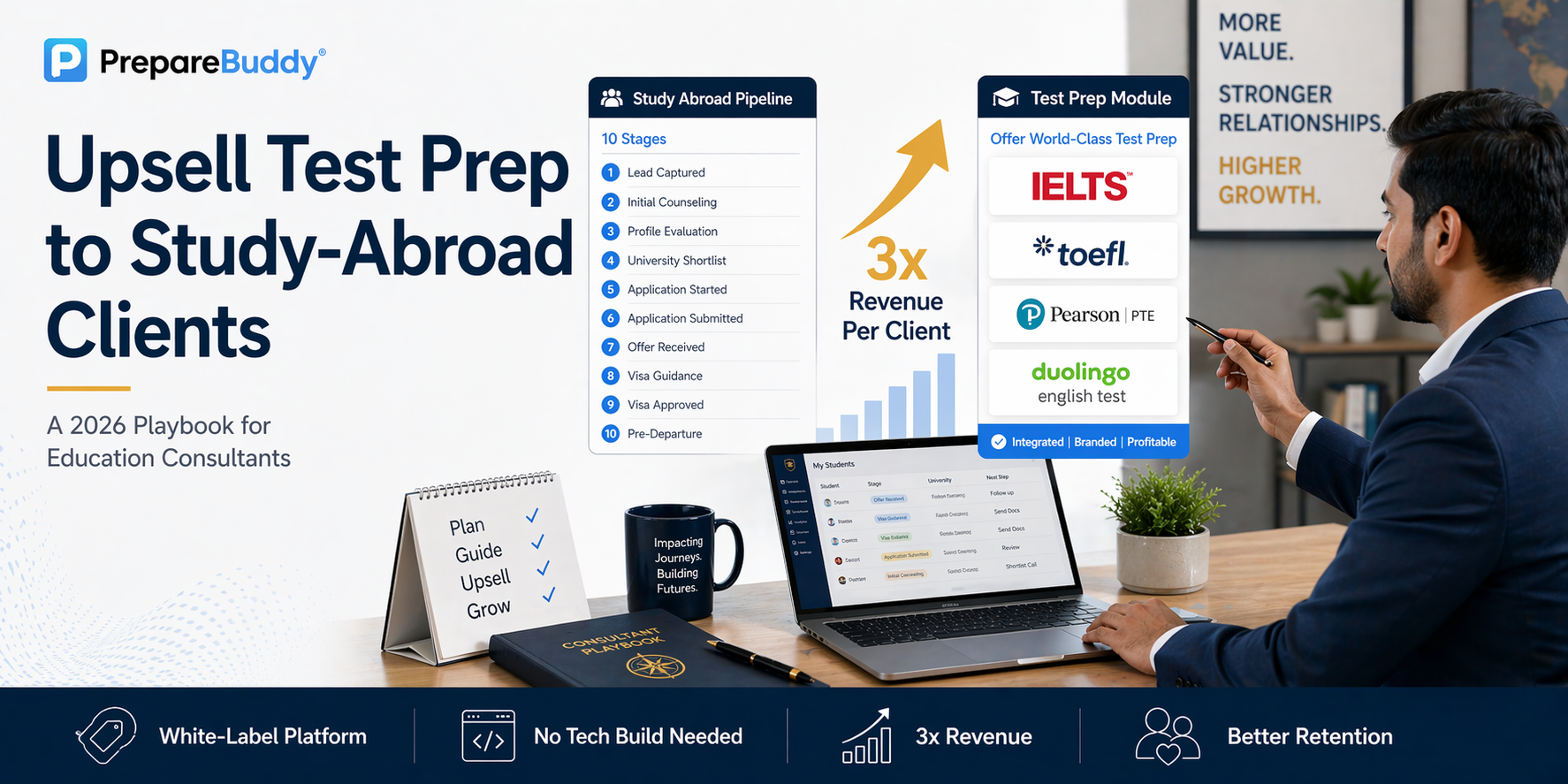
Every study-abroad consultancy has one asset it consistently under-monetises: its existing client book. By the time a student has paid your consultancy for university shortlisting, SOP review, or visa assistance, they have already signalled high intent, high budget, and high trust. The one thing they almost certainly still need — and are almost certainly buying somewhere else — is English test preparation.
This is the upsell that costs nothing to acquire and rewards you with margins that typically outperform your core service line. This playbook shows you how to structure the offer, when to pitch it, and how to deliver it without adding headcount or building technology.
Why the Test-Prep Upsell Is a 2026 Priority
Three things changed in the last 18 months that made this a better opportunity than ever:
First, the average study-abroad applicant now takes multiple standardized English tests during the application cycle as universities and immigration authorities accept a wider mix of IELTS, PTE, TOEFL, Duolingo English Test, CELPIP, and OET. Every additional test attempt is an additional prep need — and every prep need is revenue your consultancy is already adjacent to.
Second, students increasingly buy their prep from the same trusted consultant who is already handling their application — provided the consultant offers it. When they don't, students default to Google searches and end up on generic platforms that have zero visibility for your consultancy.
Third, AI-powered white-label platforms have collapsed the cost of offering branded test prep. What used to require a tech team and a six-figure build is now a logo upload and a link in your client dashboard.
The Revenue Math: What This Upsell Is Actually Worth
Consider a mid-sized consultancy managing 400 study-abroad applicants per year. Here is what the upsell looks like at realistic penetration and pricing.
| Metric | Conservative | Realistic | Aggressive |
|---|---|---|---|
| Study-abroad clients per year | 400 | 400 | 400 |
| Test-prep attach rate | 25% | 45% | 65% |
| Clients buying prep | 100 | 180 | 260 |
| Average prep package price | $180 | $220 | $260 |
| Annual upsell revenue | $18,000 | $39,600 | $67,600 |
| Platform cost (white-label) | $3,000 | $3,600 | $4,500 |
| Net margin | ~83% | ~91% | ~93% |
The attach rate is the variable that matters most. Consultancies that simply add a prep page to their website and hope for organic discovery rarely exceed 15% attach. Consultancies that build a deliberate offer sequence — bundled or standalone, timed to specific client milestones — routinely hit 40-60%.
The 5-Step Upsell Playbook
Step 1: Map the Test-Prep Need to Your Client Journey
Every consultancy already has a client journey, even if it isn't documented. Write it down from enquiry to post-arrival. Somewhere in that journey — usually right after university shortlisting and before application submission — is a 6 to 10 week window where students need to schedule and pass their English test. That window is your prime upsell moment.
For reference, the full 10-stage journey most consultancies should map is documented in our student journey management framework — from career discovery through post-arrival onboarding, with test prep sitting as a distinct revenue milestone.
Step 2: Build a Three-Tier Offer, Not a Single Package
The biggest pricing mistake consultancies make is offering only one prep package. A single price point turns every conversation into a yes/no decision. Three tiers turn it into a which-one decision — and that shift alone lifts conversion meaningfully.
| Tier | What's Included | Suggested Price | Target Student |
|---|---|---|---|
| Self-Serve | Platform access, unlimited AI practice, AI scoring, progress dashboard | $99-149 | Confident students, repeat test takers, budget-conscious |
| Guided | Self-serve + weekly mentor check-in, diagnostic review, study plan | $249-349 | First-time testers, students targeting a specific band |
| Premium | Guided + 1-on-1 coaching hours, mock test reviews, speaking feedback sessions | $499-699 | Students targeting top-band scores, high-stakes retakes |
Step 3: Anchor the Pitch to Outcomes, Not Features
The consultants who win this upsell don't pitch "12 tests covered, unlimited mocks, AI scoring." They pitch outcomes: "You need IELTS 7.0 for your target university. Your diagnostic today shows 6.0 speaking. Our Guided tier gets students from 6.0 to 7.0 in 6 weeks with a structured plan and weekly check-ins. For a $349 one-time investment, you avoid a $250 retake fee and a 4-week delay."
Every element of that pitch is concrete: a target score, a current gap, a timeline, and a comparison against the cost of doing nothing. Consultants who pitch this way convert significantly better than those who lead with generic platform features.
Step 4: Bundle at the Point of Signed Agreement
The single best moment to upsell test prep is the exact moment the client signs the main consultancy agreement. They have just committed, trust is at peak, and the mental-accounting friction of adding $300 to a $3,000 purchase is far lower than selling $300 cold three weeks later.
The mechanics are simple: add a pre-selected test-prep tier to your consultancy agreement with a single-click opt-out. Clients who want to skip can uncheck; the rest move forward bundled. Consultancies that use this method routinely see attach rates above 55% — versus 20-25% for consultancies that wait to pitch prep after signing.
Step 5: Retarget Non-Buyers with a Free Diagnostic
Not every client will buy upfront. For the 40-60% who pass, send a free diagnostic offer 2-3 weeks after signing. A 90-minute AI-scored diagnostic that returns an actual band prediction does two things: (1) it demonstrates the quality of the platform, and (2) it surfaces specific weaknesses that make the paid plan feel necessary rather than optional.
A large share of students who take a free diagnostic will convert to a paid tier within 10 days — recovering a meaningful portion of your original non-buyers without extra sales effort.
What You Need to Deliver This — Without Building Tech
The reason most consultancies have never offered test prep is that they (correctly) assumed it would require content creation, question banks, AI scoring infrastructure, and tutors. A modern white-label platform replaces all of that.
Specifically, look for a platform that delivers:
- Multi-test coverage on one login — IELTS, PTE Academic, PTE Core, TOEFL, Duolingo English Test, CELPIP, OET, plus graduate tests like GRE and GMAT. Students should not need multiple subscriptions. PrepareBuddy covers 11+ tests on a single account.
- AI-generated practice content — unlimited authentic practice matching current official formats. PrepareBuddy's 120B-parameter content engine produces material that is 96% indistinguishable from real exam questions in blind testing.
- AI scoring with high human-grader alignment — students need immediate, credible scores. Manual grading at scale is not feasible for a consultancy.
- Voice AI speaking evaluation — 48-emotion detection, 30+ English accent coverage, and real-time pronunciation scoring, so students can practise speaking without a live tutor.
- Your brand, your domain — a true white-label means students see your logo, your colours, your URL. No third-party branding leaking into your client experience.
- Analytics dashboard — you see which students are practising, which are struggling, and where to intervene. This data also feeds the retargeting flow in Step 5.
Detailed feature mapping and pricing for consultancies is available on our white-label for consultants page.
Common Objections and How to Handle Them
| Objection | How to Handle It |
|---|---|
| "My students already use free YouTube videos" | Free videos don't give scored mock tests, adaptive practice, or speaking feedback. Show a side-by-side of your diagnostic output vs a YouTube playlist. |
| "I don't have time to support another product" | White-label platforms include student onboarding, live chat support, and analytics. Your time investment is roughly 15 minutes per week reviewing the dashboard. |
| "What if my students don't score well?" | Offer a score-improvement guarantee tied to your Guided/Premium tiers: if the student doesn't hit the target band in X attempts, credit a portion toward a retake package. This actually increases conversion by shifting perceived risk. |
| "Isn't this cannibalising my existing prep partners?" | Most consultancies refer students to external prep providers for free and capture zero revenue. This converts that referral into a margin line without meaningfully changing student outcomes. |
The 30-Day Launch Plan
If you want this live and generating revenue within 30 days, here is the sequence:
- Week 1: Pick a white-label platform. Provision your branded instance. Load your logo and colours.
- Week 2: Design the three-tier offer and pricing. Update your consultancy agreement to include the pre-selected prep tier. Draft the diagnostic retargeting email.
- Week 3: Train your counsellors on the outcome-based pitch (Step 3). Role-play the three most common objections until every counsellor can handle them in 60 seconds.
- Week 4: Launch to your next 20 signing clients. Measure attach rate. Adjust pricing or tier composition based on which tier sells most.
By day 45 you will have enough conversion data to double down on what is working — typically the Guided tier at the mid-price point — and you will have added a new revenue line that compounds with every new client you sign.
Frequently Asked Questions
How long does it take to launch a white-label test-prep offer?
With a modern platform, the technical setup takes 48 hours. The full launch — including offer design, counsellor training, and client-agreement updates — typically runs 3-4 weeks. The gating factor is usually your internal decision-making speed, not the platform.
What attach rate should I target?
Consultancies that bundle at signing typically hit 40-60% attach. Consultancies that wait to pitch after the main agreement is signed typically land at 15-25%. The biggest single lever is the timing of the pitch, not the pitch itself.
Do I need to hire test-prep tutors?
No. The Self-Serve and Guided tiers run entirely on AI scoring and automated study plans. Only the Premium tier requires any human coaching time, and most consultancies outsource those hours to an existing network rather than hiring.
How do I handle refunds if a student doesn't improve?
Structure your pricing so any refund is tied to specific, measurable milestones (e.g., "If you do not improve by 0.5 bands after 30 days of active practice, we credit 50% toward an extension"). This both protects margins and signals confidence.
Can this work for consultancies under 100 clients per year?
Yes — smaller consultancies often see higher attach rates because the counsellor-client relationship is more personal. The absolute revenue is smaller, but margin percentages are usually higher.
Next Steps
The fastest way to see whether this model fits your consultancy is to run a 30-minute walkthrough against your actual client numbers. We can show you your projected attach rate, realistic pricing tiers based on your region, and a branded demo of the platform your students would see.
Book a consultancy demo at /contact and mention your annual client volume — we will send back a customised revenue model before the call. Most consultancies we speak with launch within 30 days and see their first prep revenue inside 45.


Join the Discussion